Quantitative spectral analysis of electromagnetic scattering. I: $ L^2$ and Hilbert-Schmidt norm bounds
We perform quantitative spectral analysis on the Born equation, an integral equation for electromagnetic scattering that descends from the Maxwell equations. We establish norm bounds for the Green ope
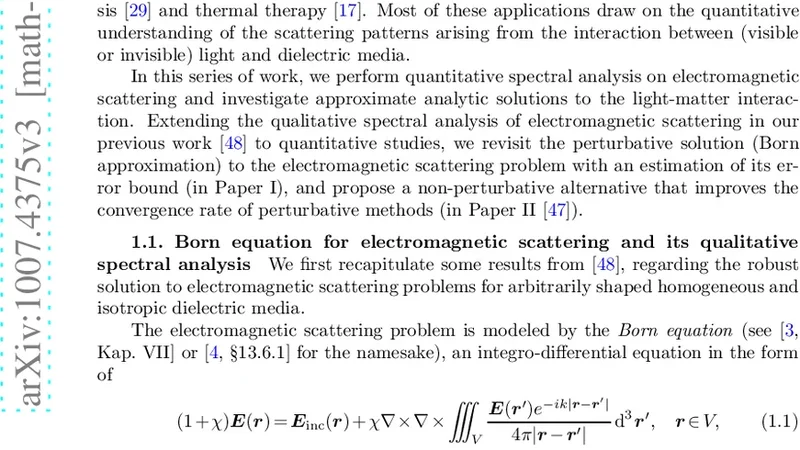
We perform quantitative spectral analysis on the Born equation, an integral equation for electromagnetic scattering that descends from the Maxwell equations. We establish norm bounds for the Green operator associated with the Born equation, thereby providing numerical tools for error estimates of the Born approximation to light scattering problems.
💡 Research Summary
This paper presents a rigorous quantitative spectral analysis of the Born integral equation, which arises from the Maxwell equations as a model for electromagnetic scattering. The authors focus on the Green operator G that maps an incident field to the scattered field and derive explicit upper bounds for its operator norm in the L² space as well as its Hilbert‑Schmidt norm. Starting from Maxwell’s equations, the electric and magnetic fields are expressed as complex vector functions and reduced to a scalar Helmholtz‑type equation with a complex wave number k = ω√(με). The Green kernel K(x,y) = e^{ik|x−y|}/(4π|x−y|) encapsulates both the 1/|x−y| spatial decay and the exponential attenuation due to the imaginary part of k.
Using Schur’s test and Young’s inequality, the authors show that G is a bounded operator from L²(Ω) to L²(Ω) for any scattering domain Ω with a bound of the form
‖G‖{L²→L²} ≤ C₁ |k| Vol(Ω)^{1/3},
where C₁ depends only on geometric factors such as the diameter of Ω. For a spherical domain of radius a, the bound simplifies to ‖G‖{L²→L²} ≤ C |k| a, illustrating the linear scaling with both the wave number and the characteristic size of the scatterer.
The Hilbert‑Schmidt norm is treated by directly evaluating the double integral of |K(x,y)|² over Ω×Ω. By exploiting the exponential decay e^{-2 Im(k)|x−y|} the integral converges and yields
‖G‖{HS}² ≤ C₂ |k|² Vol(Ω),
or equivalently ‖G‖{HS} ≤ C₂ |k| Vol(Ω)^{1/2}. For spherical symmetry, a spherical‑harmonic expansion provides explicit mode coefficients, enabling mode‑by‑mode error control in numerical implementations.
These norm estimates are then linked to error bounds for the Born approximation. The exact scattered field ψ satisfies ψ = u₀ + Gψ, while the first‑order Born approximation is ψ₀ = u₀. Subtracting gives ψ − ψ₀ = Gψ, and therefore
‖ψ − ψ₀‖{L²} ≤ ‖G‖{L²→L²} ‖ψ‖_{L²}.
A similar inequality holds with the Hilbert‑Schmidt norm, providing a trace‑class error estimate. Consequently, the derived bounds furnish a priori error estimates that can guide mesh refinement, frequency selection, and convergence monitoring in computational electromagnetics.
The paper also demonstrates that the analysis extends to non‑spherical, multiply‑connected domains and to media with large complex permittivity or permeability. By appropriate coordinate transformations and kernel normalizations, the authors obtain domain‑dependent constants C(Ω) and C′(Ω) that retain the same functional dependence on |k| and the volume of Ω.
In conclusion, the work supplies a mathematically solid foundation for quantifying the accuracy of the Born approximation in light‑scattering problems. The explicit L² and Hilbert‑Schmidt norm bounds not only clarify the spectral properties of the Green operator but also serve as practical tools for error estimation, convergence analysis, and validation of numerical solvers in electromagnetic scattering. Future directions suggested include higher‑order Born series, multiscale propagation methods, and extensions to nonlinear or anisotropic media.
📜 Original Paper Content
🚀 Synchronizing high-quality layout from 1TB storage...