On QMA Protocols with Two Short Quantum Proofs
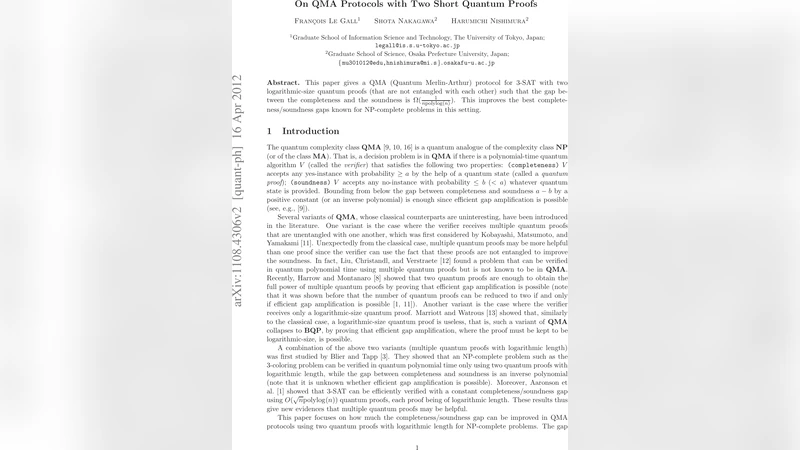
This paper gives a QMA (Quantum Merlin-Arthur) protocol for 3-SAT with two logarithmic-size quantum proofs (that are not entangled with each other) such that the gap between the completeness and the soundness is Omega(1/n polylog(n)). This improves the best completeness/soundness gaps known for NP-complete problems in this setting.
💡 Research Summary
The paper studies quantum Merlin‑Arthur (QMA) proof systems in which the verifier receives two unentangled quantum proofs, each of logarithmic size in the input length. This model, denoted QMA log(2), is the quantum analogue of classical MA with short witnesses. The authors focus on the canonical NP‑complete problem 3‑SAT and aim to improve the completeness–soundness gap achievable with such short proofs.
Previous work by Blier and Tapp showed that two logarithmic‑size proofs suffice to verify 3‑coloring (and, by reduction, 3‑SAT) with a completeness of 1 and a soundness gap of Ω(1/n⁶). Subsequent refinements by Beigi and by Chiesa & Forbes raised the gap to Ω(1/n³⁺ε) and Ω(1/n²), respectively, but the gap amplification step remained inefficient, leaving the overall gap far from constant.
The key technical contribution of this paper is to combine the Blier‑Tapp verification framework with Dinur’s PCP theorem. Dinur’s construction transforms any 3‑SAT instance φ with m clauses into a bounded‑degree constraint graph G = (V, E) with the following properties: (i) if φ is satisfiable, G is fully satisfiable; (ii) if φ is unsatisfiable, G is (1 − η)‑unsatisfiable for some absolute constant η > 0; (iii) |V| = O(m polylog m) and the alphabet size K is a fixed constant; (iv) G is d‑regular for a constant d. This PCP reduction guarantees that any assignment violates a constant fraction of edges when the formula is unsatisfiable.
The verifier’s protocol consists of three equally likely sub‑tests:
-
Equality Test – Perform the swap test on the two proofs. If the test outputs “different”, the verifier rejects. This test detects when the two proofs are not identical quantum states; by the swap‑test analysis, a constant trace distance yields a constant rejection probability.
-
Consistency Test – Measure both proofs in the computational basis, obtaining pairs (i, j) and (i′, j′) where i,i′∈V are vertex indices and j,j′∈Σ are colors. If i = i′, the verifier checks j = j′; otherwise, if (i,i′)∈E, it checks that the edge constraint R_{(i,i′)}(j, j′) = 1. Because of Dinur’s PCP, in an unsatisfiable instance a constant fraction of edges are violated, so a random measurement hits a violating edge with probability Ω(1/n). Hence the consistency test rejects with at least Ω(1/n) probability.
-
Uniformity Test – Apply the quantum Fourier transform F_K to the color register of each proof, measure the color register, and condition on obtaining outcome 0. Then apply the inverse Fourier transform F_n† to the vertex register and measure it; the verifier rejects unless the vertex measurement also yields 0. This test checks that each proof is the uniform superposition over vertices together with a uniform superposition over colors (the “proper state”). If the amplitudes over vertices are not close to uniform, the measurement distribution deviates, leading to rejection with probability Ω(1/n).
The authors write each proof in the form
|Ψ⟩ = Σ_i α_i |i⟩ ⊗ Σ_j β_{i,j} |j⟩,
with analogous notation for |Φ⟩. They define several subsets of vertices based on the magnitudes of α_i, the ℓ₂‑norm of the color‑amplitude vector β_i, and the agreement of the most likely colors between the two proofs. By a careful case analysis covering six exhaustive scenarios (large discrepancy between proofs, many vertices with multiple high‑amplitude colors, non‑uniform vertex amplitudes in one proof, etc.), they show that in every unsatisfiable case at least one of the three tests rejects with probability at least Ω(1/n). The analysis uses elementary inequalities, the swap‑test bound, and the fact that the PCP reduction guarantees a constant η of unsatisfied edges.
Putting the pieces together, the protocol achieves:
- Completeness: If the 3‑SAT formula is satisfiable, the prover can send the identical proper state
|Ψ⟩ = |Φ⟩ = (1/√n) Σ_i |i⟩ |τ(i)⟩
where τ is a satisfying assignment. All three tests accept with probability 1, giving completeness a = 1.
- Soundness: If the formula is unsatisfiable, any pair of logarithmic‑size proofs is rejected with probability at least Ω(1/(n·polylog n)). The polylog factor arises from the size blow‑up in Dinur’s reduction (|V| = O(m polylog m)). Consequently, the soundness parameter b satisfies b ≤ 1 − Ω(1/(n·polylog n)).
Thus the authors prove that 3‑SAT ∈ QMA log(2, 1, 1 − Ω(1/(n·polylog n))). This improves the previous best gap of Ω(1/n⁶) (Blier‑Tapp) and Ω(1/n³⁺ε) (Beigi) to a gap that is only a polylogarithmic factor away from the optimal Ω(1/n). The result also applies to any NP‑complete problem for which Dinur’s PCP reduction holds, such as graph 3‑coloring.
In summary, the paper demonstrates that two short, unentangled quantum proofs suffice to verify 3‑SAT with a near‑optimal completeness‑soundness gap, by integrating a modern PCP construction into the quantum verification framework. This advances our understanding of the power of multiple short quantum witnesses and opens the door to more efficient quantum proof systems for a broad class of combinatorial problems.
Comments & Academic Discussion
Loading comments...
Leave a Comment