Emulation of Synaptic Plasticity on Cobalt based Synaptic Transistor for Neuromorphic Computing
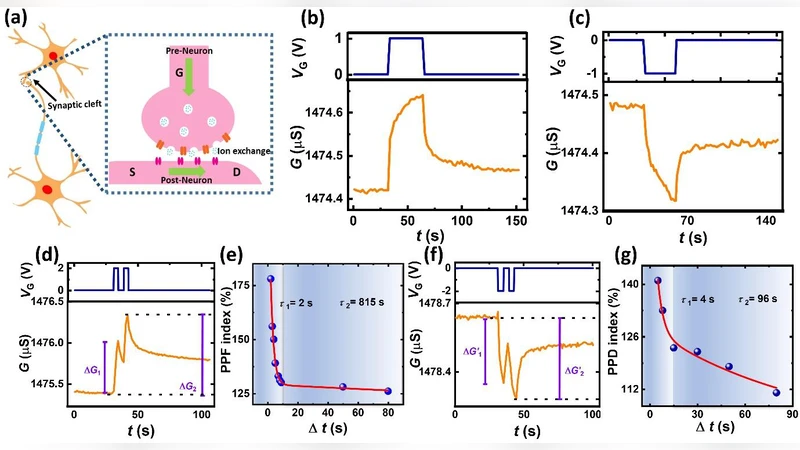
Neuromorphic Computing (NC), which emulates neural activities of the human brain, is considered for low-power implementation of artificial intelligence. Towards realizing NC, fabrication, and investigations of hardware elements such as synaptic devices and neurons are essential. Electrolyte gating has been widely used for conductance modulation by massive carrier injections and has proven to be an effective way of emulating biological synapses. Synaptic devices, in the form of synaptic transistors, have been studied using a wide variety of materials. However, studies on metallic channel based synaptic transistors remain vastly unexplored. Here, we have demonstrated a three-terminal cobalt-based synaptic transistor to emulate biological synapse. We realized gating controlled multilevel, nonvolatile conducting states in the proposed device. The device could successfully emulate essential synaptic functions demonstrating short-term and long-term plasticity. A transition from short-term memory to long-term memory has been realized by tuning gate pulse amplitude and duration. The crucial cognitive behavior viz., learning, forgetting, and relearning, has been emulated, showing resemblance to the human brain. Along with learning and memory, the device showed dynamic filtering behavior. These results provide an insight into the design of metallic channel based synaptic transistors for neuromorphic computing.
💡 Research Summary
The paper presents a three‑terminal synaptic transistor that uses a cobalt (Co) metallic channel and an electrolyte gate to emulate key functions of biological synapses for neuromorphic computing. Unlike the majority of prior work that relies on oxide, organic, or two‑dimensional semiconductor channels, the authors explore a metal‑based channel, aiming to combine high carrier mobility with CMOS‑compatible processing. The device structure consists of a Co thin‑film channel deposited on a substrate, source and drain Au/Ti contacts, and an ion‑conducting polymer electrolyte that serves as the gate dielectric. When a voltage pulse is applied to the gate, mobile ions in the electrolyte migrate toward the Co channel, injecting or extracting a large number of carriers and thereby modulating the channel conductance over several orders of magnitude.
The authors demonstrate multilevel, non‑volatile conductance states that can be programmed by varying pulse amplitude and duration. Short, low‑amplitude pulses (≤1 ms, ≤1 V) produce a transient increase in conductance that decays rapidly, mimicking short‑term plasticity (STP). Longer, higher‑amplitude pulses (≥5 ms, ≥2 V) generate a persistent conductance change, representing long‑term plasticity (LTP). By mapping the parameter space of pulse width versus voltage, a clear boundary is identified where the device transitions from STP to LTP, analogous to the biological conversion of short‑term memory into long‑term memory.
Further experiments reproduce paired‑pulse facilitation (PPF) and spike‑timing‑dependent plasticity (STDP). When two gate pulses are applied with a short inter‑pulse interval, the second pulse yields a larger conductance increment, and the magnitude of this facilitation decays with increasing interval, matching the characteristic PPF curve. By reversing the order of pre‑ and post‑synaptic spikes, the device exhibits asymmetric conductance changes that correspond to potentiation for positive timing differences and depression for negative ones, thereby reproducing the classic STDP learning window.
The paper also explores higher‑level cognitive behaviors. Repeated learning pulses increase conductance, after which the conductance gradually relaxes, modeling forgetting. Subsequent relearning pulses rebuild the conductance level more quickly, illustrating a “relearning” effect. Moreover, the device acts as a dynamic filter: low‑frequency input spikes (≤10 Hz) produce negligible conductance change, whereas high‑frequency spikes (≥100 Hz) cause cumulative conductance buildup, effectively implementing a high‑pass filter that could be used for temporal signal preprocessing in spiking neural networks.
Performance metrics show that the metallic channel enables fast switching (sub‑nanosecond response) and low energy consumption (on the order of picojoules per event), surpassing many oxide‑based synaptic transistors. However, the authors acknowledge challenges such as possible oxidation of the Co surface under repeated ion exposure, variability in conductance states after many cycles, and the need for protective interlayers to improve long‑term stability. Scaling the device to large arrays will also require careful management of electrolyte uniformity and mitigation of crosstalk between neighboring cells.
In conclusion, the study demonstrates that a cobalt‑based metallic channel, combined with electrolyte gating, can faithfully emulate short‑term and long‑term synaptic plasticity, learning‑forgetting‑relearning cycles, and dynamic filtering. This work opens a new pathway for metal‑channel synaptic transistors, offering high mobility, CMOS compatibility, and energy‑efficient operation. Future research should focus on enhancing device reliability, integrating protective layers, and developing array architectures to bring metal‑based synaptic devices closer to practical neuromorphic hardware implementations.