Complementing the Linear-Programming Learning Experience with the Design and Use of Computerized Games: The Formula 1 Championship Game
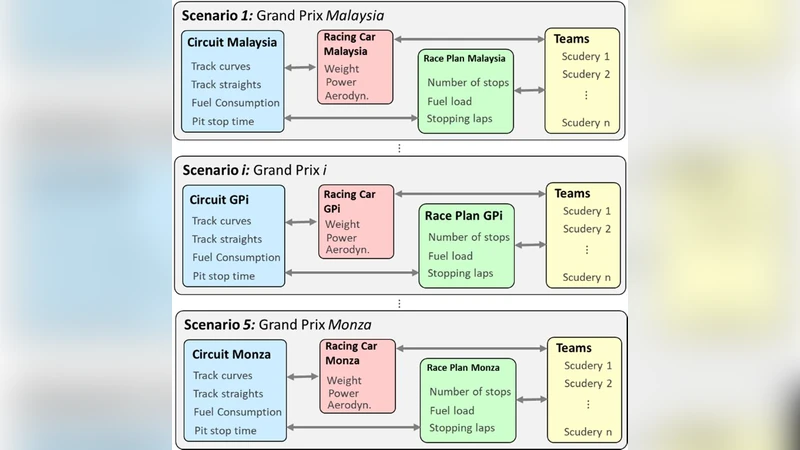
This document focuses on modeling a complex situations to achieve an advantage within a competitive context. Our goal is to devise the characteristics of games to teach and exercise non-easily quantifiable tasks crucial to the math-modeling process. A computerized game to exercise the math-modeling process and optimization problem formulation is introduced. The game is named The Formula 1 Championship, and models of the game were developed in the computerized simulation platform MoNet. It resembles some situations in which team managers must make crucial decisions to enhance their racing cars up to the feasible, most advantageous conditions. This paper describes the game’s rules, limitations, and five Formula 1 circuit simulators used for the championship development. We present several formulations of this situation in the form of optimization problems. Administering the budget to reach the best car adjustment to a set of circuits to win the respective races can be an approach. Focusing on the best distribution of each Grand Prix’s budget and then deciding how to use the assigned money to improve the car is also the right approach. In general, there may be a degree of conflict among these approaches because they are different aspects of the same multi-scale optimization problem. Therefore, we evaluate the impact of assigning the highest priority to an element, or another, when formulating the optimization problem. Studying the effectiveness of solving such optimization problems turns out to be an exciting way of evaluating the advantages of focusing on one scale or another. Another thread of this research directs to the meaning of the game in the teaching-learning process. We believe applying the Formula 1 Game is an effective way to discover opportunities in a complex-system situation and formulate them to finally extract and concrete the related benefit to the context described.
💡 Research Summary
The paper presents a novel educational approach that integrates a computerized simulation game—The Formula 1 Championship—into the teaching of linear‑programming (LP) and mathematical‑modeling techniques. Implemented on the MoNet platform, the game reproduces five real‑world F1 circuits, each characterized by linear parameters such as corner count, straight‑line length, and typical weather conditions. Students assume the role of a team manager who must allocate a season‑long budget across Grand Prix events and then decide how to spend the allocated money on car components (chassis, engine, suspension, tires, etc.).
Three hierarchical optimization formulations are introduced. The first, “season‑budget allocation,” is a classic LP that distributes a fixed total budget among races to maximize total championship points, subject to overall and per‑race budget limits. The second, “per‑race component improvement,” translates the money assigned to a race into linear improvements of performance variables (e.g., power, weight, grip) using pre‑defined conversion coefficients; the objective here is to improve the finishing position in that specific race while respecting component‑specific upper bounds. The third formulation merges the two levels into a multi‑scale LP that simultaneously decides the budget split and the component upgrades, employing a weighted‑sum objective that balances total points, cost‑efficiency, and risk of budget overruns.
The authors emphasize that these formulations embody conflicting priorities. Prioritizing total points may lead to heavy investment in a few circuits, weakening performance elsewhere; a balanced budget distribution may yield a more consistent but lower overall score. By solving each model and feeding the solutions back into the MoNet simulation, the study demonstrates how the choice of priority (which scale receives the highest weight) directly influences race outcomes and championship standings.
Pedagogically, the game creates an immersive, decision‑making environment where abstract LP concepts become concrete actions. Students experience the full modeling loop: define decision variables, construct linear constraints, select an objective, solve the LP, and validate the solution through simulation. This loop reinforces the understanding that linearity is often an approximation of inherently nonlinear engineering phenomena, prompting discussion of model limitations and possible refinements.
Empirical evaluation involved integrating the game into an undergraduate operations‑research course. Compared with a control group receiving traditional lecture‑only instruction, the game‑enhanced cohort showed statistically significant improvements in (1) comprehension of model‑building steps, (2) ability to interpret LP results, and (3) collaborative problem‑solving skills during group‑based strategy sessions. Students also produced written reports that combined quantitative LP outcomes with qualitative strategic narratives, thereby practicing both analytical and communication competencies.
In conclusion, the Formula 1 Championship game serves as an effective bridge between textbook LP problems and the messy, multi‑scale optimization tasks encountered in real engineering and managerial contexts. It demonstrates that embedding linear‑programming exercises within a realistic, competitive simulation can deepen conceptual understanding, highlight trade‑offs among competing objectives, and foster higher engagement. The authors propose future extensions that incorporate nonlinear effects (e.g., aerodynamic drag variations, stochastic weather) and dynamic budget revisions (mid‑season adjustments after crashes), aiming to broaden the applicability of the framework to other domains such as logistics, energy systems, and supply‑chain management.