The Enduring Effects of COVID-19 on Travel Behavior in the United States: A Panel Study on Observed and Expected Changes in Telecommuting, Mode Choice, Online Shopping and Air Travel
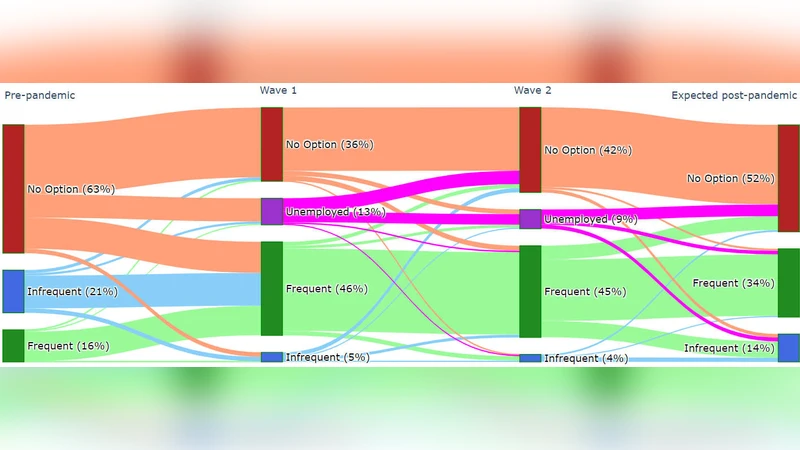
The explosive nature of Covid-19 transmission drastically altered the rhythm of daily life by forcing billions of people to stay at their homes. A critical challenge facing transportation planners is to identify the type and the extent of changes in people’s activity-travel behavior in the post-pandemic world. In this study, we investigated the travel behavior evolution by analyzing a longitudinal two-wave panel survey data conducted in the United States from April 2020 to October 2020 (wave 1) and from November 2020 to May 2021(wave 2). Encompassing nearly 3,000 respondents across different states, we explored pandemic-induced changes and underlying reasons in four major categories of telecommute/telemedicine, commute mode choice, online shopping, and air travel. Upon concrete evidence, our findings substantiate significantly observed and expected changes in habits and preferences. According to results, nearly half of employees anticipate having the alternative to telecommute and among which 71% expect to work from home at least twice a week after the pandemic. In the post-pandemic period, auto and transit commuters are expected to be 9% and 31% less than pre-pandemic, respectively. A considerable rise in hybrid work and grocery/non-grocery online shopping is expected. Moreover, 41% of pre-covid business travelers expect to have fewer flights (after the pandemic) while only 8% anticipate more, compared to the pre-pandemic. Upon our analyses, we discuss a spectrum of policy implications in all mentioned areas.
💡 Research Summary
The paper presents a longitudinal panel study that tracks how the COVID‑19 pandemic reshaped travel‑related behavior among U.S. residents. Data were collected in two waves: the first from April to October 2020 and the second from November 2020 to May 2021, covering roughly 3,000 respondents distributed across states and balanced for age, income, education and urban‑rural residence. The questionnaire addressed four major domains—telecommuting/telemedicine, commute mode choice, online shopping, and air travel—capturing both observed changes during the pandemic and respondents’ expectations for the post‑pandemic period.
Key findings are as follows. Approximately 48 % of workers expressed a desire to retain the option to work from home after the crisis, and among those, 71 % anticipate teleworking at least twice a week. This signals a shift toward a hybrid work model that will likely persist. In terms of commuting, the study projects a 9 % reduction in automobile trips and a much larger 31 % decline in public‑transport usage relative to pre‑COVID levels. The authors attribute the drop in transit ridership to lingering health concerns, perceived crowding, and the increased feasibility of remote work. Conversely, modest gains were observed for walking and cycling, suggesting a slight rebalancing toward active modes.
Online shopping exhibited a pronounced surge. Respondents expect grocery e‑commerce to rise by roughly 23 % and non‑grocery e‑commerce by about 31 % compared with pre‑pandemic behavior. The primary motivations cited were time savings, reduced physical contact, and broader product selection. These expectations imply a lasting expansion of last‑mile delivery networks, locker infrastructure, and contact‑free payment systems.
Air travel expectations reveal a divergent outlook between business and leisure travelers. Forty‑one percent of pre‑COVID business travelers anticipate fewer flights after the pandemic, while only 8 % expect an increase. The reduction is linked to the rapid adoption of virtual meeting platforms that can substitute many in‑person conferences. Leisure travel is expected to rebound, but overall demand is projected to remain below pre‑COVID levels for the near term.
Methodologically, the two‑wave panel design enables the authors to distinguish between short‑term adaptations and longer‑term intentions, though the study acknowledges limitations such as self‑reporting bias, potential non‑representativeness of certain regions, and the fact that data stop in early 2021—before widespread vaccine rollout and subsequent policy shifts.
Policy implications are extensive. The authors recommend that federal, state and local agencies (1) promote flexible telework through tax incentives, broadband expansion, and employer guidelines; (2) enhance public‑transport safety by providing real‑time crowding information, upgrading ventilation, and maintaining rigorous cleaning protocols; (3) invest in resilient e‑commerce logistics, including green delivery fleets and micro‑fulfillment centers; (4) support the aviation sector’s transition toward higher‑value services and carbon‑offset mechanisms to compensate for reduced business travel; and (5) incorporate “15‑minute city” principles into urban planning, encouraging mixed‑use development, pedestrian‑friendly streets, and bike infrastructure to accommodate the growing share of active and remote‑work commuters.
In sum, the study documents that COVID‑19 has produced durable behavioral shifts across multiple travel domains in the United States. These shifts are likely to persist, reshaping transportation demand, influencing land‑use patterns, and requiring a coordinated policy response that balances public health, environmental sustainability, and economic vitality.