Resolving G"odels Incompleteness Myth: Polynomial Equations and Dynamical Systems for Algebraic Logic
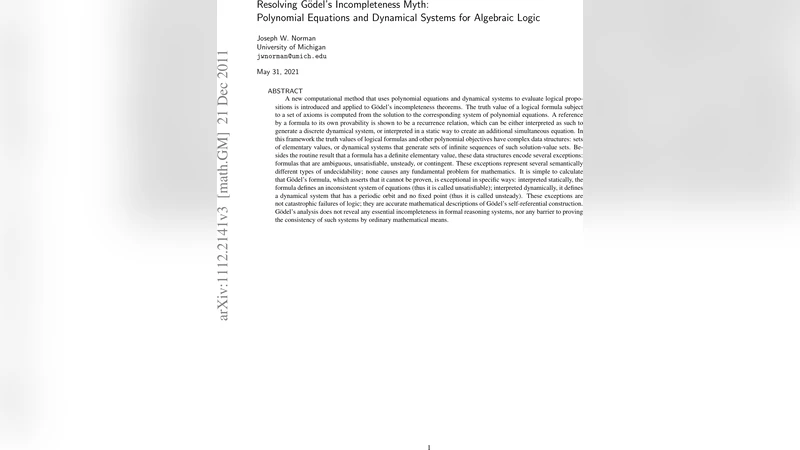
A new computational method that uses polynomial equations and dynamical systems to evaluate logical propositions is introduced and applied to Goedel’s incompleteness theorems. The truth value of a logical formula subject to a set of axioms is computed from the solution to the corresponding system of polynomial equations. A reference by a formula to its own provability is shown to be a recurrence relation, which can be either interpreted as such to generate a discrete dynamical system, or interpreted in a static way to create an additional simultaneous equation. In this framework the truth values of logical formulas and other polynomial objectives have complex data structures: sets of elementary values, or dynamical systems that generate sets of infinite sequences of such solution-value sets. Besides the routine result that a formula has a definite elementary value, these data structures encode several exceptions: formulas that are ambiguous, unsatisfiable, unsteady, or contingent. These exceptions represent several semantically different types of undecidability; none causes any fundamental problem for mathematics. It is simple to calculate that Goedel’s formula, which asserts that it cannot be proven, is exceptional in specific ways: interpreted statically, the formula defines an inconsistent system of equations (thus it is called unsatisfiable); interpreted dynamically, it defines a dynamical system that has a periodic orbit and no fixed point (thus it is called unsteady). These exceptions are not catastrophic failures of logic; they are accurate mathematical descriptions of Goedel’s self-referential construction. Goedel’s analysis does not reveal any essential incompleteness in formal reasoning systems, nor any barrier to proving the consistency of such systems by ordinary mathematical means.
💡 Research Summary
The paper introduces a novel computational framework that translates logical propositions and their accompanying axiom systems into systems of polynomial equations over a finite field (typically 𝔽₂). Logical connectives are replaced by algebraic counterparts (¬ x → 1‑x, x∧y → xy, x∨y → x + y + xy, etc.), and the truth value of a formula becomes a 0‑1 solution of the resulting equations. Crucially, the provability predicate is modeled as an existential condition: “Prov(P)” is expressed by the existence of a solution to a dedicated polynomial equation R(P, x)=0.
Applying this translation to Gödel’s self‑referential sentence G (“G is not provable”) yields a recursive algebraic relation G = ¬Prov(G). The author then examines two distinct interpretations of this recursion.
-
Static interpretation treats the equation G = ¬Prov(G) as an additional simultaneous constraint on the original system. The combined set of equations becomes inconsistent; no 0‑1 assignment satisfies all constraints. In the terminology of the paper this situation is called “unsatisfiable.”
-
Dynamic interpretation regards the recursion as a discrete-time update rule Gₜ₊₁ = ¬Prov(Gₜ). Over 𝔽₂ this reduces to Gₜ₊₁ = 1 − Gₜ, which generates the two‑cycle 0→1→0→… . The resulting dynamical system has no fixed point, so it is labeled “unstable.”
These two outcomes demonstrate that Gödel’s construction does not expose a fundamental incompleteness of formal systems; rather, it produces a special kind of exception—either an unsatisfiable static system or an unsteady dynamical system. The paper further classifies all logical formulas into four categories based on the algebraic behavior of their associated polynomial systems:
- Definite – a unique elementary value (single 0 or 1 solution).
- Ambiguous – multiple elementary values without a unique choice.
- Unsatisfiable – no solution exists.
- Unsteady – the associated dynamical system lacks a fixed point and exhibits periodic orbits.
The “unsteady” case arises naturally from self‑reference and is absent from traditional proof‑theoretic analyses, which focus solely on static, deterministic reasoning. By exposing this dynamical dimension, the author argues that Gödel’s incompleteness theorems merely identify particular algebraic exceptions rather than demonstrating an inherent limitation of formal reasoning. Consequently, ordinary mathematical techniques—model construction, consistency proofs, and inductive arguments—remain fully applicable to establishing the consistency of formal systems. The paper concludes that Gödel’s famous result does not constitute a barrier to proving consistency; instead, it is a precise mathematical description of a self‑referential construction that can be fully understood within the polynomial‑equation and dynamical‑system framework.
Comments & Academic Discussion
Loading comments...
Leave a Comment