APIzation: Generating Reusable APIs from StackOverflow Code Snippets
💡 Research Summary
The paper addresses the practical problem that many Java code snippets posted on StackOverflow (SO) lack a proper method declaration, making them difficult to reuse directly in software projects. The authors introduce the concept of “APIzation,” which denotes the activity of turning such dangling code fragments into well‑formed Application Programming Interfaces (APIs) by identifying input parameters and output return statements. To understand how developers perform this transformation, the authors conduct an empirical study that links SO snippets to real‑world GitHub (GH) methods that are explicit APIzations of those snippets.
Data collection proceeds in three steps. First, the authors query a recent snapshot of GitHub (≈ 1 million Java projects) for files that contain explicit SO links in comments or Javadoc, yielding 29,035 candidate files. Second, they apply TYPE 3 code‑clone detection (allowing insertions, deletions, and updates) with a 70 % line‑coverage threshold, resulting in 330 clone pairs. Third, manual inspection removes spurious matches, leaving 135 high‑confidence APIzation pairs.
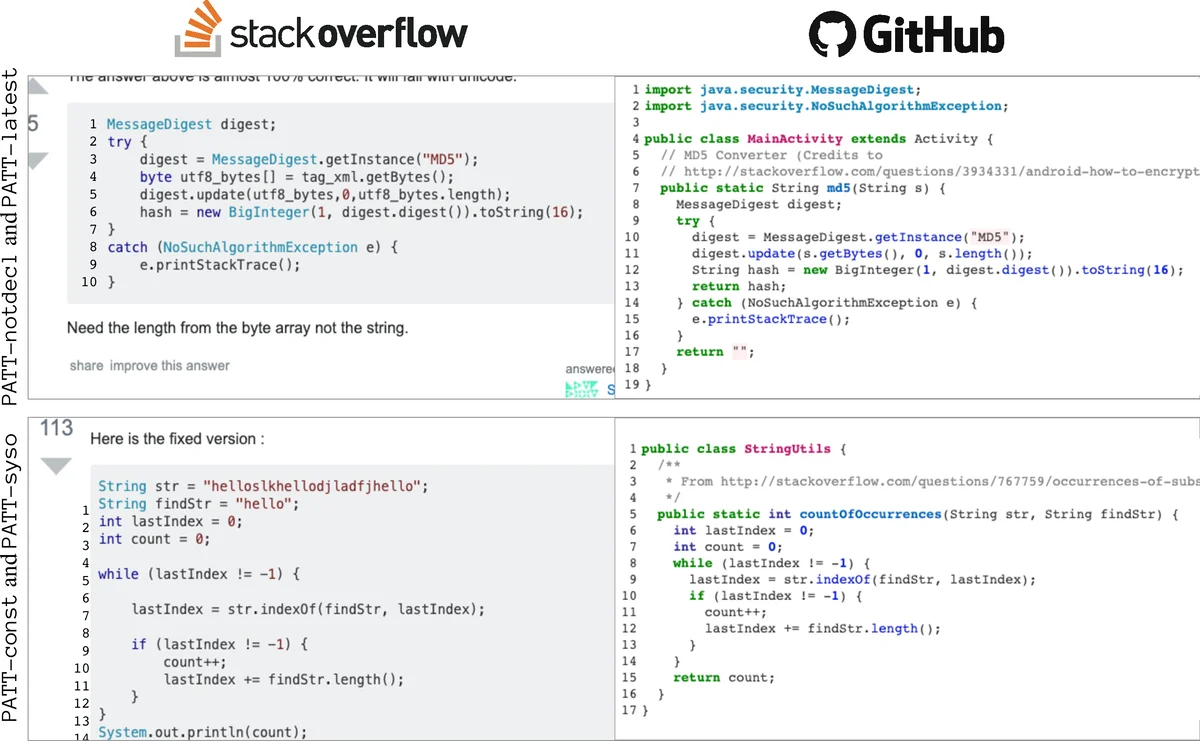
Using grounded‑theory coding on these 135 pairs, the authors identify four recurring patterns that characterize how developers decide which variables become parameters and which statements become return values:
- PATT‑notdecl – a variable referenced in the snippet but not declared is treated as an input parameter.
- PATT‑const – a variable that is declared and initialized with a literal constant, and that is not modified inside loops, is promoted to a parameter.
- PATT‑latest – the last assignment or expression in the snippet is taken as the method’s return value.
- PATT‑syso – when the final statement is a
System.out.println(or similar output), the printed value is turned into a return statement.
These patterns form the basis of the tool APIzator, which performs static analysis on a given SO snippet to (a) detect undeclared variables (PATT‑notdecl), (b) recognize constant‑initialized variables (PATT‑const), (c) locate the final expression (PATT‑latest), and (d) handle output‑printing cases (PATT‑syso). The tool also automatically generates a method name using a part‑of‑speech tagger on the SO question title, inserts required import statements, and creates a Javadoc block that records the original SO URL for provenance.
The evaluation uses a ground‑truth set of 200 APIzations manually created by 20 Java developers. APIzator’s output is compared against each human‑produced API. The tool matches the exact parameter list in 113 cases (56.5 %) and the exact return statements in 115 cases (57.5 %). When considering either parameters or return statements, the match rate rises to 163 out of 200 (81.5 %). These numbers indicate that APIzator can reliably automate the majority of the APIzation work, substantially reducing the manual effort required to integrate SO snippets into production code.
The authors discuss several limitations. The current approach is limited to Java; extending it to other languages would require new pattern discovery. Complex control flow constructs such as multiple return points, exception handling, or asynchronous APIs are not fully captured by the four patterns. Method name generation based solely on the question title can produce ambiguous or duplicate names, suggesting a need for more sophisticated naming strategies.
In addition to the tool, the paper contributes a publicly released dataset of 109,930 automatically generated APIs and a prototype search engine (https://apization.netlify.app/search/) that lets users query natural‑language descriptions and retrieve both the original SO snippet and its generated API.
Overall, the work demonstrates that a small set of empirically derived patterns can drive an effective static‑analysis pipeline for turning informal code snippets into reusable, compilable methods. By automating APIzation, the authors lower a significant barrier to code reuse, enable large‑scale cataloging of SO‑derived APIs, and open new opportunities for research on code search, synthesis, and software maintenance.
Comments & Academic Discussion
Loading comments...
Leave a Comment