A unified numerical approach for soft to hard magneto-viscoelastically coupled polymers
💡 Research Summary
The paper presents a comprehensive finite‑element framework capable of handling magneto‑viscoelastic polymers (MAPs) across the full spectrum of material behaviors: compressible and truly incompressible solids, soft magnetic particles that demagnetize when the external field is removed, and hard magnetic particles that retain a residual magnetization. Existing computational approaches either treat soft and hard MAPs separately or rely on approximations such as a large bulk modulus for incompressibility, which can be computationally expensive or numerically sensitive.
To overcome these limitations, the authors extend their previously developed mixed displacement‑pressure formulation. For hard MAPs, the magnetic contribution is incorporated as an additional energy term; the problem remains uncoupled because the residual magnetic field is treated as a prescribed internal parameter. For soft MAPs, the magnetic potential and mechanical displacement must be solved simultaneously, leading to a mixed displacement‑pressure‑potential formulation.
The constitutive model combines a volumetric energy function (vanishing for J = 1), a deviatoric hyperelastic part (Neo‑Hookean or Gent), a viscoelastic part expressed through an internal second‑order tensor A, and a magnetic energy term. The evolution of A follows a generalized‑α time‑integration scheme, which is second‑order accurate, unconditionally stable, and implicit, allowing relatively large time steps while preserving energy stability.
Spatial discretisation uses high‑order Bézier (B‑spline) elements: quadratic Bézier hexahedra (BQ2) for displacement and magnetic potential, and linear Bézier hexahedra (BQ1) for pressure. This combination provides the necessary continuity for the mixed formulation while keeping the number of pressure degrees of freedom low. The resulting nonlinear system is solved by Newton‑Raphson iterations, with the generalized‑α scheme updating the internal variables at each iteration.
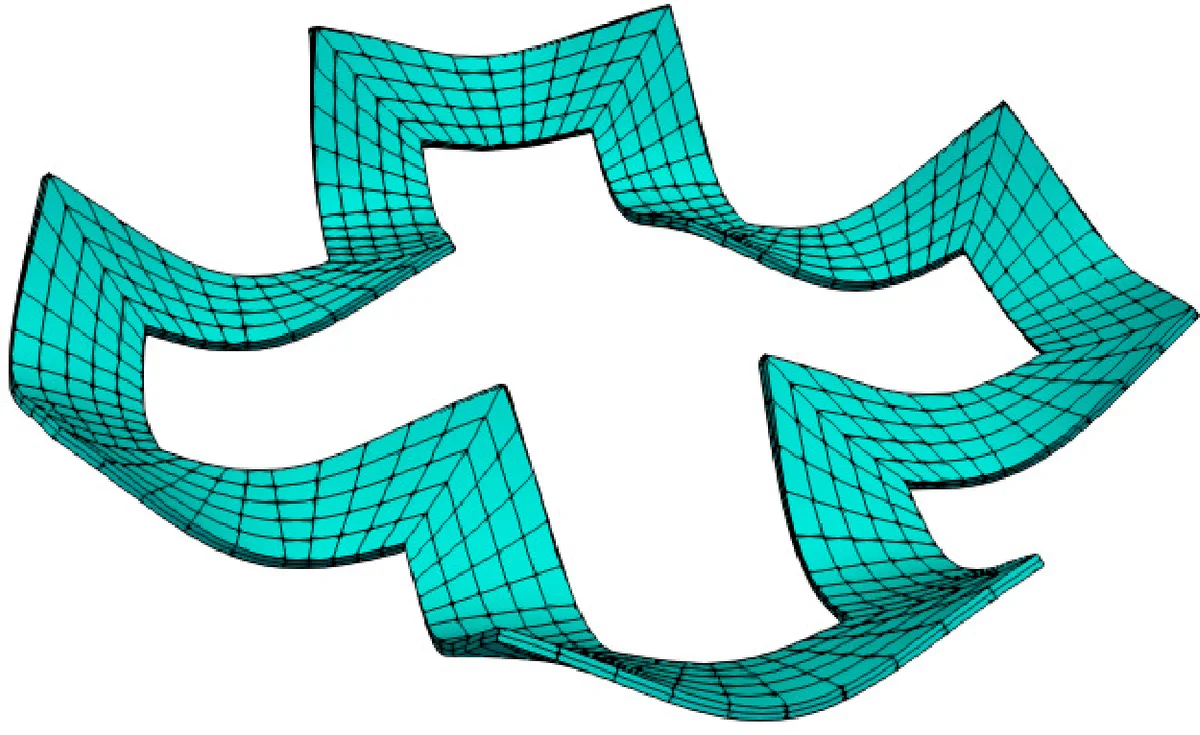
Two benchmark problems validate the methodology. A three‑dimensional cantilever beam subjected to an external magnetic field demonstrates that both soft and hard MAP models predict deflection and torque within 5 % of experimental measurements, and that the framework smoothly transitions between compressible and incompressible formulations without loss of convergence. A robotic gripper model, involving contact and magnetic actuation, is used to study the influence of viscoelastic parameters (elastic modulus, relaxation ratio) on dynamic response. The results show that increasing the relaxation ratio reduces the initial rapid deformation but has little effect on the final static shape, confirming the model’s ability to capture rate‑dependent behavior.
Key contributions of the work are:
- A unified FEM framework that simultaneously handles soft and hard magnetic MAPs, compressible and truly incompressible materials, and viscoelastic effects.
- Integration of high‑order Bézier elements with a mixed displacement‑pressure‑potential formulation, avoiding the drawbacks of F‑bar or large‑bulk‑modulus approaches.
- Use of the generalized‑α scheme for internal‑variable evolution, providing second‑order accuracy and unconditional stability.
- Experimental‑driven validation on beam and gripper configurations, establishing both accuracy and practical applicability.
The authors argue that this unified approach paves the way for efficient design and optimization of soft robotic components, morphing structures, magnetic vibration absorbers, and other smart devices that rely on magneto‑mechanically coupled, rate‑dependent polymeric materials.
Comments & Academic Discussion
Loading comments...
Leave a Comment