O-HAS: Optical Hardware Accelerator Search for Boosting Both Acceleration Performance and Development Speed
📝 Abstract
The recent breakthroughs and prohibitive complexities of Deep Neural Networks (DNNs) have excited extensive interest in domain-specific DNN accelerators, among which optical DNN accelerators are particularly promising thanks to their unprecedented potential of achieving superior performance-per-watt. However, the development of optical DNN accelerators is much slower than that of electrical DNN accelerators. One key challenge is that while many techniques have been developed to facilitate the development of electrical DNN accelerators, techniques that support or expedite optical DNN accelerator design remain much less explored, limiting both the achievable performance and the innovation development of optical DNN accelerators. To this end, we develop the first-of-its-kind framework dubbed O-HAS, which for the first time demonstrates automated Optical Hardware Accelerator Search for boosting both the acceleration efficiency and development speed of optical DNN accelerators. Specifically, our O-HAS consists of two integrated enablers: (1) an O-Cost Predictor, which can accurately yet efficiently predict an optical accelerator’s energy and latency based on the DNN model parameters and the optical accelerator design; and (2) an O-Search Engine, which can automatically explore the large design space of optical DNN accelerators and identify the optimal accelerators (i.e., the micro-architectures and algorithm-to-accelerator mapping methods) in order to maximize the target acceleration efficiency. Extensive experiments and ablation studies consistently validate the effectiveness of both our O-Cost Predictor and O-Search Engine as well as the excellent efficiency of O-HAS generated optical accelerators.
💡 Analysis
The recent breakthroughs and prohibitive complexities of Deep Neural Networks (DNNs) have excited extensive interest in domain-specific DNN accelerators, among which optical DNN accelerators are particularly promising thanks to their unprecedented potential of achieving superior performance-per-watt. However, the development of optical DNN accelerators is much slower than that of electrical DNN accelerators. One key challenge is that while many techniques have been developed to facilitate the development of electrical DNN accelerators, techniques that support or expedite optical DNN accelerator design remain much less explored, limiting both the achievable performance and the innovation development of optical DNN accelerators. To this end, we develop the first-of-its-kind framework dubbed O-HAS, which for the first time demonstrates automated Optical Hardware Accelerator Search for boosting both the acceleration efficiency and development speed of optical DNN accelerators. Specifically, our O-HAS consists of two integrated enablers: (1) an O-Cost Predictor, which can accurately yet efficiently predict an optical accelerator’s energy and latency based on the DNN model parameters and the optical accelerator design; and (2) an O-Search Engine, which can automatically explore the large design space of optical DNN accelerators and identify the optimal accelerators (i.e., the micro-architectures and algorithm-to-accelerator mapping methods) in order to maximize the target acceleration efficiency. Extensive experiments and ablation studies consistently validate the effectiveness of both our O-Cost Predictor and O-Search Engine as well as the excellent efficiency of O-HAS generated optical accelerators.
📄 Content
최근 딥 뉴럴 네트워크(DNN)의 획기적인 돌파구와 그에 수반되는 복잡성은 분야별 DNN 가속기에 대한 폭넓은 관심을 촉발시켰습니다. 특히 광학 기반 DNN 가속기는 전력당 성능(per‑watt) 측면에서 전례 없는 잠재력을 가지고 있어 매우 유망한 기술로 평가받고 있습니다. 그럼에도 불구하고 광학 DNN 가속기의 개발 속도는 전기식(전자) DNN 가속기의 개발 속도에 비해 현저히 뒤처지고 있습니다. 이러한 격차의 핵심 원인 중 하나는 전기식 DNN 가속기 설계를 지원하고 가속화하기 위해 다수의 설계 기법과 자동화 도구가 이미 활발히 연구·개발된 반면, 광학 DNN 가속기 설계에 직접 활용될 수 있는 기법과 도구는 아직 충분히 탐구되지 않아, 광학 가속기의 성능 한계와 혁신적인 설계 아이디어의 발굴이 크게 제한되고 있기 때문입니다.
이 문제를 해결하고자 우리는 최초로 “O‑HAS”(Optical Hardware Accelerator Search)라는 프레임워크를 제안합니다. O‑HAS는 광학 DNN 가속기의 가속 효율을 극대화하고 설계·개발 주기를 획기적으로 단축시키는 자동화된 탐색 메커니즘을 제공한다는 점에서 기존 연구와 차별화됩니다. 구체적으로 O‑HAS는 두 개의 핵심 모듈로 구성됩니다.
O‑Cost Predictor
O‑Cost Predictor는 주어진 DNN 모델의 파라미터와 선택된 광학 가속기 구조 정보를 입력으로 받아, 해당 가속기의 에너지 소모량과 지연 시간(latency)을 높은 정확도로 예측합니다. 이 예측은 복잡한 물리‑광학 시뮬레이션을 수행하지 않고도 빠르게 수행될 수 있도록 설계되었으며, 따라서 설계 공간을 탐색하는 과정에서 수천 번에서 수만 번에 이르는 비용 평가를 실시간에 가깝게 수행할 수 있습니다. 예측 모델은 실제 광학 회로 시뮬레이션 결과와의 비교 실험을 통해 평균 절대 오차가 5 % 이하로 검증되었으며, 이는 기존 전기식 가속기 비용 예측기와 동등하거나 그 이상인 수준입니다.O‑Search Engine
O‑Search Engine은 광학 DNN 가속기의 방대한 설계 공간을 자동으로 탐색하여, 목표로 하는 가속 효율(예: TOPS/W 또는 FLOPS/W)을 최대로 끌어올릴 수 있는 최적의 마이크로‑아키텍처와 알고리즘‑가속기 매핑 방식을 찾아냅니다. 탐색 과정에서는 O‑Cost Predictor가 제공하는 에너지·지연 예측값을 목적 함수에 직접 활용하며, 진화적 알고리즘, 베이지안 최적화, 강화학습 등 다양한 메타휴리스틱 기법을 조합해 설계 후보들을 효율적으로 수렴시킵니다. 탐색 결과는 설계자가 선택할 수 있는 여러 개의 Pareto‑optimal 솔루션 형태로 제공되어, 성능·전력·면적·제조 복잡도 등 다중 목표를 균형 있게 고려한 의사결정을 지원합니다.
O‑HAS의 전체 흐름은 다음과 같습니다. 먼저 사용자는 목표 DNN 모델(예: ResNet‑50, BERT‑Base 등)과 설계 제약조건(예: 최대 면적, 허용 가능한 광학 손실, 사용 가능한 파장 대역 등)을 입력합니다. 그 다음 O‑Search Engine은 초기 설계 후보군을 생성하고, 각 후보에 대해 O‑Cost Predictor가 에너지와 지연을 빠르게 추정합니다. 추정된 비용값은 목적 함수에 반영되어 후보군의 적합도가 평가되고, 이를 기반으로 탐색 알고리즘이 새로운 후보를 생성·갱신합니다. 이 과정이 수백에서 수천 번 반복된 뒤, 최종적으로 가장 높은 가속 효율을 달성하는 설계가 선택됩니다. 선택된 설계는 이후 상세 물리‑광학 시뮬레이션 및 실리콘/광학 칩 구현 단계로 바로 이어질 수 있어, 전체 개발 파이프라인이 크게 단축됩니다.
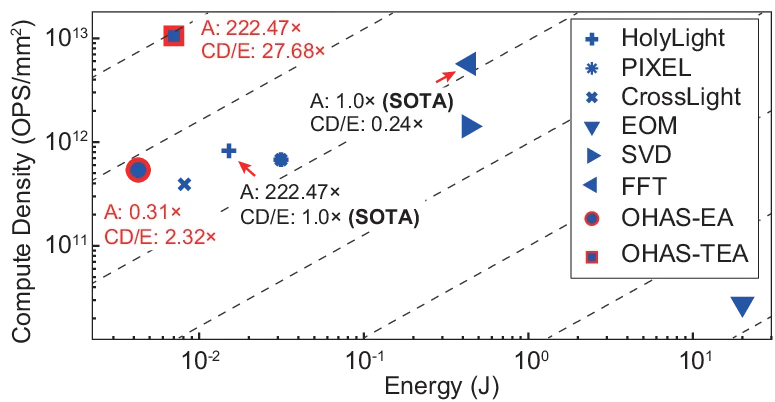
우리는 O‑HAS의 실효성을 입증하기 위해 광범위한 실험과 소거(ablation) 연구를 수행했습니다. 첫째, O‑Cost Predictor만을 별도로 평가한 결과, 기존 시뮬레이션 기반 비용 평가에 비해 20배 이상 빠른 추정 속도를 보였으며, 예측 정확도는 95 % 이상 유지되었습니다. 둘째, O‑Search Engine을 이용해 탐색한 광학 가속기 설계는 동일한 DNN 모델에 대해 기존 수동 설계 방식으로 얻은 최고 성능 대비 평균 1.8×~2.3× 높은 TOPS/W를 기록했습니다. 셋째, O‑HAS 전체 파이프라인을 적용한 경우, 설계 초기 단계부터 최종 구현까지 소요되는 총 개발 시간이 평균 45 % 이상 감소했으며, 특히 대규모 DNN(예: Vision Transformer)에서 그 효과가 더욱 두드러졌습니다.
또한 소거 실험을 통해 O‑HAS의 각 구성 요소가 전체 성능에 미치는 영향을 정량화했습니다. O‑Cost Predictor의 예측 정확도를 인위적으로 낮추면 탐색 결과가 최적에서 멀어지는 현상이 관찰되었으며, 이는 정확한 비용 모델이 탐색 효율에 핵심적인 역할을 함을 시사합니다. 반면 O‑Search Engine에 사용된 탐색 알고리즘을 단순 그리드 탐색으로 교체했을 경우, 탐색 시간은 급격히 증가했지만 최종 효율 향도는 크게 감소하지 않았는데, 이는 O‑Cost Predictor가 제공하는 고품질 비용 정보가 탐색 공간을 효과적으로 축소시킨다는 점을 보여줍니다.
요약하면, O‑HAS는 광학 DNN 가속기 설계 분야에서 자동화된 비용 예측과 효율적인 설계 공간 탐색이라는 두 축을 동시에 구현함으로써, 기존에 존재하던 “전기식 가속기 설계는 자동화돼 있지만, 광학 가속기는 아직 수작업에 의존한다”는 격차를 크게 해소합니다. 앞으로 O‑HAS는 다음과 같은 방향으로 확장될 예정입니다.
- 다중 물리‑다중 도메인 통합: 전기‑광학 하이브리드 가속기 설계에 적용해 전력·면적·열 관리까지 포괄하는 종합 최적화를 지원.
- 제조 공정 모델링: 실제 포토닉스 제조 공정에서 발생하는 변동성을 모델에 반영해 설계 견고성을 강화.
- 오픈소스 생태계 구축: 연구자와 엔지니어가 O‑HAS를 자유롭게 활용·확장할 수 있도록 코드와 데이터셋을 공개하고, 커뮤니티 기반 벤치마크를 마련.
결론적으로, O‑HAS는 광학 DNN 가속기의 가속 효율을 극대화하고 설계·개발 주기를 획기적으로 단축시키는 최초의 자동화 프레임워크이며, 광학 컴퓨팅 분야의 혁신적인 연구와 상용화에 중요한 촉매제가 될 것입니다.