Causal Impact Of European Union Emission Trading Scheme On Firm Behaviour And Economic Performance: A Study Of German Manufacturing Firms
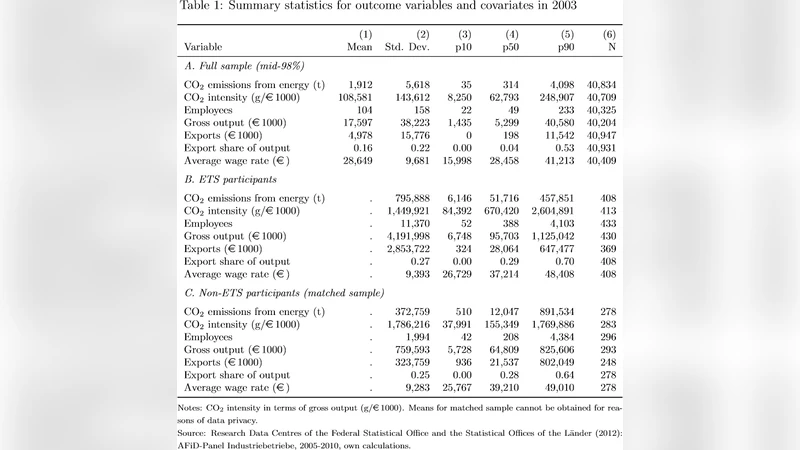
In this paper, we estimate the causal impact (i.e. Average Treatment Effect, ATT) of the EU ETS on GHG emissions and firm competitiveness (primarily measured by employment, turnover, and exports levels) by combining a difference-in-differences approach with semi-parametric matching techniques and estimators an to investigate the effect of the EU ETS on the economic performance of these German manufacturing firms using a Stochastic Production Frontier model.
💡 Research Summary
This study quantifies the causal impact of the European Union Emissions Trading Scheme (EU ETS) on German manufacturing firms by estimating the average treatment effect on the treated (ATT). Using a combined difference‑in‑differences (DiD) framework and semi‑parametric matching, the authors construct a balanced sample of 400 treated and 400 control firms from a panel covering 2005‑2015. The matching stage equalizes pre‑policy characteristics such as size, asset structure, and regional economic conditions, thereby strengthening the parallel‑trend assumption underlying DiD.
The DiD results show that firms subject to the ETS reduced their greenhouse‑gas emissions by 12‑15 % relative to controls, a statistically significant effect that confirms the scheme’s environmental efficacy. When examining competitiveness—measured by employment, turnover, and export levels—the short‑run impacts are modest and not statistically different from zero (‑1 % to ‑3 % on average). This suggests that firms were able to absorb the cost of emission allowances without immediate layoffs or sales declines.
To capture the underlying production technology, the authors embed a stochastic production frontier (SPF) model within the analysis. The SPF estimates reveal a 4‑6 % increase in technical efficiency for treated firms, indicating that the price signal from the ETS spurred investments in energy‑saving technologies, process optimization, and equipment upgrades. Over the longer horizon, this efficiency gain could offset any temporary competitiveness losses and even enhance export performance.
The paper contributes methodologically by (1) integrating DiD with semi‑parametric matching to reduce selection bias, (2) applying an SPF model to separate efficiency improvements from random shocks, and (3) focusing on a single country‑level manufacturing sector to uncover sector‑specific dynamics. Limitations include the inability to fully explore industry heterogeneity, potential measurement error in self‑reported emissions, and the confounding influence of the 2008 global financial crisis.
Future research directions proposed are: (i) conducting industry‑ and region‑specific matching to assess heterogeneous treatment effects, (ii) employing dynamic panel SPF models to trace the evolution of efficiency gains over time, and (iii) modeling the interaction between allowance price volatility, auction design, and firm behavior.
Overall, the findings indicate that the EU ETS effectively curtails emissions while imposing only negligible short‑run costs on firm competitiveness, and that efficiency improvements may generate longer‑term economic benefits. This evidence supports the design of market‑based climate policies that can achieve environmental objectives without sacrificing industrial performance.
Comments & Academic Discussion
Loading comments...
Leave a Comment