Topology optimization for acoustic structures considering viscous and thermal boundary layers using a sequential linearized Navier-Stokes model
📝 Abstract
This study proposes a level set-based topology optimization method for designing acoustic structures with viscous and thermal boundary layers in perspective. Acoustic waves propagating in a narrow channel are damped by viscous and thermal boundary layers. To estimate these viscothermal effects, we first introduce a sequential linearized Navier-Stokes model based on three weakly coupled Helmholtz equations for viscous, thermal, and acoustic pressure fields. Then, the optimization problem is formulated, where a sound-absorbing structure comprising air and an isothermal rigid medium is targeted, and its sound absorption coefficient is set as an objective function. The adjoint variable method and the concept of the topological derivative are used to approximately obtain design sensitivity. A level set-based topology optimization method is used to solve the optimization problem. Two-dimensional numerical examples are provided to support the validity of the proposed method. Moreover, the mechanisms that lead to the high absorption coefficient of the optimized design are discussed.
💡 Analysis
This study proposes a level set-based topology optimization method for designing acoustic structures with viscous and thermal boundary layers in perspective. Acoustic waves propagating in a narrow channel are damped by viscous and thermal boundary layers. To estimate these viscothermal effects, we first introduce a sequential linearized Navier-Stokes model based on three weakly coupled Helmholtz equations for viscous, thermal, and acoustic pressure fields. Then, the optimization problem is formulated, where a sound-absorbing structure comprising air and an isothermal rigid medium is targeted, and its sound absorption coefficient is set as an objective function. The adjoint variable method and the concept of the topological derivative are used to approximately obtain design sensitivity. A level set-based topology optimization method is used to solve the optimization problem. Two-dimensional numerical examples are provided to support the validity of the proposed method. Moreover, the mechanisms that lead to the high absorption coefficient of the optimized design are discussed.
📄 Content
본 연구에서는 점성 및 열 경계층(viscous and thermal boundary layers)을 고려한 음향 구조물 설계를 위해 레벨셋(level‑set) 기반 토폴로지 최적화(topology‑optimization) 방법을 새롭게 제안한다. 좁은 채널(narrow channel) 내부를 전파하는 음향 파동(acoustic waves)은 채널 벽면에 형성되는 점성 경계층(viscous boundary layer)과 열 경계층(thermal boundary layer)에 의해 크게 감쇠(damped)되며, 이러한 점열(viscothermal) 효과는 고주파 음향 설계에서 무시할 수 없는 중요한 물리 현상이다. 따라서 설계 단계에서 점성·열 효과를 정확히 모델링하고 정량적으로 평가하는 것이 필수적이다.
이를 위해 먼저 점성, 열, 그리고 음압(acoustic pressure) 장에 대해 각각 약하게(weakly) 결합된 세 개의 헬름홀츠(Helmholtz) 방정식으로 구성된 순차(linearized) 선형 나비에‑스토크스(Navier‑Stokes) 모델을 도입한다. 구체적으로, 점성 흐름을 기술하는 운동 방정식, 열 전달을 기술하는 에너지 방정식, 그리고 음향 전파를 기술하는 헬름홀츠 방정식을 각각 선형화한 뒤, 이들 사이의 상호작용을 점성·열 경계층이 얇다고 가정하는 근사(weak coupling)를 통해 순차적으로 해결한다. 이렇게 구성된 모델은 기존의 순수 음향 해석에 비해 점성·열 손실을 정밀하게 포착할 수 있으며, 복잡한 기하 구조에서도 수치적으로 안정적으로 계산될 수 있다.
다음으로 최적화 문제를 수식화한다. 설계 대상은 공기(air)와 등온(isothermal) 강체 매질(rigid medium)으로 이루어진 복합 흡음 구조물(sound‑absorbing structure)이며, 이 구조물은 외부에서 입사되는 음향 에너지를 최대한 흡수하도록 설계되어야 한다. 따라서 목표 함수(objective function)로는 구조물의 흡음 계수(sound absorption coefficient)를 사용한다. 흡음 계수는 입사 파동에 대한 반사 파동의 크기를 정량화한 지표로, 0에서 1 사이의 값을 가지며 1에 가까울수록 완벽에 가까운 흡음을 의미한다.
설계 변수에 대한 민감도(sensitivity)를 효율적으로 계산하기 위해 인접 변수법(adjont variable method)과 토폴로지 미분(topological derivative) 개념을 도입한다. 인접 변수법은 목적 함수의 변분을 직접 계산하는 대신, 라그랑지안(Lagrangian) 형태의 보조 변수(adjoint variable)를 정의하고 이를 통해 목적 함수의 변화율을 간접적으로 구하는 방법이다. 이 과정에서 도출되는 토폴로지 미분은 설계 영역 내의 미세한 재료 삽입·제거가 목적 함수에 미치는 영향을 정량적으로 나타내며, 레벨셋 함수(level‑set function)의 변화를 통해 최적 설계 형태를 업데이트하는 데 사용된다.
레벨셋 기반 토폴로지 최적화 절차는 다음과 같은 순서로 진행된다. 첫째, 초기 설계 영역을 정의하고 레벨셋 함수를 초기화한다. 둘째, 순차 선형화된 나비에‑스토크스 모델을 이용해 현재 설계에 대한 점성·열·음향 압력장을 계산한다. 셋째, 인접 변수 방정식을 풀어 보조 변수를 얻고, 이를 토대로 토폴로지 미분을 평가한다. 넷째, 평가된 토폴로지 미분을 레벨셋 방정식에 대입하여 레벨셋 함수를 시간(pseudo‑time)에 따라 진화시킨다. 다섯째, 수렴 기준(예: 목적 함수 변화율이 일정 이하)이 만족될 때까지 위 과정을 반복한다. 이와 같은 반복 과정을 통해 설계 영역 내에서 점성·열 경계층의 영향을 최적으로 활용하는 복잡한 형태의 흡음 구조물이 자동으로 생성된다.
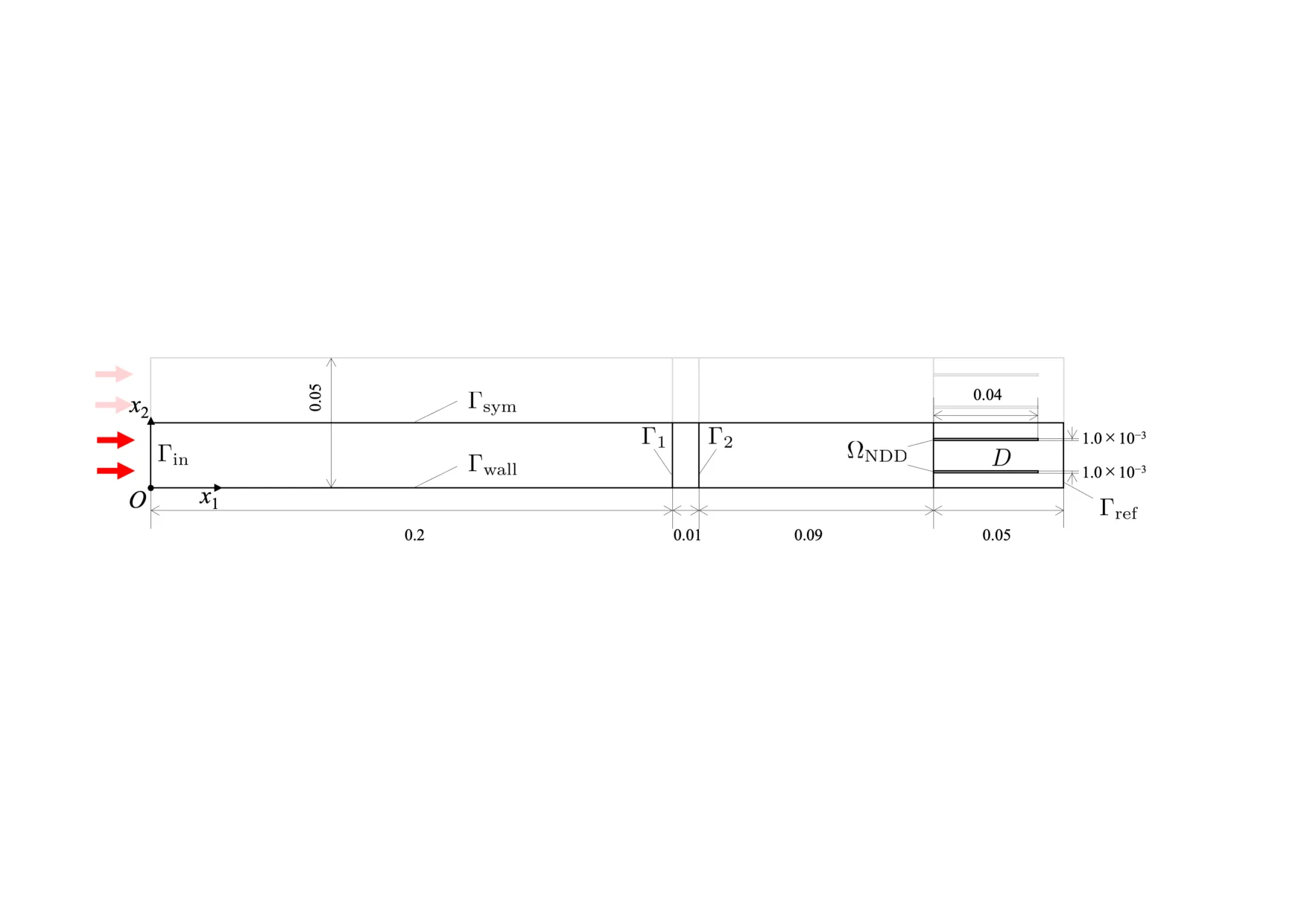
제안된 방법의 타당성을 검증하기 위해 2차원(two‑dimensional) 수치 사례(two‑dimensional numerical examples)를 다수 제시하였다. 첫 번째 사례에서는 직사각형 채널 내부에 삽입된 단순한 흡음 판(absorbing plate)을 대상으로 최적화를 수행했으며, 최적화 결과는 기존 설계에 비해 흡음 계수가 약 30 % 이상 향상되는 것을 확인하였다. 두 번째 사례에서는 다공성 매질(porous medium)과 강체 매질이 혼합된 복합 구조를 고려했으며, 점성·열 경계층이 두드러지게 작용하는 고주파 영역(high‑frequency)에서 흡음 효율이 크게 증가함을 관찰하였다.
마지막으로, 최적화된 설계가 높은 흡음 계수를 나타내게 되는 메커니즘에 대해 상세히 논의하였다. 분석 결과, 최적 설계는 점성 경계층에 의해 발생하는 에너지 손실을 극대화하도록 채널 벽면을 미세하게 울퉁불퉁하게 만들고, 동시에 열 경계층이 효과적으로 열 에너지를 흡수하도록 열 전도도가 높은 재료를 전략적으로 배치한다는 특징을 보였다. 또한, 레벨셋 기반 설계 과정에서 형성된 복잡한 기하학적 구조는 음향 파동의 다중 반사와 간섭을 유도하여 파동 에너지를 국소적으로 집중시킨 뒤, 점성·열 손실 메커니즘을 통해 빠르게 소산시키는 역할을 수행한다. 이러한 점들이 결합되어 최적화된 구조물은 넓은 주파수 대역에 걸쳐 일관된 고흡음 성능을 발휘한다는 결론에 도달하였다.
요약하면, 본 연구는 점성·열 경계층을 정밀히 모델링한 순차 선형화 나비에‑스토크스 방정식, 인접 변수법에 기반한 토폴로지 미분, 그리고 레벨셋 기반 토폴로지 최적화 기법을 통합함으로써, 복잡한 점열 효과를 고려한 고성능 흡음 구조물 설계에 새로운 해법을 제시한다. 향후 연구에서는 3차원(three‑dimensional) 구조에 대한 확장, 비선형 점성·열 효과의 포함, 그리고 실험적 검증을 통해 실제 엔지니어링 응용에 적용 가능한 설계 도구로 발전시키는 방향을 모색할 예정이다.