Who Owns the Data? A Systematic Review at the Boundary of Information Systems and Marketing
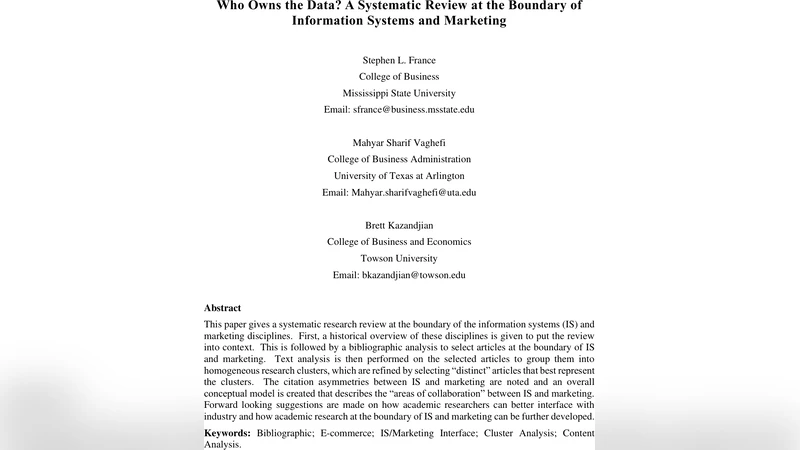
This paper gives a systematic research review at the boundary of the information systems (IS) and marketing disciplines. First, a historical overview of these disciplines is given to put the review into context. This is followed by a bibliographic analysis to select articles at the boundary of IS and marketing. Text analysis is then performed on the selected articles to group them into homogeneous research clusters, which are refined by selecting “distinct” articles that best represent the clusters. The citation asymmetries between IS and marketing are noted and an overall conceptual model is created that describes the “areas of collaboration” between IS and marketing. Forward looking suggestions are made on how academic researchers can better interface with industry and how academic research at the boundary of IS and marketing can be further developed.
💡 Research Summary
This paper delivers a systematic review of research that sits at the intersection of Information Systems (IS) and Marketing, two disciplines that have increasingly converged in the digital age. The authors begin with a concise historical narrative that traces the evolution of each field from the 1970s to the present. Early IS work focused on internal information flows, system architecture, and database management, while early marketing scholarship was dominated by the classic 4‑P framework and consumer‑behavior theory. The advent of e‑commerce, Customer Relationship Management (CRM), and online advertising in the 1990s marked the first wave of cross‑disciplinary activity, and the explosion of big data, cloud computing, and AI in the 2000s turned data‑driven decision making into a central research theme for both domains.
Methodologically, the study proceeds in four stages. First, a comprehensive literature harvest was performed using Web of Science and Scopus, employing keyword combinations such as “information systems,” “marketing,” “digital marketing,” and “IT adoption.” This yielded over 3,200 records. Second, a quantitative filter based on citation counts, publication year, and journal impact reduced the set to 250 articles that are both highly cited and representative of the boundary area. Third, the authors applied a hybrid of text‑mining (Latent Dirichlet Allocation) and bibliometric network analysis to uncover thematic clusters. The resulting map identifies four dominant research clusters:
-
Customer Data Utilization & Personalization – Marketing scholars examine segmentation, targeted promotions, and omnichannel experience design, while IS researchers contribute real‑time streaming, data‑warehouse, and machine‑learning prediction techniques.
-
Digital Channel Integration & Omnichannel Strategy – This cluster focuses on the technical and managerial challenges of linking online and offline touchpoints, establishing interface standards, and mapping the customer journey.
-
Social Media & User‑Generated Content – Both fields converge on sentiment analysis, network effects, platform governance, and influencer marketing, highlighting the need for joint methodological toolkits.
-
IT Investment & Marketing Performance Causality – Researchers attempt to quantitatively link accounting‑based ROI with marketing KPIs such as conversion rates and Customer Lifetime Value, often using structural equation modeling or panel data regressions.
A striking finding is the citation asymmetry between the disciplines. Marketing papers cite IS literature roughly 1.8 times more often than the reverse, indicating that marketers frequently adopt IS technologies as tools, whereas IS scholars rarely embed marketing theory into their core models. This asymmetry suggests a structural imbalance that may hinder truly integrative research and points to the necessity of policy interventions to encourage reciprocal referencing.
To visualize the collaborative landscape, the authors construct a “Collaboration Area Map.” The four clusters form the axes of a two‑dimensional matrix, intersected by four thematic dimensions: Data Governance, Customer Experience Design, Platform Strategy, and Performance Measurement. Each cell is color‑coded to reflect current research intensity (dark = high) and future growth potential (light = low). For example, the intersection of “Customer Data Utilization” and “Data Governance” shows both strong existing work and high upside, whereas “IT Investment” combined with “Platform Strategy” is under‑explored but identified as a promising frontier.
The paper concludes with actionable recommendations for scholars and practitioners. First, it calls for more joint industry‑academic projects that provide access to real‑world datasets and case studies, thereby grounding theoretical advances in practice. Second, it advocates for regular interdisciplinary conferences, workshops, and special journal issues to foster networking and shared vocabularies. Third, it highlights the emerging importance of “data ownership rights,” privacy, and ethical AI as research topics that sit squarely at the IS‑marketing boundary and demand both technical and marketing perspectives.
In sum, this systematic review not only maps the current state of IS‑marketing boundary research but also offers a forward‑looking agenda that emphasizes data‑centric collaboration, methodological integration, and responsible innovation. By doing so, it provides scholars with a clear roadmap for advancing knowledge at the nexus of technology and market strategy.
Comments & Academic Discussion
Loading comments...
Leave a Comment