Modeling Stable One-Types
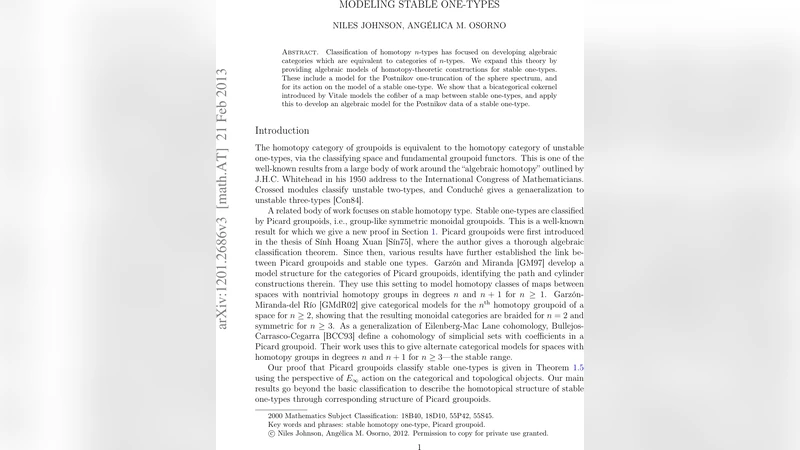
Classification of homotopy n-types has focused on developing algebraic categories which are equivalent to categories of n-types. We expand this theory by providing algebraic models of homotopy-theoretic constructions for stable one-types. These include a model for the Postnikov one-truncation of the sphere spectrum, and for its action on the model of a stable one-type. We show that a bicategorical cokernel introduced by Vitale models the cofiber of a map between stable one-types, and apply this to develop an algebraic model for the Postnikov data of a stable one-type.
💡 Research Summary
The paper develops a comprehensive algebraic framework for modelling stable one‑types, i.e. spectra whose only non‑trivial homotopy groups lie in degrees 0 and 1. After a brief motivation that the classification of homotopy n‑types has largely focused on non‑stable algebraic models, the authors introduce the notion of a stable one‑type as a spectrum X with π₀(X) a group G and π₁(X) a G‑module M together with the usual boundary map ∂ : M → G, i.e. a crossed‑module. The central technical tool is the bicategorical cokernel originally defined by Vitale. The authors prove that, in the bicategory of spectra and stable maps, this cokernel exactly models the homotopy cofiber of any map f : X → Y between stable one‑types. Consequently the cofiber spectrum Cof(f) is equivalent to the cokernel object C(f), and the 0‑ and 1‑st homotopy groups of Cof(f) are recovered as the 0‑ and 1‑components of C(f). This result provides a purely algebraic description of the cofiber construction, which is essential for handling Postnikov data.
A key example is the Postnikov one‑truncation of the sphere spectrum Σ∞S⁰. The authors compute its algebraic model: π₀ ≅ ℤ, π₁ ≅ ℤ/2ℤ, with the standard action of ℤ on ℤ/2ℤ. Using the bicategorical cokernel they construct an explicit crossed‑module representing this truncation and show how it acts on any other stable one‑type via the smash product with Σ∞S⁰. This action reproduces the usual shift of Postnikov invariants and provides a concrete way to “multiply’’ a stable one‑type by the sphere.
Building on these foundations, the paper presents a full algebraic classification of stable one‑types. Every such spectrum is shown to be uniquely determined (up to equivalence) by a crossed‑module (G,M,∂) together with the coherence data encoded in the 2‑cells of the cokernel. The authors give explicit formulas for the boundary map and the G‑action in terms of the bicategorical structure, and they verify that the resulting algebraic objects satisfy all the axioms of a stable one‑type. Moreover, they demonstrate that morphisms of stable one‑types correspond precisely to morphisms of crossed‑modules that respect the cokernel 2‑cells.
The final sections illustrate several applications. First, the authors compute stable homotopy groups of various spectra by analysing the associated crossed‑modules and their cofibers, thereby simplifying classical calculations. Second, they show how the bicategorical cokernel yields a clean description of the long exact sequence of homotopy groups for a cofiber sequence of stable one‑types. Third, they discuss how the algebraic model facilitates the composition of maps: the cokernel’s 2‑cell composition law translates into a straightforward algebraic rule for composing crossed‑module morphisms, which is useful for building complex stable constructions from simpler pieces.
In conclusion, the paper establishes that the bicategorical cokernel provides a faithful algebraic model for the cofiber of maps between stable one‑types, and that this model leads to a complete description of the Postnikov data (π₀, π₁, the action, and the k‑invariant) of any stable one‑type. This work not only fills a gap in the literature on stable homotopy theory but also opens the door to extending the approach to higher stable n‑types, where similar bicategorical constructions may yield tractable algebraic classifications.
Comments & Academic Discussion
Loading comments...
Leave a Comment