Which is the ontology of Dark Matter and Dark Energy?
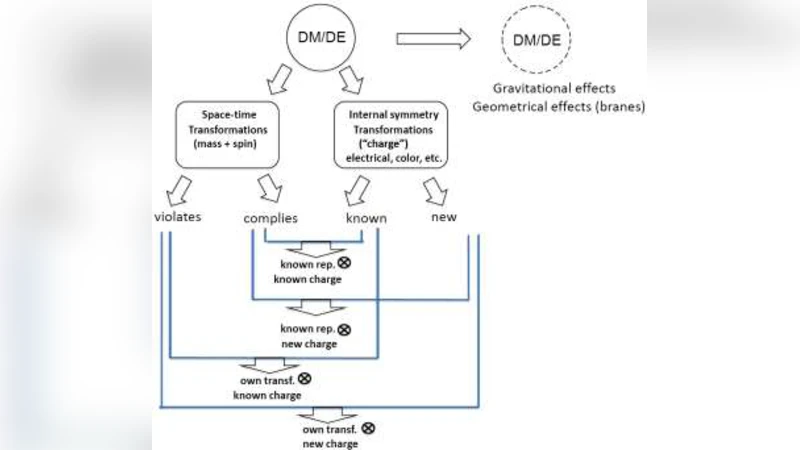
We adopt in this work the idea that the building blocks of the visible Universe belong to a class of the irreducible representations of the Poincare group of transformations (the “things”) endowed with classificatory quantum numbers (“the properties”). After a discussion of this fundamentality, the question of the nature of both “dark” components of the Universe which are deemed necessary, but have not been observed, is analyzed within this context. We broadly discuss the ontology of dark matter/dark energy in relation to the irreducible representations of the Poincaré group + quantum numbers, pointing out some cases in which the candidates can be associated to them, and others for which a reclassification of both the dark and visible (ordinary) components would be needed.
💡 Research Summary
The paper begins by reaffirming a widely accepted principle in modern theoretical physics: every elementary constituent of the visible universe can be described as an irreducible representation (irrep) of the Poincaré group, equipped with a set of quantum numbers that label its intrinsic properties such as mass, spin, and charge. In this view, the “thing” is the mathematical representation itself, while the “property” is the collection of quantum numbers that uniquely identify a particle within that representation. This framework underlies the Standard Model and provides a unified language for classifying all known particles and their interactions.
Having established this foundation, the authors turn to the two “dark” components that dominate the cosmic energy budget—dark matter (DM) and dark energy (DE)—and ask how they can be accommodated within the same representation‑theoretic scheme. They propose two complementary strategies.
The first strategy is an extension of the existing irrep catalogue. By introducing new quantum numbers (for example, a hidden gauge charge, a sterile neutrino number, or a non‑standard mass parameter) or by allowing previously forbidden values of existing quantum numbers, one can embed many of the popular DM candidates into the Poincaré classification. A scalar irrep with an added hidden charge can host axion‑like particles; a spin‑½ irrep with a sterile lepton number can accommodate sterile neutrinos; a vector irrep with a modified mass term can describe weakly interacting massive particles (WIMPs). In this picture, DM remains a particle in the traditional sense, but its quantum numbers lie outside the range probed by current collider or direct‑detection experiments, making indirect astrophysical observations the primary testing ground.
The second strategy is more radical: it calls for a re‑interpretation or “re‑classification” of both visible and dark sectors. Here the authors keep the Poincaré irreps unchanged but alter the physical meaning assigned to the quantum numbers. For instance, the vacuum expectation value of a scalar field—mathematically a scalar irrep—can be identified with the cosmological constant or a dynamical quintessence field, thereby providing a representation‑theoretic home for dark energy. Similarly, anomalous galactic rotation curves and cluster mass profiles could be modeled as a non‑standard mass‑transfer phenomenon within existing irreps, effectively treating a portion of ordinary matter as “dark” because its mass appears in a hidden sector of the representation space. This approach preserves the elegance of the original symmetry structure while offering a phenomenological bridge to the dark sector.
The authors carefully weigh the pros and cons of each approach. The extension method retains experimental testability but risks over‑parameterization: each new quantum number adds a degree of freedom that must be justified both theoretically and observationally. Moreover, the physical reality of such hidden quantum numbers remains speculative. The re‑classification method avoids proliferating new parameters and stays within the well‑tested Poincaré framework, but it raises conceptual questions about what it means to “re‑label” a particle’s properties without introducing new dynamical entities. In particular, interpreting vacuum energy as dark energy does not automatically solve the fine‑tuning problem associated with the cosmological constant.
In conclusion, the paper argues that the ontology of dark matter and dark energy can indeed be expressed within the language of Poincaré irreducible representations, but doing so forces a choice between (1) expanding the quantum‑number space to accommodate new particle candidates, or (2) redefining the physical interpretation of existing quantum numbers to encompass the dark sector. Both routes demand rigorous theoretical development and decisive experimental or observational validation. The work thus frames a central question for fundamental physics: whether the universe’s hidden mass‑energy components are truly new irreps awaiting discovery, or whether they are already encoded in the known representation structure, awaiting a reinterpretation of their quantum numbers.