A Incidência Final dos Tributos Indiretos no Brasil: Estimativa Usando a Matriz de Insumo-Produto 2015
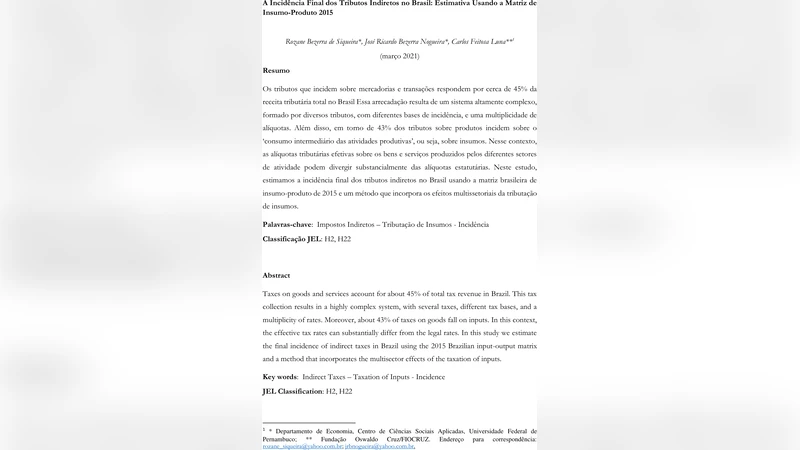
Taxes on goods and services account for about 45% of total tax revenue in Brazil. This tax collection results in a highly complex system, with several taxes, different tax bases, and a multiplicity of rates. Moreover, about 43% of taxes on goods fall on inputs. In this context, the effective tax rates can substantially differ from the legal rates. In this study we estimate the final incidence of indirect taxes in Brazil using the 2015 Brazilian input-output matrix and a method that incorporates the multisector effects of the taxation of inputs.
💡 Research Summary
This paper investigates the final incidence of indirect taxes on goods and services in Brazil by employing the 2015 Brazilian Input‑Output (I‑O) matrix and a methodological framework that captures the multisectoral effects of input taxation. The authors begin by highlighting the extraordinary complexity of Brazil’s tax system: indirect taxes represent roughly 45 % of total tax revenue, and about 43 % of those taxes are levied on intermediate inputs rather than final consumption. While most existing literature focuses on statutory tax rates and aggregate revenue, it largely ignores how input taxes cascade through production networks and ultimately affect end‑consumers.
To address this gap, the study utilizes the 2015 I‑O table, which details inter‑industry flows across 86 sectors, together with sector‑specific statutory rates for federal, state, and municipal indirect taxes. The authors construct a “tax incidence matrix” that maps the statutory rate applied to each intermediate input, and then apply the Leontief inverse (L⁻¹) to trace how a unit of final demand in any sector propagates through the economy, accumulating tax burdens at each stage. By comparing the statutory rates with the effective rates derived from the Leontief analysis, the paper quantifies the divergence between legal and actual tax burdens.
The empirical results reveal several key patterns. First, effective final‑burden rates systematically exceed statutory rates. For sectors with a nominal 10 % tax rate, the average effective rate is about 13.2 %, with some manufacturing subsectors reaching above 15 %. This upward shift is driven by the accumulation of input taxes across multiple production stages. Second, the magnitude of the tax pass‑through varies markedly across sectors. Industries with high intermediate‑input intensity—such as manufacturing and wholesale trade—experience larger pass‑through effects, whereas service‑oriented sectors exhibit relatively modest increases. Third, although the analysis assumes perfect competition, the authors acknowledge that price rigidity, market power, and the sizable informal economy in Brazil likely amplify or dampen the observed pass‑through in practice.
From a policy perspective, the findings caution against tax reforms that ignore the input‑tax component. Reducing input taxes on essential goods—those disproportionately consumed by low‑income households—could improve vertical equity without sacrificing revenue, as the current structure imposes a hidden burden on final consumers through the production chain. The paper also suggests that future work should integrate dynamic general‑equilibrium models to assess long‑run effects on investment, productivity, and welfare, and that updated I‑O tables (post‑2015) should be incorporated to capture recent tax changes, such as the 2022 value‑added tax adjustments.
Limitations include reliance on a single year’s I‑O data, which may not reflect subsequent fiscal reforms, and the perfect‑competition assumption, which may understate the role of market imperfections. The authors propose extending the framework with firm‑level margin data and scenario‑based simulations to provide policymakers with a more granular tool for evaluating tax policy impacts. Overall, the study makes a substantive contribution by quantifying the hidden incidence of Brazil’s indirect tax system and offering actionable insights for more equitable and efficient tax design.
Comments & Academic Discussion
Loading comments...
Leave a Comment