Effect of Input-output Randomness on Gameplay Satisfaction in Collectable Card Games
Randomness is an important factor in games, so much so that some games rely almost purely on it for its outcomes and increase players’ engagement with them. However, randomness can affect the game experience depending on when it occurs in a game, altering the chances of planning for a player. In this paper, we refer to it as “input-output randomness”. Input-output randomness is a cornerstone of collectable card games like Hearthstone, in which cards are drawn randomly (input randomness) and have random effects when played (output randomness). While the topic might have been commonly discussed by game designers and be present in many games, few empirical studies have been performed to evaluate the effects of these different kinds of randomness on the players’ satisfaction. This research investigates the effects of input-output randomness on collectable card games across four input-output randomness conditions. We have developed our own collectable card game and experimented with the different kinds of randomness with the game. Our results suggest that input randomness can significantly impact game satisfaction negatively. Overall, our results present helpful considerations on how and when to apply randomness in game design when aiming for players’ satisfaction.
💡 Research Summary
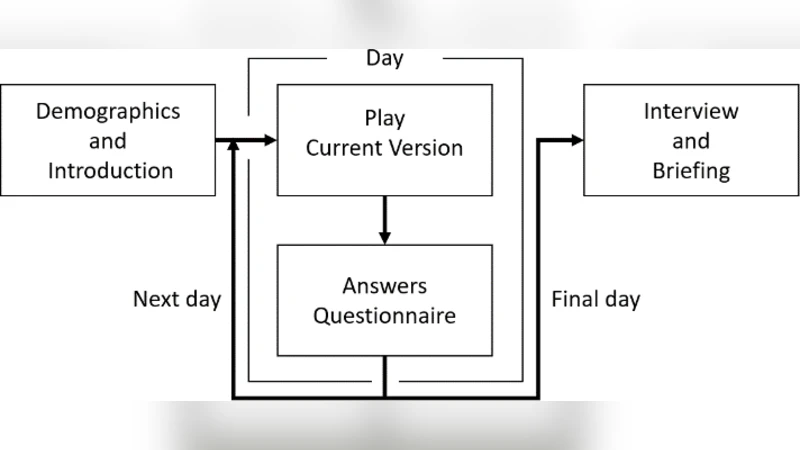
The paper investigates how two distinct forms of randomness—input randomness (the random drawing of cards) and output randomness (the random effects of cards when played)—affect player satisfaction in collectible card games (CCGs). To obtain controlled experimental data, the authors built a simplified CCG prototype that allows independent toggling of input and output randomness. Four experimental conditions were created: (1) deterministic gameplay with neither form of randomness, (2) only input randomness active, (3) only output randomness active, and (4) both forms active, which mirrors typical CCGs. Over 200 participants per condition played ten rounds each, after which they completed a questionnaire measuring five satisfaction dimensions: desire to replay, sense of strategic control, enjoyment, immersion, and stress. The authors applied one‑way ANOVA and Tukey post‑hoc tests to compare conditions, and they supplemented quantitative results with short post‑play interviews.
The results show a clear pattern: any presence of input randomness significantly lowers satisfaction scores, especially the desire to replay and perceived strategic control (p < .01). Condition 2 (input only) performed almost as poorly as condition 4 (both random), indicating that the mere uncertainty of the hand outweighs any excitement generated by random card effects. In contrast, condition 3 (output only) produced satisfaction levels statistically indistinguishable from the fully deterministic baseline. Qualitative feedback confirms that players attribute frustration primarily to “unexpected draws” that disrupt planning, whereas random card effects are viewed as a source of occasional excitement when they do not interfere with hand certainty.
From a design perspective, the study suggests that input randomness should be limited or mitigated. Possible strategies include restricting random draws to early game phases, providing draw‑compensation mechanisms (e.g., “choose one of two cards” or guaranteed draws after a certain number of turns), or allowing players to exchange cards. Output randomness, when bounded (e.g., low‑probability triggers, effects with limited variance), can add variability and surprise without harming overall satisfaction. The authors argue that a balanced combination—minimal hand‑level randomness paired with controlled effect‑level randomness—optimizes player enjoyment in CCGs.
The paper contributes empirical evidence to a topic that has largely been discussed anecdotally among game designers. By isolating the two randomness dimensions and measuring their separate impacts, it provides concrete guidance for designers seeking to harness randomness for engagement while preserving the strategic depth that players value. Future work is proposed to explore how these findings generalize across different game genres, player skill levels, and long‑term retention metrics.