Fractal Topology Foundations
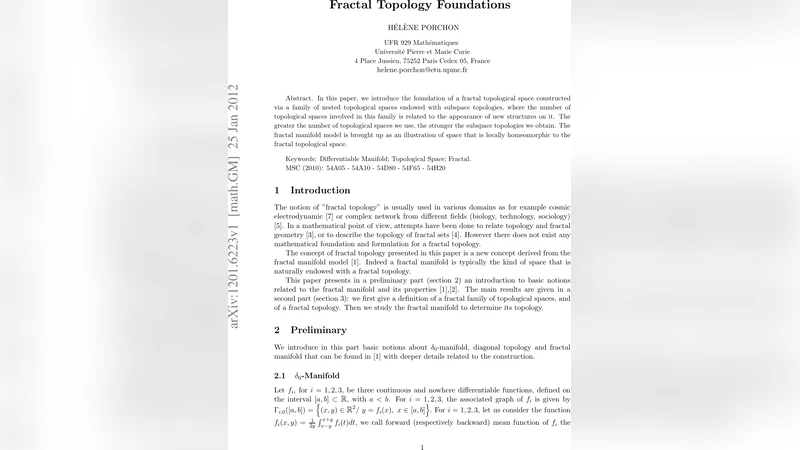
In this paper, we introduce the foundation of a fractal topological space constructed via a family of nested topological spaces endowed with subspace topologies, where the number of topological spaces involved in this family is related to the appearance of new structures on it. The greater the number of topological spaces we use, the stronger the subspace topologies we obtain. The fractal manifold model is brought up as an illustration of space that is locally homeomorphic to the fractal topological space.
💡 Research Summary
The paper introduces a novel construction called a “fractal topological space” by iteratively nesting a countable family of topological spaces, each endowed with the subspace topology inherited from the previous one. The authors begin by recalling the standard notion of subspace topology: given a space (X) and a subset (A\subset X), the topology on (A) consists of intersections of open sets of (X) with (A). They then consider a sequence ({X_i}{i\in\mathbb{N}}) satisfying (X_1\subset X_2\subset\cdots). For each inclusion, the topology (\tau{i+1}) on (X_{i+1}) refines (\tau_i) by adding new open sets while preserving all the old ones. In this way the family produces a hierarchy of increasingly fine topologies; the “strength” of a topology is measured by the cardinality of its open‑set family, which grows with the number of spaces in the sequence.
The central definition states that the fractal topological space (F) is the direct limit of the system ((X_i,\tau_i)). Formally, \