Evolution of interdependent co-authorship and citation networks
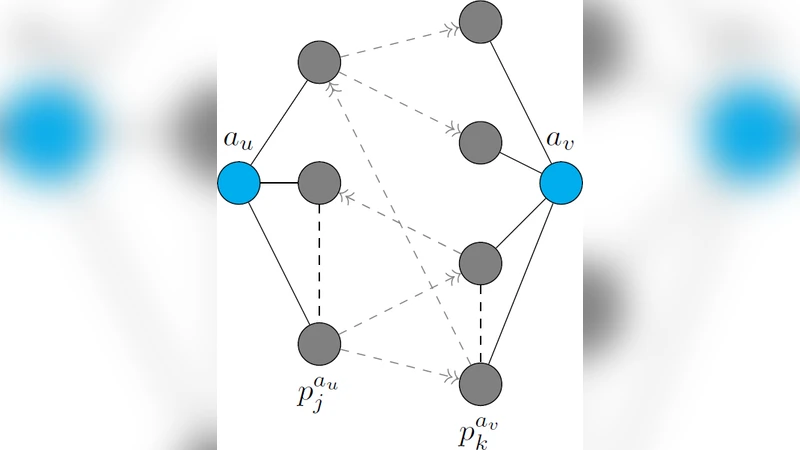
Studies of bibliographic data suggest a strong correlation between the growth of citation networks and their corresponding co-authorship networks. We explore the interdependence between evolving citation and co-authorship networks focused on the publications, by Indian authors, in American Physical Society journals between 1970 and 2013. We record interactions between each possible pair of authors in two ways: first, by tracing the change in citations they exchanged and, second, by tracing the shortest path between authors in the co-authorship network. We create these data for every year of the period of our analysis. We use probability methods to quantify the correlation between citations and shortest paths, and the effect on the dynamics of the citation-co-authorship system. We find that author pairs who have a co-authorship distance $d \leq 3$ significantly affect each others citations, but that this effect falls off rapidly for longer distances in the co-authorship network. The exchange of citation between pairs with $d=1$ exhibits a sudden increase at the time of first co-authorship events and decays thereafter, indicating an aging effect in collaboration. This suggests that the dynamics of the co-authorship network appear to be driving those of the citation network rather than vice versa. Moreover, the majority of citations received by most authors are due to reciprocal citations from current, or past, co-authors. We conclude that, in order to answer questions on nature and dynamics of scientific collaboration, it is necessary to study both co-authorship and citation network simultaneously.
💡 Research Summary
**
The paper investigates the mutual dependence between evolving citation and co‑authorship networks using a longitudinal dataset of publications by Indian researchers in the American Physical Society (APS) journals from 1970 to 2013. After disambiguating author names, the authors identify 8,084 unique Indian scientists and construct, for each year, a cumulative bipartite graph linking authors to papers. From this bipartite representation they derive two projected networks: (i) an undirected, weighted co‑authorship network and (ii) a directed citation network. Both networks are represented by $N\times N$ matrices—$D(t)$ for shortest‑path distances $d_{ij}(t)$ in the co‑authorship graph and $C(t)$ for cumulative citation counts $c_{ij}(t)$ from author $j$ to author $i$ up to year $t$.
The authors formulate a set of research questions concerning (1) the proportion of author pairs that exchange citations without ever co‑authoring, (2) how citations are exchanged among co‑authors, (3) how these patterns vary with network distance, (4) whether receiving a citation influences the likelihood of forming a new co‑authorship, (5) the functional relationship between citation probability and distance, and (6) the waiting‑time distributions for successive co‑authorship and co‑citation events.
To answer these, they compute, for each year, the fraction of pairs with $c_{ij}+c_{ji}>0$ for each distance class $d=0,1,2,3,\dots$. They compare empirical frequencies with a null model generated by randomizing edges while preserving the degree sequence (a configuration‑model style randomization). Statistical tests reveal a strong positive correlation for distances $d\le3$, with the effect dropping sharply beyond $d=3$. In particular, for $d=1$ the probability that a pair exchanges at least one citation is roughly 27 %, compared with 12 % for $d=2$, 6 % for $d=3$, and less than 2 % for larger distances.
A key contribution is the temporal analysis of citation dynamics around the first joint publication of a pair (the “first co‑authorship” year $T_c$). By aligning all pairs so that $T_c=0$, the authors show a pronounced citation “burst” at $T_c$, followed by an exponential decay with a characteristic time of about 2–3 years. This aging effect indicates that collaboration immediately raises the visibility of the partners, but the influence wanes over time.
Conversely, the authors examine whether receiving a citation makes a new co‑authorship more likely. They find that after a citation event, the probability of forming a new co‑authorship within the next two years is higher for pairs that are already within two or three hops in the co‑authorship graph (≈9 % for $d=2$, ≈5 % for $d=3$) than for more distant pairs, suggesting a bidirectional feedback loop.
Aggregating citation counts per author, the study discovers that about 68 % of all citations received by an author come from current or former co‑authors, underscoring the dominance of reciprocal citations within collaborative circles. This finding challenges the view of citations as a purely independent measure of scholarly impact.
The authors conclude that the structure and dynamics of the co‑authorship network drive those of the citation network rather than the reverse. They argue that any robust assessment of scientific productivity or policy design must consider both networks simultaneously, incorporating measures of network distance, clustering, and temporal aging. Future work is suggested to extend the analysis across disciplines, to include international collaborations, and to develop more sophisticated models that embed aging kernels directly into citation‑growth mechanisms.
Comments & Academic Discussion
Loading comments...
Leave a Comment