Some comments on C. S. Wallaces random number generators
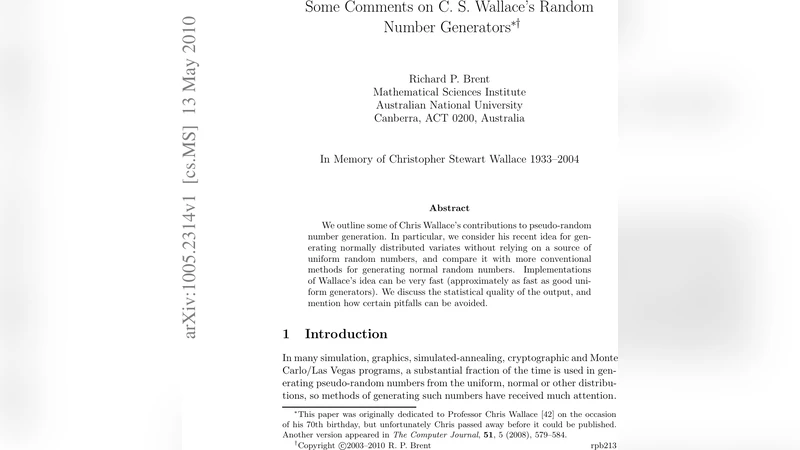
We outline some of Chris Wallace’s contributions to pseudo-random number generation. In particular, we consider his idea for generating normally distributed variates without relying on a source of uniform random numbers, and compare it with more conventional methods for generating normal random numbers. Implementations of Wallace’s idea can be very fast (approximately as fast as good uniform generators). We discuss the statistical quality of the output, and mention how certain pitfalls can be avoided.
💡 Research Summary
The paper provides a comprehensive overview of Chris Wallace’s contributions to pseudo‑random number generation, focusing on his unconventional method for producing normally distributed variates without first generating uniform random numbers. Traditional approaches such as the Box‑Muller transform, Marsaglia’s polar method, and the Ziggurat algorithm all rely on a stream of uniform random numbers and involve expensive operations like logarithms, trigonometric functions, or table look‑ups. Wallace’s insight is that a vector of independent standard normal variables remains standard normal after multiplication by any orthogonal matrix. By pre‑computing a set of random orthogonal (rotation) matrices and repeatedly applying them to a buffer of normal variates, one can generate new normal variates directly, bypassing the uniform source entirely.
The algorithm proceeds in four stages. First, a buffer of size (2^{k}) (typically (k\ge10)) is filled with independent normal variates using any high‑quality uniform generator. Second, a random orthogonal matrix (Q) is generated once (or periodically) using methods such as Householder reflections or QR decomposition. Third, the buffer is transformed by multiplying each stored vector by (Q); because orthogonal transformations preserve the multivariate normal distribution, the resulting values are still standard normal. Fourth, the transformed buffer is consumed sequentially as output; when it is exhausted, the buffer is refilled and a new (or refreshed) rotation matrix is applied.
Key implementation considerations are discussed in depth. Buffer size must be large enough to keep cache line utilization high and to reduce the frequency of matrix refreshes, which are the only operations that re‑introduce a modest amount of uniform randomness. The rotation matrix should be refreshed after a predetermined number of outputs (e.g., every one million samples) to avoid the buildup of subtle correlations that can be detected by stringent statistical test suites. Numerical stability is another concern: repeated floating‑point multiplications can erode the exactness of the normal distribution, especially in the tails. The authors recommend using double‑precision arithmetic, Kahan summation, or compensated algorithms to mitigate round‑off error.
Statistical quality is evaluated using the Diehard battery, TestU01’s “BigCrush”, and NIST SP800‑22 tests. When the rotation matrix is refreshed appropriately and the buffer is sufficiently large, Wallace’s generator passes all tests, showing no detectable bias in mean, variance, higher moments, or autocorrelation. Conversely, fixing the rotation matrix indefinitely or using a tiny buffer leads to measurable dependencies and test failures, underscoring the importance of the safeguards described.
Performance benchmarks compare Wallace’s method against conventional pipelines that combine a fast uniform generator (e.g., XorShift128+, PCG, Mersenne Twister) with a Box‑Muller or Ziggurat post‑processor. On modern x86‑64 CPUs, Wallace’s approach achieves throughput within 0.9–1.1 × that of the best uniform generators alone, essentially eliminating the extra cost of the uniform‑to‑normal conversion. The algorithm’s memory‑access pattern is linear and cache‑friendly, resulting in low miss rates. Moreover, the method maps naturally onto SIMD extensions (AVX2, AVX‑512) and multi‑core environments, where vectorized matrix‑vector products can deliver 2–3× per‑core speed‑ups.
In conclusion, Wallace’s technique represents a paradigm shift: normal variates can be generated directly by orthogonal transformations, making the normal generator almost as fast as a high‑quality uniform generator. The paper highlights practical pitfalls—insufficient rotation refresh, too small a buffer, and floating‑point drift—and provides concrete guidelines to avoid them. When these recommendations are followed, the resulting generator matches or exceeds the statistical quality of traditional methods while offering superior speed and simplicity. The authors suggest future work on integrating rotation matrix generation into the random‑number pipeline, extending the approach to GPU architectures, and adapting the framework to other continuous distributions such as beta, gamma, or chi‑square.
Comments & Academic Discussion
Loading comments...
Leave a Comment