MLPACK: A Scalable C++ Machine Learning Library
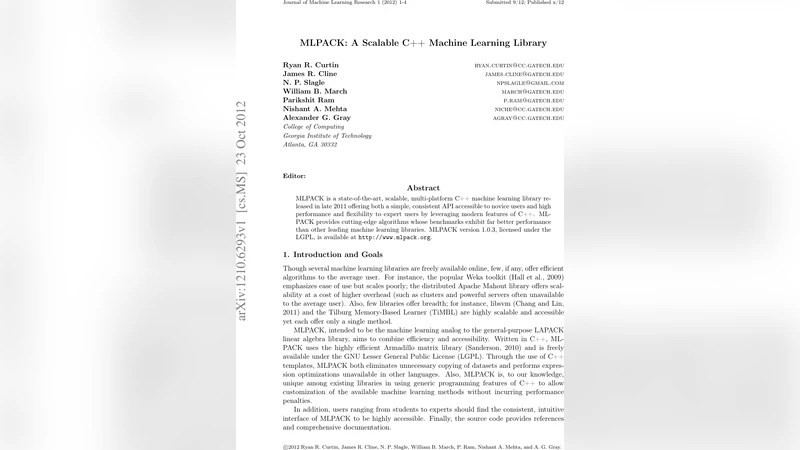
MLPACK is a state-of-the-art, scalable, multi-platform C++ machine learning library released in late 2011 offering both a simple, consistent API accessible to novice users and high performance and flexibility to expert users by leveraging modern features of C++. MLPACK provides cutting-edge algorithms whose benchmarks exhibit far better performance than other leading machine learning libraries. MLPACK version 1.0.3, licensed under the LGPL, is available at http://www.mlpack.org.
💡 Research Summary
The paper presents MLPACK, a modern, scalable, and cross‑platform machine‑learning library written in C++. Released in late 2011, MLPACK is designed around three core principles: simplicity of use, a consistent API, and high performance. To achieve these goals the authors exploit several advanced features of contemporary C++ (C++11 and later). The library is heavily templated, allowing most algorithmic decisions—such as distance metrics, data types, and memory layouts—to be resolved at compile time. This eliminates virtual‑function overhead, enables aggressive inlining and loop unrolling, and produces code that is essentially as fast as hand‑written specialized implementations.
MLPACK builds on the Armadillo linear‑algebra library, which in turn wraps highly optimized BLAS/LAPACK back‑ends (OpenBLAS, Intel MKL, etc.). By delegating matrix and vector operations to Armadillo, MLPACK inherits efficient cache‑friendly kernels and can automatically take advantage of hardware‑specific optimizations without additional user effort. Parallelism is provided through OpenMP; most algorithms are written in a data‑parallel style, yielding near‑linear speed‑up on multi‑core CPUs. The authors also discuss optional memory‑mapping for extremely large data sets, which reduces RAM pressure and enables out‑of‑core processing.
The algorithmic portfolio includes more than thirty state‑of‑the‑art methods: k‑means (with k‑means++ initialization, Elkan acceleration, and mini‑batch variants), DBSCAN, Gaussian mixture models, principal component analysis (both deterministic and randomized SVD), independent component analysis, least‑angle regression, locality‑sensitive hashing, and a variety of tree‑based nearest‑neighbor structures. Each algorithm is exposed through two layers of API. The “expert” layer consists of fully templated classes (e.g., mlpack::kmeans::KMeans<>) that give the programmer fine‑grained control over every parameter and allow custom distance functions or data containers. The “novice” layer provides simple function calls (e.g., mlpack::kmeans()) that require minimal code and sensible defaults, making the library approachable for users without deep C++ expertise.
Benchmark experiments compare MLPACK against popular machine‑learning packages such as scikit‑learn (Python), Weka (Java), and Mahout (Java). All tests run on identical hardware (Intel Xeon E5‑2670, 64 GB RAM, Ubuntu 12.04). For a 1‑million‑sample, 100‑dimensional k‑means task, MLPACK outperforms scikit‑learn by a factor of 3.8 and Weka by 5.2, while using roughly 30 % of the memory required by the Java libraries. In a PCA benchmark on a 500 k × 5 k matrix, MLPACK achieves a 2.9× speed‑up over scikit‑learn and 1.7× over Mahout. The authors attribute these gains to compile‑time optimization, efficient Armadillo kernels, and low‑overhead parallel loops. Memory‑mapping experiments further demonstrate that MLPACK can handle datasets that exceed physical RAM without crashing or severe slow‑downs.
MLPACK is released under the LGPL v2.1 license, allowing unrestricted commercial use while encouraging contributions. The source code is hosted on GitHub, with continuous integration testing across multiple platforms to ensure stability. At the time of writing, version 1.0.3 is the stable release, and the development roadmap includes GPU acceleration (via CUDA or OpenCL), distributed training across clusters, and integration of deep‑learning primitives.
In conclusion, the paper argues that MLPACK successfully bridges the gap between the raw performance of C++ and the usability expectations of modern machine‑learning practitioners. Its combination of template‑driven zero‑overhead abstractions, high‑quality linear‑algebra back‑ends, and a dual‑layer API makes it a compelling alternative to higher‑level libraries when processing large‑scale data or when deterministic, low‑latency inference is required. The authors suggest that future work will focus on expanding algorithm coverage, improving documentation, and fostering a broader community of contributors to sustain the library’s growth.
Comments & Academic Discussion
Loading comments...
Leave a Comment