Efficient Computation of N -point Correlation Functions in D Dimensions
📝 Abstract
We present efficient algorithms for computing the $N $-point correlation functions (NPCFs) of random fields in arbitrary $D $-dimensional homogeneous and isotropic spaces. Such statistics appear throughout the physical sciences, and provide a natural tool to describe stochastic processes. algorithms for computing the NPCF components have $\mathcal{O}(n^N)$ complexity (for a data set containing $n$ particles); their application is thus computationally infeasible unless $N$ is small. By projecting the statistic onto a suitably-defined angular basis, we show that the estimators can be written in a separable form, with complexity $\mathcal{O}(n^2) $, or $\mathcal{O}(n_{\rm g}\log n_{\rm g})$ if evaluated using a Fast Fourier Transform on a grid of size $n_{\rm g} $. Our decomposition is built upon the $D $-dimensional hyperspherical harmonics; these form a complete basis on the $(D-1) $-sphere and are intrinsically related to angular momentum operators. Concatenation of $(N-1)$ such harmonics gives states of definite combined angular momentum, forming a natural separable basis for the NPCF. As $N$ and $D$ grow, the number of basis components quickly becomes large, providing a practical limitation to this (and all other) approaches: however, the dimensionality is greatly reduced in the presence of symmetries; for example, isotropic correlation functions require only states of zero combined angular momentum. We provide a \textsc{Julia} package implementing our estimators, and show how they can be applied to a variety of scenarios within cosmology and fluid dynamics. The efficiency of such estimators will allow higher-order correlators to become a standard tool in the analysis of random fields.
💡 Analysis
We present efficient algorithms for computing the $N $-point correlation functions (NPCFs) of random fields in arbitrary $D $-dimensional homogeneous and isotropic spaces. Such statistics appear throughout the physical sciences, and provide a natural tool to describe stochastic processes. algorithms for computing the NPCF components have $\mathcal{O}(n^N)$ complexity (for a data set containing $n$ particles); their application is thus computationally infeasible unless $N$ is small. By projecting the statistic onto a suitably-defined angular basis, we show that the estimators can be written in a separable form, with complexity $\mathcal{O}(n^2) $, or $\mathcal{O}(n_{\rm g}\log n_{\rm g})$ if evaluated using a Fast Fourier Transform on a grid of size $n_{\rm g} $. Our decomposition is built upon the $D $-dimensional hyperspherical harmonics; these form a complete basis on the $(D-1) $-sphere and are intrinsically related to angular momentum operators. Concatenation of $(N-1)$ such harmonics gives states of definite combined angular momentum, forming a natural separable basis for the NPCF. As $N$ and $D$ grow, the number of basis components quickly becomes large, providing a practical limitation to this (and all other) approaches: however, the dimensionality is greatly reduced in the presence of symmetries; for example, isotropic correlation functions require only states of zero combined angular momentum. We provide a \textsc{Julia} package implementing our estimators, and show how they can be applied to a variety of scenarios within cosmology and fluid dynamics. The efficiency of such estimators will allow higher-order correlators to become a standard tool in the analysis of random fields.
📄 Content
우리는 임의의 $D$ 차원 균질·등방성 공간에서 무작위 장(random fields)의 $N $‑점 상관함수(N‑point correlation functions, 이하 NPCF)를 효율적으로 계산할 수 있는 알고리즘을 제시한다. 이러한 통계량은 물리학 전반에 걸쳐 나타나며, 확률적 과정을 기술하는 자연스러운 도구가 된다. 기존에 NPCF의 각 성분을 직접 계산하는 알고리즘은 데이터 집합에 포함된 입자 수를 $n $이라고 할 때 $\mathcal{O}(n^{N}) $의 계산 복잡도를 가진다. 따라서 $N $이 작지 않은 경우에는 계산 비용이 급격히 증가하여 실용적으로 사용하기 어렵다.
우리는 통계량을 적절히 정의된 각도 기반(angular basis) 위에 투영(projection)함으로써, 추정량(estimator)을 분리 가능한 형태(separable form) 로 표현할 수 있음을 보인다. 이때 계산 복잡도는 $\mathcal{O}(n^{2})$ 로 크게 감소한다. 더 나아가, 격자(grid) 상에 $n_{\rm g}$ 개의 점을 두고 Fast Fourier Transform(FFT)을 이용해 평가하면 $\mathcal{O}(n_{\rm g}\log n_{\rm g})$ 의 복잡도로 계산이 가능하다.
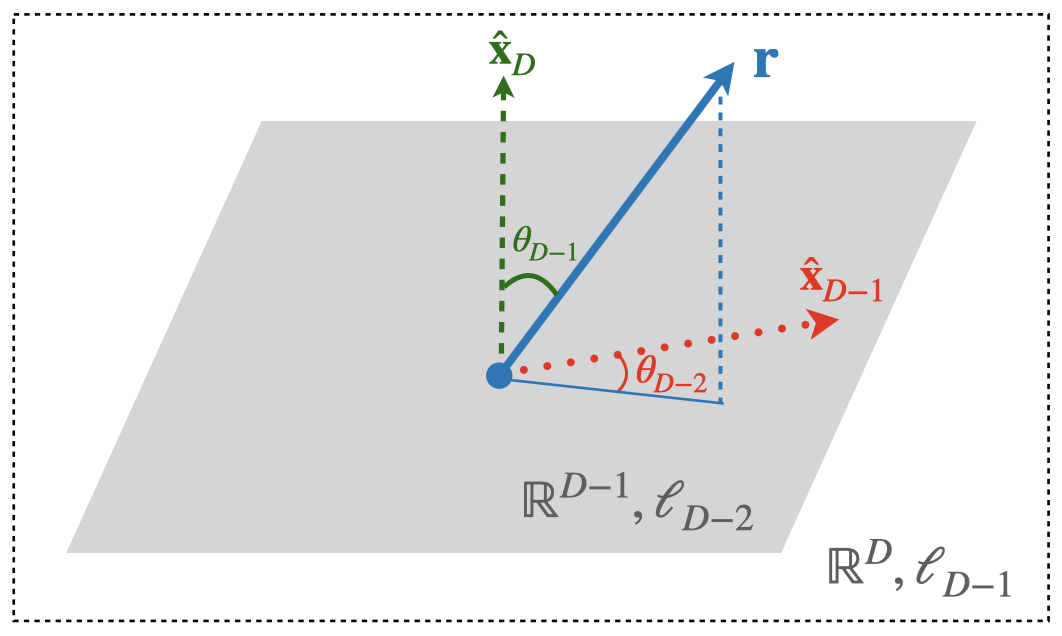
우리의 분해는 $D$ 차원 초구조조화함수(hyperspherical harmonics) 를 기반으로 한다. 초구조조화함수는 $(D-1) $‑구면 $(D-1) $‑sphere 위에서 완전한 기저(basis)를 이루며, 각운동량 연산자(angular‑momentum operators)와 본질적으로 연결되어 있다. $(N-1)$ 개의 이러한 조화함수를 차례대로 결합(concatenation)하면 결합된 각운동량(combined angular momentum) 이 확정된 상태(state)를 얻을 수 있다. 이러한 상태들은 NPCF를 기술하기 위한 자연스러운 분리 가능한 기저를 형성한다.
$N$ 과 $D$ 가 커짐에 따라 필요한 기저 성분의 수가 급격히 증가한다. 이는 현재 제시된 방법뿐만 아니라 모든 기존 접근법에 공통적으로 존재하는 실용적인 한계점이다. 그러나 대칭성(symmetry) 이 존재할 경우 차원 수는 크게 감소한다. 예를 들어, 등방성(isotropic) 상관함수는 결합 각운동량이 0인 상태(zero combined angular momentum) 만을 필요로 하므로, 필요한 기저 성분이 극히 제한된다.
우리는 이러한 추정량을 구현한 \textsc{Julia} 패키지 를 제공한다. 이 패키지는 사용자가 손쉽게 NPCF를 계산할 수 있도록 설계되었으며, 다음과 같은 다양한 물리학·공학 분야에 적용될 수 있다.
- 우주론(cosmology) : 대규모 구조의 비선형 성장, 은하 분포의 고차 상관, 우주 마이크로파 배경(CMB) 비등방성 분석 등에 고차 NPCF가 유용하게 쓰인다.
- 유체역학(fluid dynamics) : 난류(turbulence)에서의 에너지 전달 메커니즘을 파악하기 위해 3‑점·4‑점 상관함수를 계산하고, 구조 함수(structure function)와 연결한다.
- 통계 물리학(statistical physics) : 스핀 시스템이나 양자장 이론에서 고차 상관을 통해 상전이(phase transition)의 미세 구조를 탐색한다.
제안된 알고리즘의 효율성은 기존 $\mathcal{O}(n^{N})$ 방식에 비해 수십~수백 배 빠른 계산을 가능하게 하며, 따라서 이전에는 실용적으로 불가능했던 고차(N≥4) 상관함수 를 일상적인 데이터 분석에 도입할 수 있게 만든다. 이는 무작위 장의 통계적 특성을 보다 정밀하게 규명하고, 새로운 물리적 현상을 발견하는 데 중요한 도구가 될 것이다.
요약하면, 우리는
- $D$ 차원 초구조조화함수를 이용해 NPCF를 완전하고 정규화된 기저 로 전개,
- $(N-1)$ 개의 조화함수를 결합해 결합 각운동량이 고정된 상태 를 구성,
- 이 기저를 이용해 추정량을 분리 가능한 형태 로 재작성함으로써 계산 복잡도를 $\mathcal{O}(n^{2})$ (또는 FFT 사용 시 $\mathcal{O}(n_{\rm g}\log n_{\rm g}) $) 로 낮춤,
이라는 세 가지 핵심 아이디어를 제시한다.
마지막으로, 제공되는 \textsc{Julia} 패키지는 다음과 같은 주요 기능을 포함한다.
- 사용자 정의 차원 $D$ 와 점의 개수 $N$ 에 대한 자동 기저 생성
- FFT 기반 가속 옵션 및 직접 $O(n^{2})$ 계산 옵션 제공
- 등방성, 비등방성, 그리고 특정 대칭(예: 회전 대칭, 반사 대칭) 을 고려한 대칭 제한(symmetry constraints) 자동 적용
- 결과를 시각화하고, 다른 통계량(예: 파워 스펙트럼, 바이스펙트럼) 과의 비교를 위한 인터페이스
이러한 도구와 알고리즘을 활용하면, 무작위 장의 고차 상관 구조를 보다 정밀하고 효율적으로 탐구할 수 있다. 앞으로 고차 NPCF가 무작위 장 분석의 표준 도구 로 자리 잡게 될 것이며, 이는 천문학, 물리학, 공학 전반에 걸친 연구에 새로운 가능성을 열어줄 것이다.