On $H$-Topological Intersection Graphs
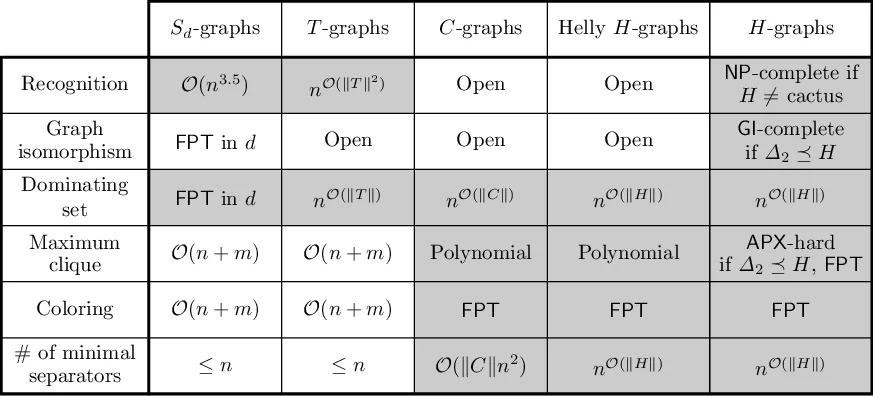
Bir'{o} et al. (1992) introduced $H$-graphs, intersection graphs of connected subgraphs of a subdivision of a graph $H$. They are related to many classes of geometric intersection graphs, e.g., interval graphs, circular-arc graphs, split graphs, and chordal graphs. We negatively answer the 25-year-old question of Bir'{o} et al. which asks if $H$-graphs can be recognized in polynomial time, for a fixed graph $H$. We prove that it is NP-complete if $H$ contains the diamond graph as a minor. We provide a polynomial-time algorithm recognizing $T$-graphs, for each fixed tree $T$. When $T$ is a star $S_d$ of degree $d$, we have an $O(n^{3.5})$-time algorithm. We give FPT- and XP-time algorithms solving the minimum dominating set problem on $S_d$-graphs and $H$-graphs parametrized by $d$ and the size of $H$, respectively. The algorithm for $H$-graphs adapts to an XP-time algorithm for the independent set and the independent dominating set problems on $H$-graphs. If $H$ contains the double-triangle as a minor, we prove that $H$-graphs are GI-complete and that the clique problem is APX-hard. The clique problem can be solved in polynomial time if $H$ is a cactus graph. When a graph $G$ has a Helly $H$-representation, the clique problem can be solved in polynomial time. We show that both the $k$-clique and the list $k$-coloring problems are solvable in FPT-time on $H$-graphs (parameterized by $k$ and the treewidth of $H$). In fact, these results apply to classes of graphs with treewidth bounded by a function of the clique number. We observe that $H$-graphs have at most $n^{O(|H|)}$ minimal separators which allows us to apply the meta-algorithmic framework of Fomin et al. (2015) to show that for each fixed $t$, finding a maximum induced subgraph of treewidth $t$ can be done in polynomial time. When $H$ is a cactus, we improve the bound to $O(|H|n^2)$.
💡 Research Summary
The paper conducts a comprehensive study of H‑graphs, a class of intersection graphs defined as the intersection graphs of connected subgraphs of a subdivision of a fixed host graph H. The authors address several fundamental algorithmic problems—recognition, graph isomorphism, minimum dominating set, maximum clique, and coloring—by relating the computational complexity of each problem to structural properties of H.
First, they resolve a long‑standing open question posed by Biró, Hujter, and Tuza (1992) concerning the recognition of H‑graphs. By a reduction from the problem of testing whether the interval dimension of a height‑2 partial order is at most three, they prove that H‑graph recognition is NP‑complete whenever H contains the diamond graph (K₄ minus an edge) as a minor. Consequently, any host graph that is not a cactus yields an intractable recognition problem. On the positive side, they present polynomial‑time recognition algorithms for two important subclasses. When H is a star S₍d₎ of degree d, an O(n³·⁵) algorithm is given; more generally, for any fixed tree T, they devise a polynomial‑time algorithm that decides T‑graph membership.
Second, the authors investigate the Minimum Dominating Set problem. For S₍d₎‑graphs they obtain an FPT algorithm parameterized by d, running in O(d·n·(n+m)) + 2^{O(d)} time. For arbitrary H‑graphs they give an XP algorithm whose running time is n^{O(|H|)}. The same technique yields XP algorithms for Maximum Independent Set and Minimum Independent Dominating Set on H‑graphs.
Third, they study the Clique and Graph Isomorphism problems. If H contains the double‑triangle (two triangles sharing an edge) as a minor, they prove that the Clique problem is APX‑hard and that Graph Isomorphism is GI‑complete on H‑graphs. Conversely, when H is a cactus, the Clique problem becomes polynomial‑time solvable. Moreover, for Helly H‑graphs—where every family of pairwise intersecting subgraphs has a common vertex—the maximum clique can be found in linear time by aggregating cliques around each host vertex.
Fourth, the paper addresses parameterized versions of k‑Clique and list k‑Coloring. Using treewidth‑based arguments, they show that both problems are fixed‑parameter tractable when parameterized by k together with the treewidth of H. In fact, the results extend to any graph class that satisfies a “clique‑treewidth” property, i.e., where treewidth is bounded by a function of the clique number.
Finally, the authors bound the number of minimal separators in H‑graphs. They prove that any H‑graph on n vertices has at most n^{O(|H|)} minimal separators, and improve this bound to O(|H|·n²) when H is a cactus. By invoking the meta‑algorithmic framework of Fomin, Todinca, and Villanger (2015), they conclude that for each fixed t, the problem of finding a maximum induced subgraph of treewidth t can be solved in polynomial time on H‑graphs; the running time becomes O(|H|·n²) for cactus hosts.
Overall, the work delineates a clear complexity landscape for a wide range of algorithmic problems on H‑graphs, showing that the presence of certain minors (diamond, double‑triangle) in the host graph H triggers hardness, while tree‑like hosts admit efficient algorithms. The results bridge geometric intersection graph theory with parameterized complexity, providing both hardness proofs and constructive algorithms that deepen our understanding of how host‑graph structure influences computational tractability.
Comments & Academic Discussion
Loading comments...
Leave a Comment