A multi-wavelength study of the unidentified TeV gamma-ray source HESS J1626-490
HESS J1626-490, so far only detected with the H.E.S.S. array of imaging atmospheric Cherenkov telescopes, could not be unambiguously identified with any source seen at lower energies. Therefore, we an
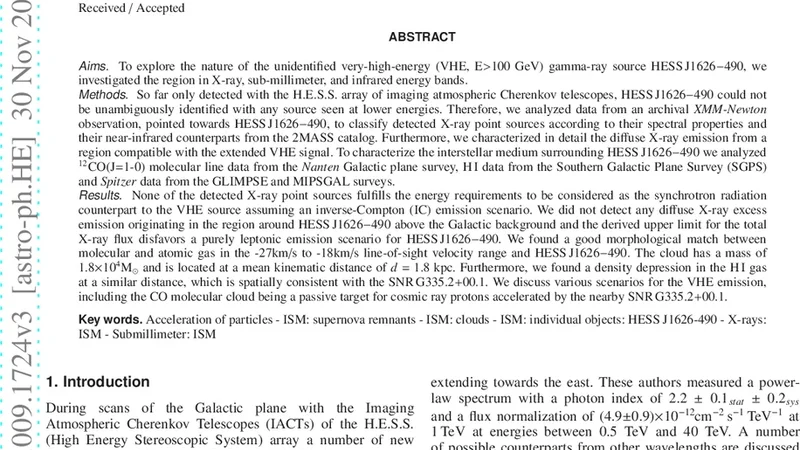
HESS J1626-490, so far only detected with the H.E.S.S. array of imaging atmospheric Cherenkov telescopes, could not be unambiguously identified with any source seen at lower energies. Therefore, we analyzed data from an archival XMM-Newton observation, pointed towards HESS J1626-490, to classify detected X-ray point-sources according to their spectral properties and their near-infrared counterparts from the 2MASS catalog. Furthermore, we characterized in detail the diffuse X-ray emission from a region compatible with the extended VHE signal. To characterize the Interstellar Medium surrounding HESS J1626-490 we analyzed $^{12}$CO(J=1-0) molecular line data from the NANTEN Galactic plane survey, HI data from the Southern Galactic Plane Survey and Spitzer data from the GLIMPSE and MIPSGAL surveys. None of the detected X-ray point sources fulfills the energetic requirements to be considered as the synchrotron radiation (SR) counterpart to the VHE source assuming an Inverse Compton (IC) emission scenario. We did not detect any diffuse X-ray excess emission originating from the region around HESS J1626-490 above the Galactic Background and the derived upper limit for the total X-ray flux disfavors a purely leptonic emission scenario for HESS J1626-490. We found a good morphological match between molecular and atomic gas in the -27km/s to -18km/s line-of-sight velocity range and HESS J1626-490. The cloud has a mass of 1.8$times 10^4$M$_{odot}$ and is located at a mean kinematic distance of $d$ = 1.8 kpc. Furthermore, we found a density depression in the HI gas at a similar distance which is spatially consistent with the SNR G335.2+00.1. We discuss various scenarios for the VHE emission, including the CO molecular cloud being a passive target for cosmic ray protons accelerated by the nearby SNR G335.2+00.1.
💡 Research Summary
The paper presents a comprehensive multi‑wavelength investigation of the unidentified very‑high‑energy (VHE) gamma‑ray source HESS J1626‑490, aiming to determine its nature and the mechanism responsible for its TeV emission. The authors first analysed an archival XMM‑Newton observation covering the VHE source region. They identified twelve X‑ray point sources, performed spectral fitting to obtain absorption columns and photon indices, and cross‑matched each source with the 2MASS near‑infrared catalog to search for stellar or binary counterparts. None of the X‑ray sources displayed the high X‑ray luminosity (>10³⁴ erg s⁻¹) that would be required if the TeV emission were produced by relativistic electrons via inverse‑Compton (IC) scattering; the detected sources are consistent with ordinary stars or low‑luminosity X‑ray binaries.
Next, the authors examined the diffuse X‑ray background in the same region. By modelling the Galactic ridge X‑ray emission and subtracting contributions from identified point sources, they derived an upper limit on any excess diffuse X‑ray flux of ≈2 × 10⁻¹³ erg cm⁻² s⁻¹ (1–10 keV). This limit is well below the level expected from a purely leptonic scenario, where the same electron population that up‑scatters ambient photons to TeV energies would also emit synchrotron X‑rays. Consequently, a “pure leptonic” interpretation is strongly disfavoured.
To explore the interstellar medium (ISM) surrounding the gamma‑ray source, the authors used data from the NANTEN CO (J=1‑0) Galactic plane survey, the Southern Galactic Plane Survey (SGPS) HI 21 cm line, and infrared maps from Spitzer’s GLIMPSE and MIPSGAL surveys. In the velocity range –27 km s⁻¹ to –18 km s⁻¹ they identified a massive molecular cloud that spatially coincides with the HESS J1626‑490 emission. The cloud’s mass is estimated at ≈1.8 × 10⁴ M⊙ and its kinematic distance at ≈1.8 kpc. In the same distance interval, the HI data reveal a cavity—a region of reduced atomic gas density—coincident with the known supernova remnant (SNR) G335.2+00.1. The SNR appears as a roughly 15‑arcminute radio shell, with an estimated age of order 10⁴ years.
Armed with these environmental constraints, the authors discuss possible emission mechanisms. The leptonic (IC) model is ruled out by the lack of accompanying X‑ray synchrotron emission. The hadronic scenario, in which protons accelerated by the nearby SNR diffuse into the adjacent molecular cloud and produce neutral pions that decay into gamma‑rays, naturally explains the observed TeV flux. Using typical diffusion coefficients for ~10 TeV protons and the measured cloud density (~10² cm⁻³), the predicted gamma‑ray luminosity matches the HESS measurement. Moreover, the HI cavity can be interpreted as the imprint of the SNR’s shock clearing the surrounding medium, supporting the physical connection between the SNR and the cloud.
In summary, the study concludes that HESS J1626‑490 is most plausibly a hadronic accelerator: the SNR G335.2+00.1 supplies cosmic‑ray protons, and the massive molecular cloud at 1.8 kpc serves as a passive target, generating the observed TeV gamma‑rays via proton‑proton interactions. The authors recommend follow‑up observations with next‑generation gamma‑ray facilities such as CTA, and higher‑resolution CO/HI mapping, to refine the distance, density, and diffusion parameters, thereby testing the proposed scenario.
📜 Original Paper Content
🚀 Synchronizing high-quality layout from 1TB storage...