Energy Efficiency of Opportunistic Device-to-Device Relaying Under Lognormal Shadowing
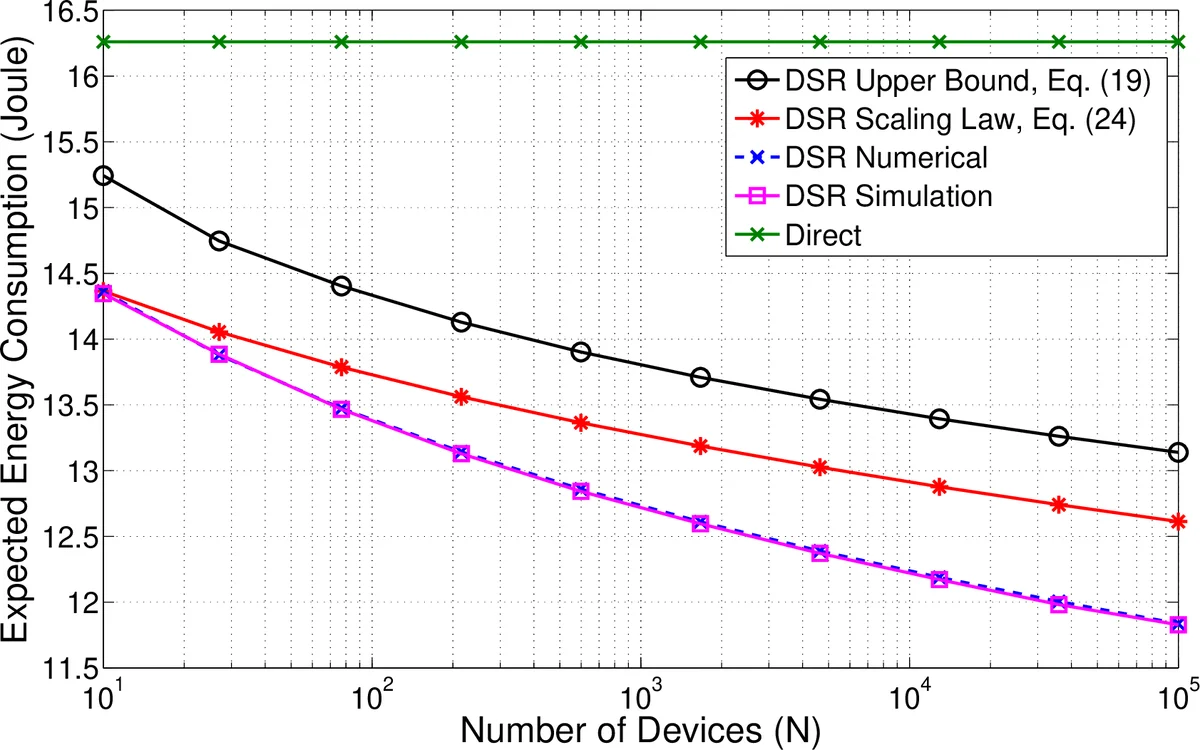
Energy consumption is a major limitation of low power and mobile devices. Efficient transmission protocols are required to minimize an energy consumption of the mobile devices for ubiquitous connectivity in the next generation wireless networks. Opportunistic schemes select a single relay using the criteria of the best channel and achieve a near-optimal diversity performance in a cooperative wireless system. In this paper, we study the energy efficiency of the opportunistic schemes for device-to-device communication. In the opportunistic approach, an energy consumed by devices is minimized by selecting a single neighboring device as a relay using the criteria of minimum consumed energy in each transmission in the uplink of a wireless network. We derive analytical bounds and scaling laws on the expected energy consumption when the devices experience log-normal shadowing with respect to a base station considering both the transmission as well as circuit energy consumptions. We show that the protocol improves the energy efficiency of the network comparing to the direct transmission even if only a few devices are considered for relaying. We also demonstrate the effectiveness of the protocol by means of simulations in realistic scenarios of the wireless network.
💡 Research Summary
The paper investigates the energy efficiency of a device‑to‑device (D2D) opportunistic relaying scheme in environments dominated by log‑normal shadowing, such as indoor offices, shopping malls, or densely populated areas. The authors consider a single‑cell uplink scenario where a source device may either transmit directly to the base station (BS) or first forward its data to a nearby device (relay) via a short‑range D2D link, after which the relay forwards the data to the BS.
Key contributions are:
-
System Model with Log‑Normal Shadowing – The BS‑device channel gain is modeled as a log‑normal random variable, incorporating distance‑based path loss and a shadowing term with standard deviation σ (in dB). The D2D link, being short‑range, is modeled with Rayleigh fading and a separate path‑loss exponent.
-
Energy Consumption Formulation – Both transmission power and circuit power are taken into account. For a direct transmission the energy per packet is
\
Comments & Academic Discussion
Loading comments...
Leave a Comment