Adhesion-induced Discontinuous Transitions and Classifying Social Networks
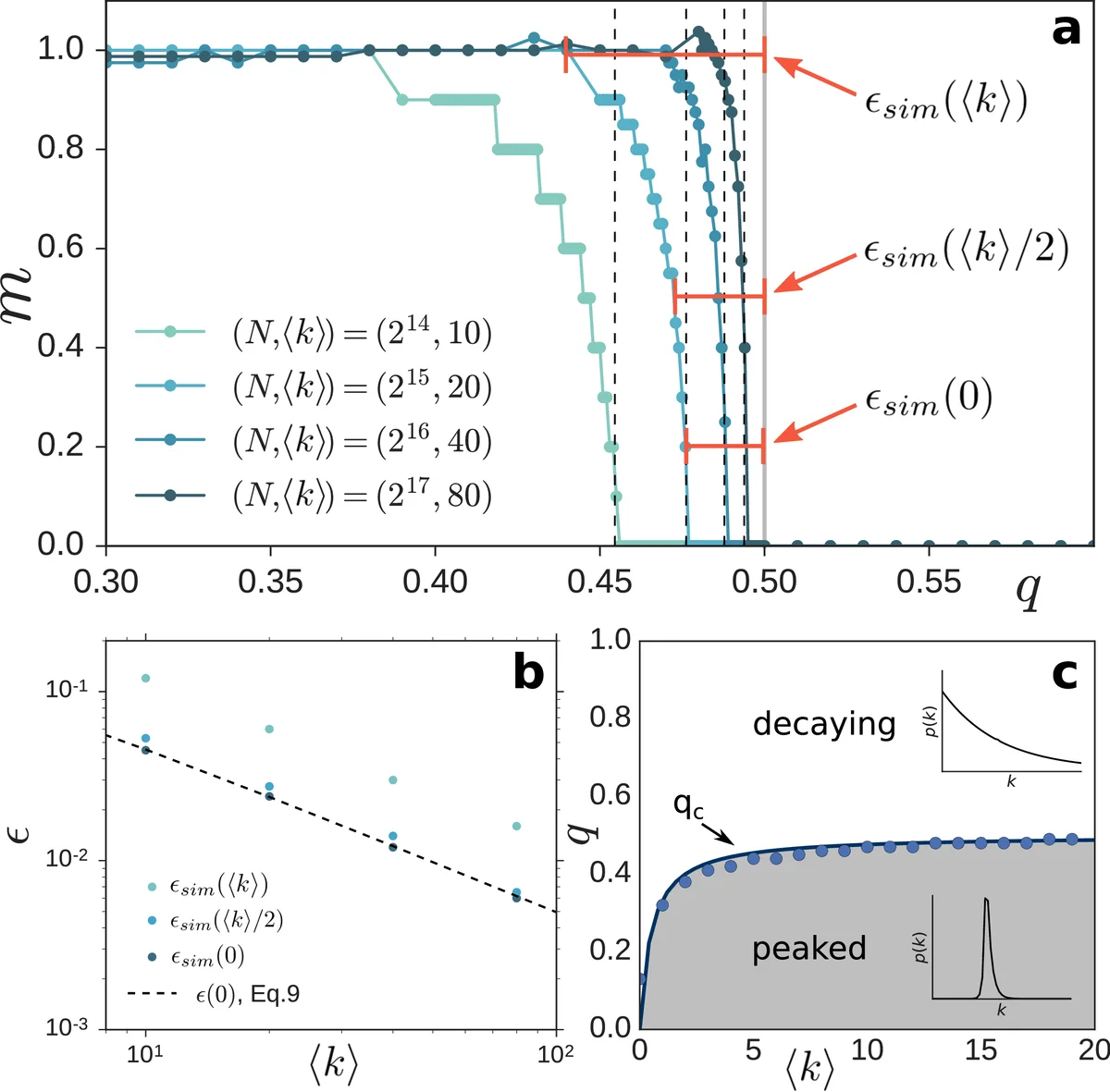
Transition points mark qualitative changes in the macroscopic properties of large complex systems. Explosive transitions, exhibiting properties of both continuous and discontinuous phase transitions, have recently been uncovered in network growth processes. Real networks not only grow but often also restructure, yet common network restructuring processes, such as small world rewiring, do not exhibit phase transitions. Here, we uncover a class of intrinsically discontinuous transitions emerging in network restructuring processes controlled by \emph{adhesion} – the preference of a chosen link to remain connected to its end node. Deriving a master equation for the temporal network evolution and working out an analytic solution, we identify genuinely discontinuous transitions in non-growing networks, separating qualitatively distinct phases with monotonic and with peaked degree distributions. Intriguingly, our analysis of heuristic data indicates a separation between the same two forms of degree distributions distinguishing abstract from face-to-face social networks.
💡 Research Summary
The paper investigates a class of non‑growing network restructuring processes in which each link possesses an “adhesion” preference: a probability q that the lower‑degree endpoint of a randomly chosen link will be cut, and a complementary probability 1‑q that the higher‑degree endpoint will be cut. After a cut, the dangling end is re‑attached to a node selected with probability proportional to k + 1, i.e., a standard preferential‑attachment rule with a unit offset that prevents nodes from disappearing. This simple two‑step rewiring rule defines a stochastic ensemble of temporal networks that, despite having a fixed number of nodes N and links L, evolves a non‑trivial degree distribution Pₜ(k).
The authors derive an exact master equation for the degree distribution: \
Comments & Academic Discussion
Loading comments...
Leave a Comment