Quantifying Transient Spreading Dynamics on Networks
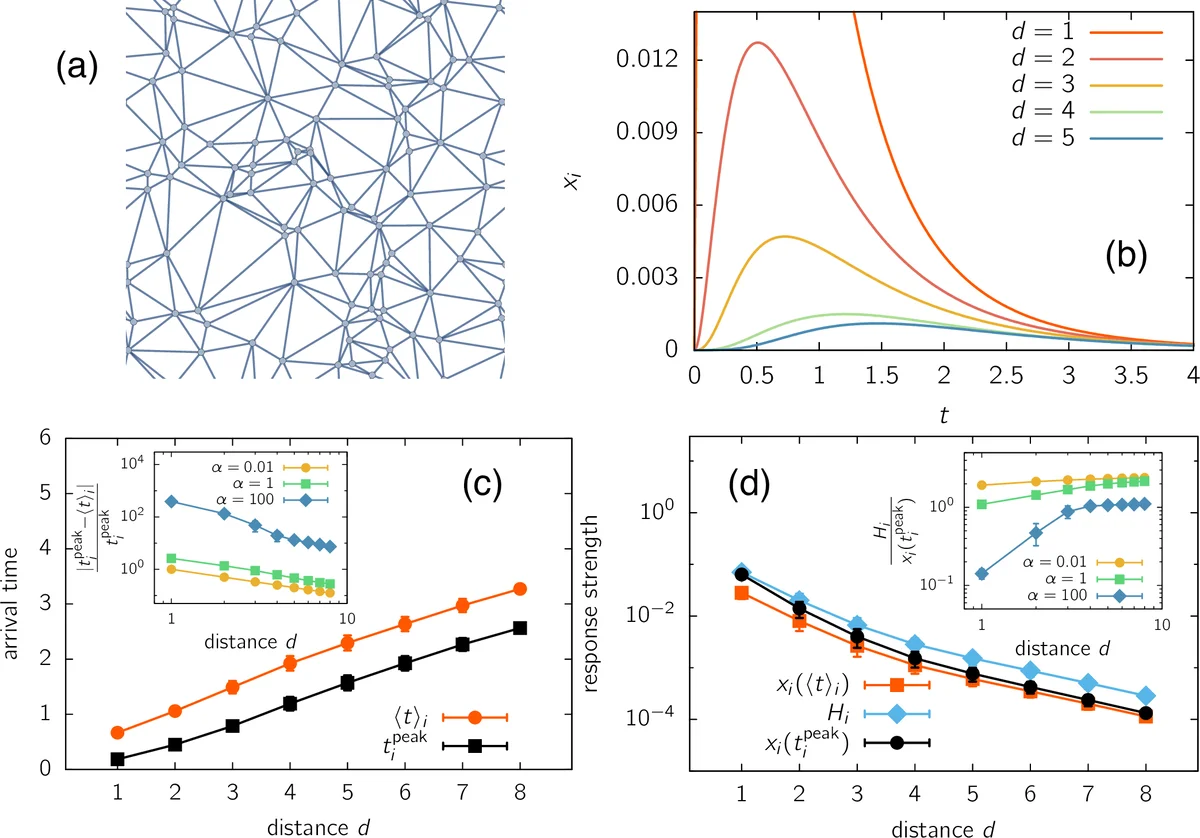
Spreading phenomena on networks are essential for the collective dynamics of various natural and technological systems, from information spreading in gene regulatory networks to neural circuits or from epidemics to supply networks experiencing perturbations. Still, how local disturbances spread across networks is not yet quantitatively understood. Here we analyze generic spreading dynamics in deterministic network dynamical systems close to a given operating point. Standard dynamical systems’ theory does not explicitly provide measures for arrival times and amplitudes of a transient, spreading signal because it focuses on invariant sets, invariant measures and other quantities less relevant for transient behavior. We here change the perspective and introduce effective expectation values for deterministic dynamics to work out a theory explicitly quantifying when and how strongly a perturbation initiated at one unit of a network impacts any other. The theory provides explicit timing and amplitude information as a function of the relative position of initially perturbed and responding unit as well as on the entire network topology.
💡 Research Summary
The paper “Quantifying Transient Spreading Dynamics on Networks” addresses a fundamental gap in the analysis of how local perturbations propagate through complex networks. While classical dynamical‑systems theory excels at describing long‑term invariant sets, attractors, and statistical measures, it offers little insight into the timing and magnitude of transient signals that travel from a perturbed node to the rest of the network. The authors propose a novel framework that treats the time courses of node states as positive functions, normalizes them to probability densities, and then extracts expectation‑type quantities that directly quantify typical response times, durations, and strengths.
The authors start from a deterministic continuous‑time network of N coupled units described by (\dot y = F(y)). Assuming the system operates near a stable fixed point (y^) (so that (F(y^)=0)), they linearize the dynamics to obtain (\dot x = M x), where (M = DF(y^*)) is a weighted adjacency‑like matrix with non‑negative off‑diagonal entries and negative diagonal dominance, guaranteeing all eigenvalues have negative real parts. A single node (k) is initially perturbed, i.e., (x(0) = e_k). The exact solution is (x(t) = e^{Mt} e_k), but the peak time (t_{\text{peak}}^i) (where (\dot x_i=0) and (\ddot x_i<0)) satisfies a transcendental equation that cannot be solved analytically for generic topologies.
To bypass this difficulty, Lemma 1 proves that for any (t>0) all components (x_i(t)) are strictly positive. This allows the definition of a response density (\rho_i(t) = x_i(t)/Z_i), where the total response strength (Z_i = \int_0^\infty x_i(t)dt). Lemma 2 shows that (Z_i = - (M^{-1}x_0)i); for a single‑node perturbation this reduces to (- (M^{-1}){ik}). The authors then interpret the first moment of (\rho_i) as a typical response time: \
Comments & Academic Discussion
Loading comments...
Leave a Comment