Detecting Directionality in Random Fields Using the Monogenic Signal
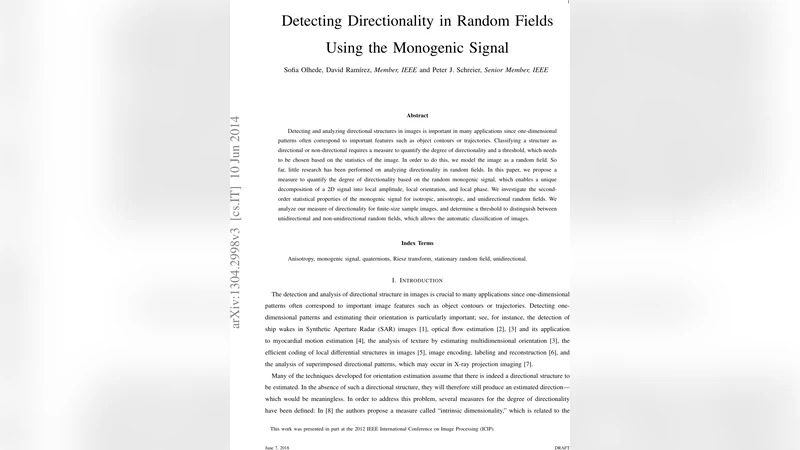
Detecting and analyzing directional structures in images is important in many applications since one-dimensional patterns often correspond to important features such as object contours or trajectories. Classifying a structure as directional or non-directional requires a measure to quantify the degree of directionality and a threshold, which needs to be chosen based on the statistics of the image. In order to do this, we model the image as a random field. So far, little research has been performed on analyzing directionality in random fields. In this paper, we propose a measure to quantify the degree of directionality based on the random monogenic signal, which enables a unique decomposition of a 2D signal into local amplitude, local orientation, and local phase. We investigate the second-order statistical properties of the monogenic signal for isotropic, anisotropic, and unidirectional random fields. We analyze our measure of directionality for finite-size sample images, and determine a threshold to distinguish between unidirectional and non-unidirectional random fields, which allows the automatic classification of images.
💡 Research Summary
The paper addresses the problem of detecting and quantifying directional structures in two‑dimensional random fields, a task that is essential in many imaging applications such as ship‑wake detection in SAR, optical flow, texture analysis, and medical imaging. The authors propose a novel measure of “degree of unidirectionality” based on the random monogenic signal, which extends the analytic signal concept to 2‑D by coupling the original image with its two Riesz transforms.
First, the monogenic signal is defined as a quaternion‑valued field
m(x) = f(x) + i g(x) + j h(x),
where f(x) is the real image and g(x), h(x) are the first and second Riesz transforms. The Riesz transform has the crucial properties of translation, dilation, and rotation equivariance, making it ideally suited for separating structural (orientation) from energetic (amplitude) information.
Assuming the image is a zero‑mean, wide‑sense stationary random field, the authors use the spectral representation f(x)=∫ dZ_f(k) e^{i k·x} to derive closed‑form expressions for the auto‑ and cross‑covariances of f, g, and h. They show that the covariance of the original field equals the sum of the covariances of the two Riesz components (r_ff = r_gg + r_hh), and they provide explicit integral formulas involving the power spectral density S_ff(k) and the angular factor cos κ, sin κ.
Three canonical classes of random fields are examined: isotropic (S_ff independent of direction), geometrically anisotropic (elliptical spectral contours), and unidirectional (energy concentrated along a single direction). For isotropic fields the proposed directionality measure U evaluates to zero, for perfectly unidirectional fields it equals one, and for intermediate anisotropy it lies between 0 and 1. The measure is defined as
U = (|g|² – |h|²)² / (|g|² + |h|²)²,
which depends only on the relative energies of the two Riesz components at each pixel and can be averaged over the whole image.
Because real images are finite, the authors carefully analyze the bias and variance of U for an N × N sample. They distinguish between the continuous‑space Riesz transform and its periodic discrete implementation (used in practice) and derive the expected value E
Comments & Academic Discussion
Loading comments...
Leave a Comment