Towards the statistical construction of hybrid development methods
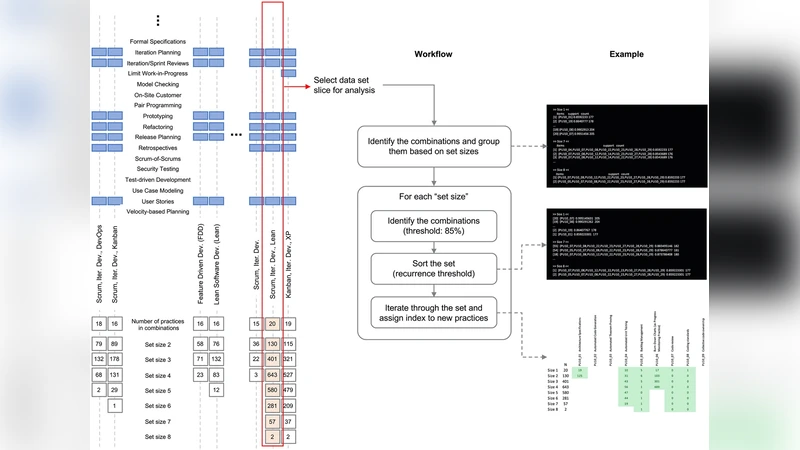
Hardly any software development process is used as prescribed by authors or standards. Regardless of company size or industry sector, a majority of project teams and companies use hybrid development methods (short: hybrid methods) that combine different development methods and practices. Even though such hybrid methods are highly individualized, a common understanding of how to systematically construct synergetic practices is missing. In this article, we make a first step towards a statistical construction procedure for hybrid methods. Grounded in 1467 data points from a large-scale practitioner survey, we study the question: What are hybrid methods made of and how can they be systematically constructed? Our findings show that only eight methods and few practices build the core of modern software development. Using an 85% agreement level in the participants’ selections, we provide examples illustrating how hybrid methods can be characterized by the practices they are made of. Furthermore, using this characterization, we develop an initial construction procedure, which allows for defining a method frame and enriching it incrementally to devise a hybrid method using ranked sets of practice.
💡 Research Summary
Software development teams rarely follow a single prescribed methodology; instead, most adopt hybrid approaches that blend elements from multiple methods and practices. Despite the prevalence of such hybrids, there is no systematic, evidence‑based procedure for constructing them. This paper addresses that gap by analysing a large‑scale practitioner survey comprising 1,467 respondents and over 2,500 individual data points.
The authors first asked participants to list the development methods they actually use and the concrete practices (e.g., daily stand‑up, continuous integration) they apply. Using frequency analysis and method‑practice correlation matrices, they identified eight “core methods” that appear in at least 85 % of the responses: Scrum, Kanban, Waterfall, Extreme Programming (XP), Lean, DevOps, Rational Unified Process (RUP), and SAFe. From the same dataset they extracted twelve “core practices” that are both highly selected and strongly correlated across the core methods, such as sprint planning, backlog grooming, daily stand‑up, continuous integration (CI), continuous deployment (CD), automated testing, code review, feedback loops, value‑stream visualization, risk management, documentation, and team‑skill development.
A key insight is that many of these practices recur across several methods, forming a set of “synergistic practices” that can serve as the glue for any hybrid composition. For example, feedback loops and automated testing appear in almost every core method, suggesting that quality assurance and rapid feedback are indispensable building blocks. Likewise, CI/CD and lean value‑stream mapping are tightly linked in DevOps and Lean, indicating that combining these two practices can simultaneously accelerate delivery and improve quality.
Based on these statistical findings, the authors propose an initial construction procedure consisting of three stages:
-
Define a method frame – Choose one to three of the eight core methods that best match the project’s size, domain, team capabilities, and organizational culture. The selection is guided by a mapping of business goals and risk profiles to method characteristics.
-
Map ranked practices – For the chosen methods, rank the core practices according to their overall agreement level and the strength of their correlation with the selected methods. This ranking produces a prioritized list that minimizes redundancy and conflict.
-
Incrementally enrich the hybrid – Start with the highest‑ranked practices, implement them, and then iteratively add lower‑ranked practices as the project evolves. At each iteration, measure the impact of the newly introduced practice, adjust or replace it if necessary, and continue until the hybrid method satisfies the desired performance, quality, and agility targets.
The procedure blends quantitative evidence (the 85 % agreement threshold and correlation analysis) with a pragmatic, step‑wise rollout, distinguishing it from purely experience‑based ad‑hoc hybridisation. It also offers a clear mechanism for avoiding “practice overload” by explicitly considering practice‑practice interactions.
The paper acknowledges several limitations: the survey sample may be skewed toward certain regions or industries; the definition of practices can be ambiguous; and the proposed model does not yet incorporate real‑time adaptation mechanisms for rapidly changing project contexts. Future work is suggested to broaden the respondent base, standardise practice taxonomies, and develop dynamic feedback loops that allow continuous refinement of the hybrid composition.
In summary, this study provides the first statistically grounded taxonomy of the methods and practices that constitute modern software development hybrids, and it translates that taxonomy into a concrete, three‑step construction framework. By doing so, it supplies both researchers and practitioners with a reproducible, data‑driven roadmap for designing, evaluating, and evolving hybrid development methods.