On rheonomic nonholonomic deformations of the Euler equations proposed by Bilimovich
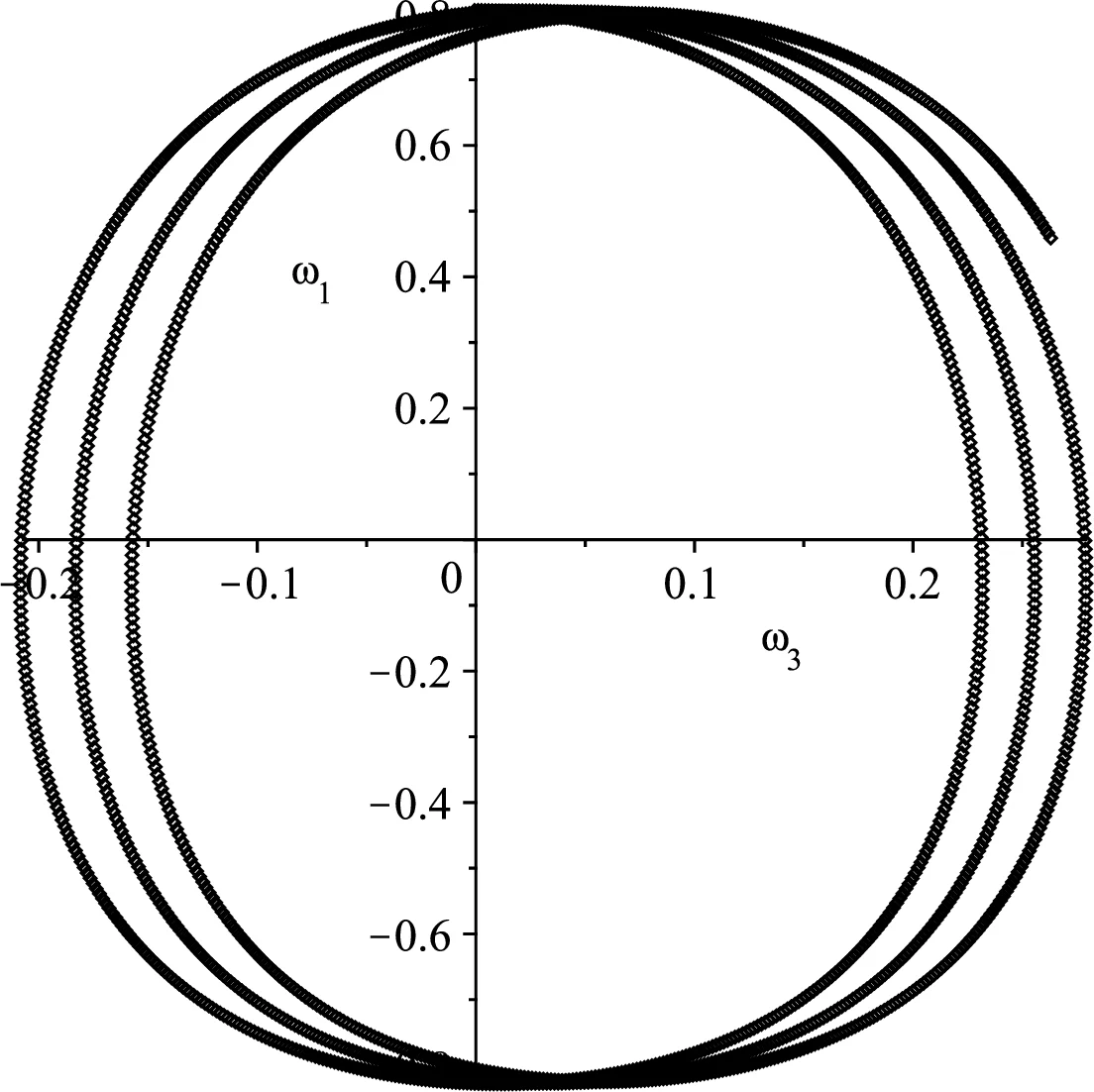
In 1913 A.D. Bilimovich observed that rheonomic linear and homogeneous in generalized velocities constraints are ideal. As a typical example, he considered rheonomic nonholonomic deformation of the Euler equations which scleronomic version is equivalent to the nonholonomic Suslov system. For the Bilimovich system equations of motion are reduced to quadrature, which is discussed in rheonomic and scleronomic cases.
💡 Research Summary
The paper revisits a little‑known result of A.D. Bilimovich (1913) that time‑dependent (rheonomic) linear‑homogeneous constraints in the generalized velocities are ideal, i.e., the virtual work of the reaction forces vanishes. Using this observation the authors study a non‑holonomic deformation of the Euler equations for a rigid body. The undeformed system is the classical Euler top with kinetic energy (T=\tfrac12(I\omega,\omega)) and conserved energy and squared angular momentum.
A rheonomic constraint of the form
\
Comments & Academic Discussion
Loading comments...
Leave a Comment