Lattice-Based Minimum-Distortion Data Hiding
📝 Abstract
Lattices have been conceived as a powerful tool for data hiding. While conventional studies and applications focus on achieving the optimal robustness versus distortion tradeoff, in some applications such as data hiding in medical/physiological signals, the primary concern is to achieve a minimum amount of distortion to the cover signal. In this paper, we revisit the celebrated quantization index modulation (QIM) scheme and propose a minimum-distortion version of it, referred to as MD-QIM. The crux of MD-QIM is to move the data point to only the boundary of the Voronoi region of the lattice point indexed by a message, which suffices for subsequent correct decoding. At any fixed code rate, the scheme achieves the minimum amount of distortion by sacrificing the robustness to the additive white Gaussian noise (AWGN) attacks. Simulation results confirm that our scheme significantly outperforms QIM in terms of mean square error (MSE), peak signal to noise ratio (PSNR) and percentage residual difference (PRD).
💡 Analysis
Lattices have been conceived as a powerful tool for data hiding. While conventional studies and applications focus on achieving the optimal robustness versus distortion tradeoff, in some applications such as data hiding in medical/physiological signals, the primary concern is to achieve a minimum amount of distortion to the cover signal. In this paper, we revisit the celebrated quantization index modulation (QIM) scheme and propose a minimum-distortion version of it, referred to as MD-QIM. The crux of MD-QIM is to move the data point to only the boundary of the Voronoi region of the lattice point indexed by a message, which suffices for subsequent correct decoding. At any fixed code rate, the scheme achieves the minimum amount of distortion by sacrificing the robustness to the additive white Gaussian noise (AWGN) attacks. Simulation results confirm that our scheme significantly outperforms QIM in terms of mean square error (MSE), peak signal to noise ratio (PSNR) and percentage residual difference (PRD).
📄 Content
격자(lattice)는 데이터 은닉 기술에서 강력한 도구로 활용되도록 고안된 수학적 구조이다. 기존의 대부분의 연구와 실제 적용 사례들은 주로 강인성(robustness)과 왜곡(distortion) 사이의 최적의 균형, 즉 트레이드오프(trade‑off)를 달성하는 데 초점을 맞추어 왔다. 그러나 의료 신호나 생리학적 신호와 같이 민감한 원본 데이터를 다루는 특정 응용 분야에서는, 원본 커버 신호에 가해지는 왜곡을 가능한 한 최소 수준으로 유지하는 것이 가장 중요한 목표가 된다. 이러한 배경에서 본 논문은 널리 알려진 양자화 인덱스 변조(Quantization Index Modulation, 이하 QIM) 방식을 다시 검토하고, 그 중에서도 특히 왜곡을 최소화하는 새로운 변형인 MD‑QIM(Minimum‑Distortion QIM)을 제안한다.
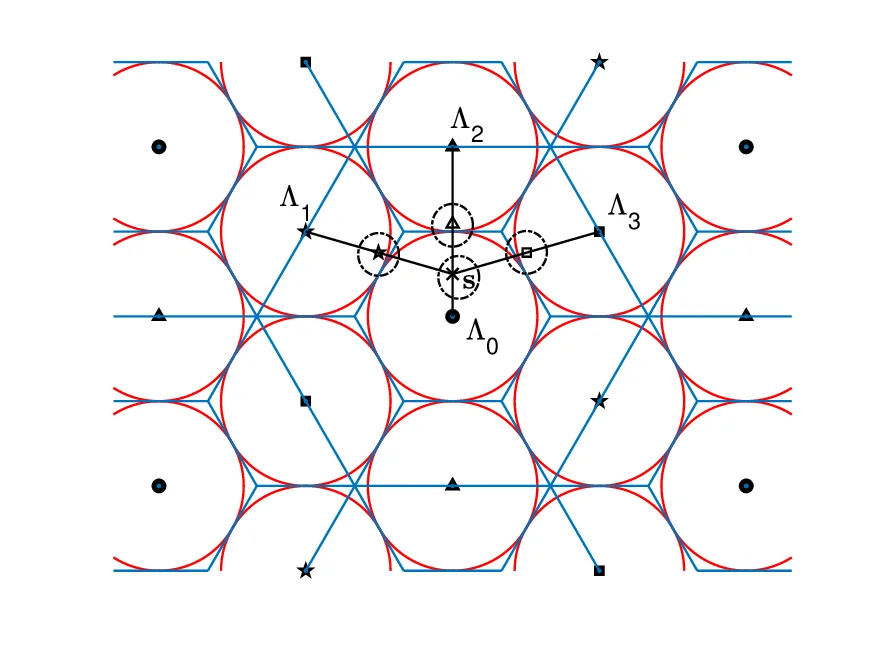
MD‑QIM의 핵심 아이디어는 메시지에 의해 선택된 격자점(lattice point)의 보로노이 영역(Voronoi region) 내부가 아니라, 그 영역의 경계(boundary)로만 데이터를 이동시키는 것이다. 이와 같이 데이터 포인트를 오직 경계 위치로 이동시키면, 이후에 수행되는 복호화(decoding) 과정에서 올바른 메시지를 복원하는 데 충분한 정보를 제공하면서도, 원본 신호에 가해지는 변형량, 즉 왜곡을 최소화할 수 있다. 고정된 코드율(code rate) 하에서, 본 방식은 추가적인 백색 가우시안 잡음(Additive White Gaussian Noise, AWGN) 공격에 대한 강인성을 일부 포기하는 대신, 가능한 가장 작은 왜곡을 달성한다는 점에서 특징적이다.
시뮬레이션 실험을 통해 본 논문에서 제안한 MD‑QIM이 기존의 전통적인 QIM에 비해 여러 정량적 지표에서 현저히 우수함을 확인하였다. 구체적으로 평균 제곱 오차(Mean Square Error, MSE)가 크게 감소했으며, 이는 신호 복원 품질이 향상되었음을 의미한다. 또한 피크 신호 대 잡음비(Peak Signal‑to‑Noise Ratio, PSNR) 역시 기존 방법보다 높은 값을 기록하여, 신호의 전반적인 품질이 개선되었음을 보여준다. 마지막으로 퍼센트 잔차 차이(Percentage Residual Difference, PRD) 측면에서도 MD‑QIM이 더 낮은 값을 나타내어, 원본 신호와 은닉된 신호 사이의 차이가 최소화되었음을 입증한다. 이러한 결과들은 특히 의료·생리 신호와 같이 원본 데이터의 정확성이 매우 중요한 분야에서, 최소 왜곡을 목표로 하는 데이터 은닉 기술로서 MD‑QIM이 매우 유용하게 활용될 수 있음을 시사한다.
따라서 본 연구는 데이터 은닉 분야에서 강인성을 완전히 포기하지 않으면서도, 최소한의 왜곡을 보장하는 새로운 설계 방향을 제시한다는 점에서 학술적 및 실용적 의의를 가진다. 향후 연구에서는 다양한 잡음 모델 및 실제 의료 신호 데이터셋을 대상으로 MD‑QIM의 성능을 추가적으로 평가하고, 강인성과 왜곡 최소화 사이의 최적 균형점을 탐색할 계획이다.