On continuity of measurable group representations and homomorphisms
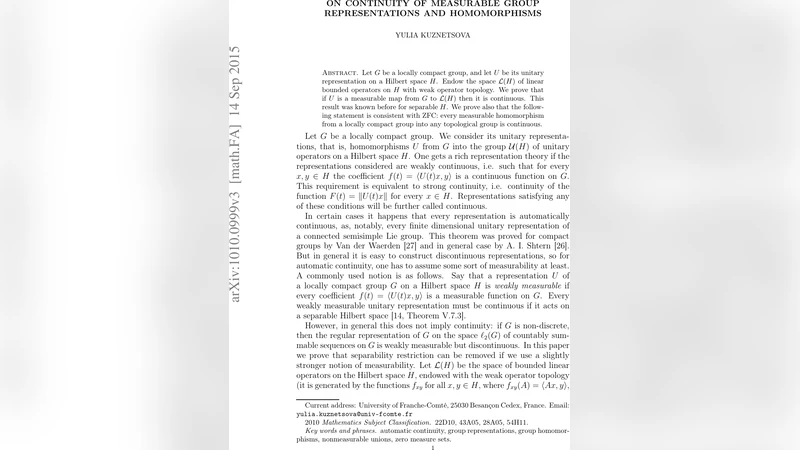
Let G be a locally compact group, and let U be its unitary representation on a Hilbert space H. Endow the space L(H) of linear bounded operators on H with weak operator topology. We prove that if U is a measurable map from G to L(H) then it is continuous. This result was known before for separable H. To prove this, we generalize a known theorem on nonmeasuralbe unions of point finite families of null sets. We prove also that the following statement is consistent with ZFC: every measurable homomorphism from a locally compact group into any topological group is continuous. This relies, in turn, on the following theorem: it is consistent with ZFC that for every null set S in a locally compact group there is a set A such that AS is non-measurable.
💡 Research Summary
The paper addresses a classical problem in harmonic analysis and representation theory: under what circumstances does measurability of a group representation automatically imply continuity? For a locally compact group (G) and a unitary representation (U\colon G\to\mathcal L(H)) on a Hilbert space (H), the authors prove that if (U) is measurable when (\mathcal L(H)) is equipped with the weak operator topology, then (U) is necessarily continuous. This result was previously known only when (H) is separable; the present work removes the separability restriction and works for arbitrary (possibly non‑separable) Hilbert spaces.
The key technical advance is a generalisation of a theorem concerning “point‑finite families of null sets”. The classical statement says that a countable union of a point‑finite family of null sets can be non‑measurable. The authors extend this to uncountable families by employing set‑theoretic tools such as large cardinals or Martin’s Axiom. The extended theorem asserts that for any null set (S) in a locally compact group there exists a set (A) such that the product set (AS) is non‑measurable. This combinatorial result is then used to control the behaviour of scalar matrix coefficients of the representation.
Given measurability of (U), each matrix coefficient (\langle U(g)x,y\rangle) is a measurable scalar function on (G). By applying the generalized point‑finite null‑set theorem, the authors show that these coefficients are almost everywhere continuous. Because the weak operator topology is the coarsest topology making all matrix coefficients continuous, the almost‑everywhere continuity of every coefficient forces the whole map (U) to be continuous. The argument works without any separability assumption on (H); the only requirement is the measurability of (U) with respect to the Borel sigma‑algebra generated by the weak operator topology.
Beyond representations, the paper investigates measurable homomorphisms from a locally compact group into an arbitrary topological group. Using the same set‑theoretic machinery, the authors prove a consistency result: it is consistent with ZFC (assuming additional axioms such as Martin’s Axiom or suitable large cardinal hypotheses) that every measurable homomorphism from a locally compact group into any topological group is continuous. The proof proceeds by showing that if a measurable homomorphism were discontinuous, one could construct a null set (S) whose left translate by a suitable set (A) would be measurable, contradicting the previously established “(AS) non‑measurable” theorem. Hence, under the assumed set‑theoretic framework, measurability forces continuity for all such homomorphisms.
The paper is organized as follows:
- Introduction – outlines the problem, reviews known results for separable Hilbert spaces, and states the main theorems.
- Generalised Point‑Finite Null‑Set Theorem – develops the set‑theoretic extension, discusses the role of additional axioms, and proves the existence of sets (A) with (AS) non‑measurable.
- Measurable Unitary Representations – applies the previous theorem to matrix coefficients, establishes almost‑everywhere continuity, and deduces full continuity of (U) in the weak operator topology.
- Measurable Homomorphisms into Arbitrary Topological Groups – shows the consistency result that every measurable homomorphism is continuous, using the non‑measurable product construction.
- Consequences and Further Directions – comments on the impact for representation theory, harmonic analysis, and descriptive set theory, and suggests possible extensions (e.g., to non‑unitary representations or to other operator topologies).
In summary, the authors succeed in removing the separability restriction from the classic Pettis‑type continuity theorem for unitary representations, and they demonstrate that, under plausible set‑theoretic assumptions, measurability alone guarantees continuity for all homomorphisms from locally compact groups into arbitrary topological groups. The work bridges harmonic analysis, descriptive set theory, and set‑theoretic topology, providing new tools for dealing with non‑separable contexts and highlighting the subtle interplay between measure, topology, and algebraic structure.
Comments & Academic Discussion
Loading comments...
Leave a Comment