Unified model of sediment transport threshold and rate across weak and intense subaqueous bedload, windblown sand, and windblown snow
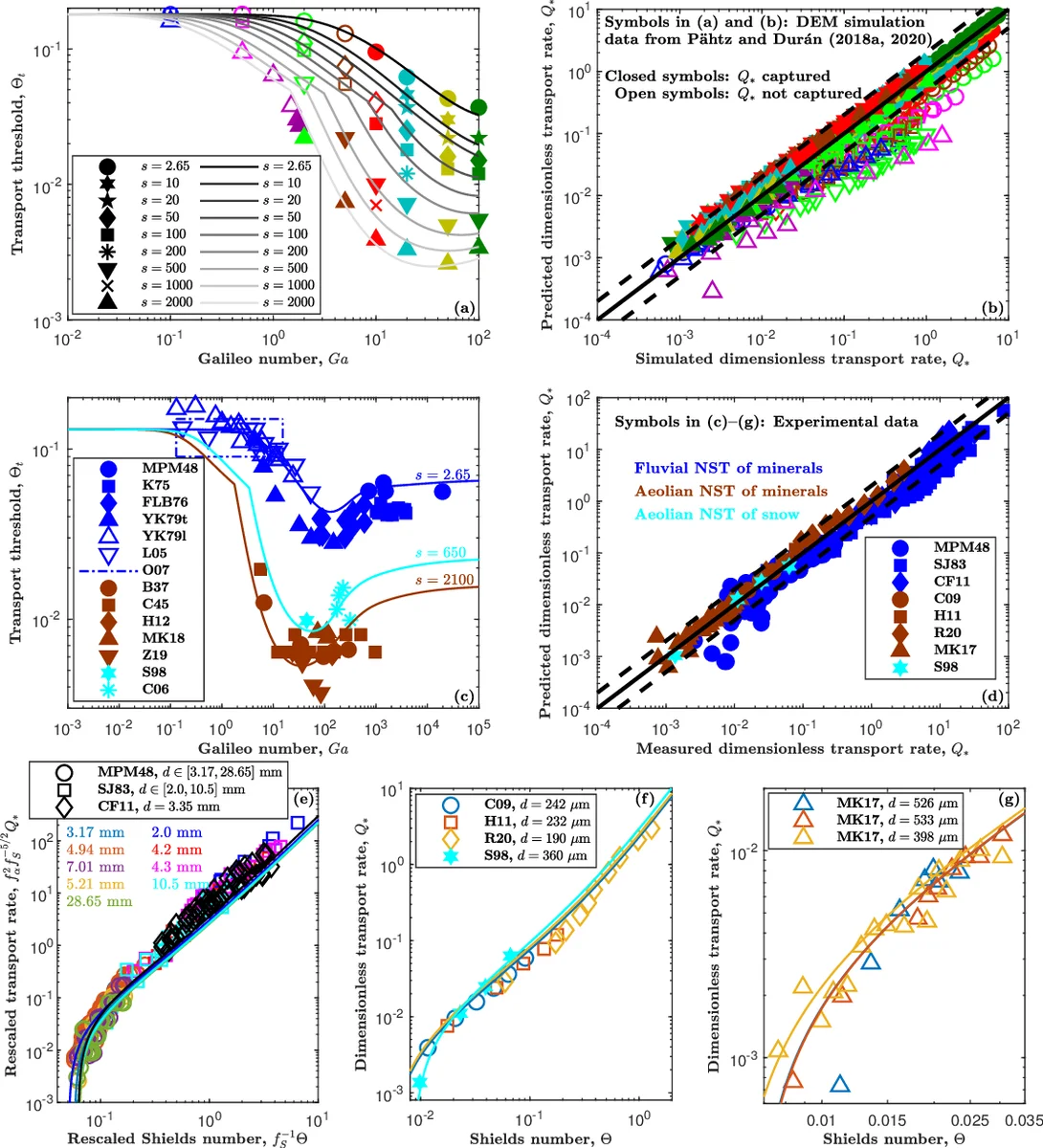
Nonsuspended sediment transport (NST) refers to the sediment transport regime in which the flow turbulence is unable to support the weight of transported grains. It occurs in fluvial environments (i.e., driven by a stream of liquid) and in aeolian environments (i.e., wind-blown) and plays a key role in shaping sedimentary landscapes of planetary bodies. NST is a highly fluctuating physical process because of turbulence, surface inhomogeneities, and variations of grain size and shape and packing geometry. Furthermore, the energy of transported grains varies strongly due to variations of their flow exposure duration since their entrainment from the bed. In spite of such variability, we here propose a deterministic model that represents the entire grain motion, including grains that roll and/or slide along the bed, by a periodic saltation motion with rebound laws that describe an average rebound of a grain after colliding with the bed. The model simultaneously captures laboratory and field measurements and discrete element method (DEM)-based numerical simulations of the threshold and rate of equilibrium NST within a factor of about 2, unifying weak and intense transport conditions in oil, water, and air (oil only for threshold). The model parameters have not been adjusted to these measurements but determined from independent data sets. Recent DEM-based numerical simulations (Comola, Gaume, et al., 2019, https://doi.org/10.1029/2019GL082195) suggest that equilibrium aeolian NST on Earth is insensitive to the strength of cohesive bonds between bed grains. Consistently, the model captures cohesive windblown sand and windblown snow conditions despite not explicitly accounting for cohesion.
💡 Research Summary
This paper presents a deterministic, unified framework for predicting both the transport threshold and equilibrium transport rate of nonsuspended sediment transport (NST) across a wide range of environments, including subaqueous bedload in water and oil, windblown sand, and windblown snow. The authors argue that, despite the inherently stochastic nature of NST—driven by turbulent fluctuations, heterogeneous bed topography, and variable grain properties—a single “average” periodic saltation trajectory can capture the essential physics of grain motion. By representing the entire grain ensemble (including rolling and sliding grains) with a periodic hop characterized by average rebound laws, the model derives three key quantities from first principles: the critical Shields number (Θₜ), the bed friction coefficient (μ_b), and the threshold dimensionless particle velocity (vₓ*ₜ).
The model builds on the earlier work of Pätz and Durán (2020), which expressed the dimensionless transport rate Q* as a function of the dimensionless transport load M* and a velocity term vₓ*. However, that formulation required empirical fitting of Θₜ, μ_b, and vₓₜ. In the present study, Θₜ is defined as the smallest Shields number for which a non‑trivial steady‑state saltation trajectory exists, i.e., the point where the kinetic energy gained during a hop balances the energy lost on impact. μ_b emerges from a newly introduced bed‑friction law that links the average fluid–particle velocity difference to the shear stress transmitted at the bed, naturally incorporating the effect of longitudinal bed slope α. The threshold velocity vₓₜ follows from the balance of momentum exchange and is approximated by a simple scaling vₓ*ₜ ≈ 2 κ⁻¹ √Θₜ (κ being the von Kármán constant).
All model parameters are obtained from independent data sets: the particle‑fluid density ratio s, the Galileo number Ga, and the slope angle α. No ad‑hoc calibration is performed. Substituting the derived Θₜ, μ_b, and vₓₜ into the Pätz‑Durán transport‑rate equation Q = M* vₓₜ (1 + c_M M) (with c_M ≈ 1.7 from DEM simulations) yields predictions that match laboratory experiments, field measurements, and discrete‑element method (DEM) simulations within a factor of two for a broad spectrum of conditions. Notably, the model successfully reproduces results for cohesive sand and snow, supporting recent DEM findings (Comola et al., 2019) that equilibrium aeolian NST on Earth is largely insensitive to inter‑grain cohesion.
A critical insight concerns the role of bed slope. Traditional corrections apply a simple cosine factor to Θₜ, but the present analysis shows that slope influences μ_b directly, leading to a non‑linear dependence of Θₜ on α that better fits the data, especially for steep fluvial channels and dune slopes.
The authors also delineate the model’s limitations. For very low values of s¹ᐟ² Ga (e.g., highly viscous oil flows), the transport‑rate formulation (which assumes a certain scaling of the settling velocity) breaks down, and predictions deviate. Moreover, the framework assumes spherical, monodisperse grains and neglects complex bedform evolution (ripples, dunes) and grain shape effects, which may become important in natural settings.
In conclusion, the paper delivers a physically grounded, parameter‑free (aside from independently measured s, Ga, α) model that unifies NST thresholds and rates across liquid and gaseous media, weak and intense transport regimes, and even cohesive materials. This advancement offers a powerful tool for planetary geomorphology (e.g., Titan’s methane rivers, Martian sand dunes) and for engineering applications such as coastal erosion mitigation and sediment management, where reliable predictions of sediment transport under diverse conditions are essential.
Comments & Academic Discussion
Loading comments...
Leave a Comment