A method to search for long duration gravitational wave transients from isolated neutron stars using the generalized FrequencyHough
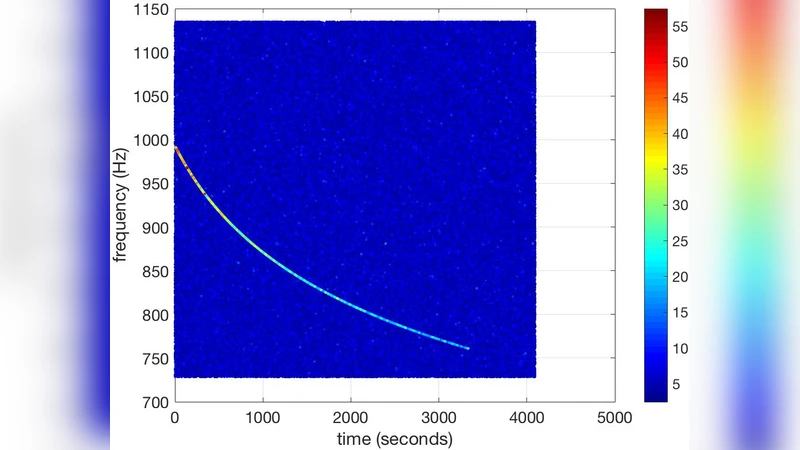
We describe a method to detect gravitational waves lasting $O(hours-days)$ emitted by young, isolated neutron stars, such as those that could form after a supernova or a binary neutron star merger, using advanced LIGO/Virgo data. The method is based on a generalization of the FrequencyHough (FH), a pipeline that performs hierarchical searches for continuous gravitational waves by mapping points in the time/frequency plane of the detector to lines in the frequency/spindown plane of the source. We show that signals whose spindowns are related to their frequencies by a power law can be transformed to coordinates where the behavior of these signals is always linear, and can therefore be searched for by the FH. We estimate the sensitivity of our search across different braking indices, and describe the portion of the parameter space we could explore in a search using varying fast Fourier Transform (FFT) lengths.
💡 Research Summary
The paper presents a novel data‑analysis pipeline designed to detect gravitational‑wave (GW) transients lasting from hours to days that could be emitted by very young, isolated neutron stars formed after a core‑collapse supernova or a binary neutron‑star merger. Existing continuous‑wave (CW) searches, such as the FrequencyHough (FH) method, assume a linear frequency evolution (constant spin‑down) and therefore cannot efficiently target signals whose spin‑down follows a power‑law relation (\dot f = -k f^{n}) with a braking index (n) that may take values 1, 3, 5, 7 or intermediate values depending on the dominant emission mechanism (wind braking, magnetic dipole radiation, quadrupolar “mountain”, r‑modes, etc.).
To overcome this limitation the authors introduce a coordinate transformation that linearises the non‑linear frequency evolution. Defining (x = f^{-(n-1)}) (and similarly (x_{0}=f_{0}^{-(n-1)})), the power‑law evolution becomes a straight line: (x = x_{0} + (n-1)k (t-t_{0})). In this transformed space the standard FH Hough transform can be applied unchanged: each peak in the time‑frequency map is mapped to a line in the ((x_{0},k)) plane, and the accumulation of many such lines produces a Hough histogram whose peaks correspond to candidate signals.
The authors discuss practical aspects of the transformed peak‑map: because the mapping concentrates points at low (x) (high frequencies) the noise is non‑uniform. They mitigate this by constructing peak‑maps over a frequency band 20‑25 % wider than the target band and discarding candidates that fall in the excess region after the Hough step. Candidate selection is performed by dividing the Hough plane into equal‑area squares (e.g., 5 × 5) and picking the highest‑count pixel in each square, optionally adding a second candidate if it is sufficiently separated in (k). This strategy ensures uniform coverage of the parameter space and reduces susceptibility to strong instrumental lines.
A detection statistic, the critical ratio (CR = (y-\mu)/\sigma) (where (y) is the bin count, (\mu) and (\sigma) are the mean and standard deviation of the noise‑only histogram), is used to rank candidates. Coincidence analysis across multiple detectors is then performed by requiring candidates to be within three bins in both (x_{0}) and (k); sky position is assumed known (e.g., from an electromagnetic counterpart), so no sky‑grid is needed. Known instrumental lines are vetoed, and persistence vetoes are applied as in the original FH pipeline.
For each surviving candidate the authors apply a heterodyne phase correction based on the recovered parameters ((f_{0},\dot f_{0},n)). This demodulation should render the signal monochromatic in the corrected data, allowing the use of longer FFTs in a follow‑up stage. By refining the ((x_{0},k)) grid resolution by a factor of ten, the FFT length can also be increased by a factor of ten, substantially improving sensitivity.
Sensitivity estimates are obtained both analytically and via software injections for a range of braking indices. The results show that the generalized FH can recover signals with strain amplitudes down to (h\sim10^{-22})–(10^{-23}) depending on (n) and the chosen FFT length. The authors also discuss the trade‑off between FFT duration, computational cost, and the size of the parameter space (especially the range of (k) values).
Finally, the paper outlines future directions: extending the method to all‑sky searches (which would increase computational demands), incorporating machine‑learning classifiers to improve candidate ranking, and integrating the pipeline into low‑latency searches following electromagnetic alerts. In summary, the work provides a coherent framework that bridges the gap between short‑duration burst searches and long‑duration CW searches, enabling the community to probe a previously inaccessible class of young neutron‑star GW emitters.
Comments & Academic Discussion
Loading comments...
Leave a Comment