Exoplanet Atmosphere Retrieval from Multifractal Analysis of Secondary Eclipse Spectra
We extend a data-based model-free multifractal method of exoplanet detection to probe exoplanetary atmospheres. Whereas the transmission spectrum is studied during the primary eclipse, we analyze the emission spectrum during the secondary eclipse, thereby probing the atmospheric limb. In addition to the spectral structure of exoplanet atmospheres, the approach provides information to study phenomena such as atmospheric flows, tidal-locking behavior, and the dayside-nightside redistribution of energy. The approach is demonstrated using Spitzer data for exoplanet HD189733b. The central advantage of the method is the lack of model assumptions in the detection and observational schemes.
💡 Research Summary
The paper presents a novel, model‑free technique for retrieving exoplanet atmospheric information from secondary‑eclipse observations by exploiting the multifractal properties of time‑series photometry. Building on a previously introduced multifractal temporally weighted detrended fluctuation analysis (MF‑TWDFA), the authors treat each wavelength channel of a Spitzer infrared dataset for HD 189733b as an independent flux time series. MF‑TWDFA does not assume any a priori temporal structure; instead it quantifies scale‑dependent fluctuations and automatically extracts characteristic timescales that correspond to physical events during the secondary eclipse: τ₁₂ (ingress/egress), τ₂₃ (full occultation), and τ₁₄ (total eclipse duration).
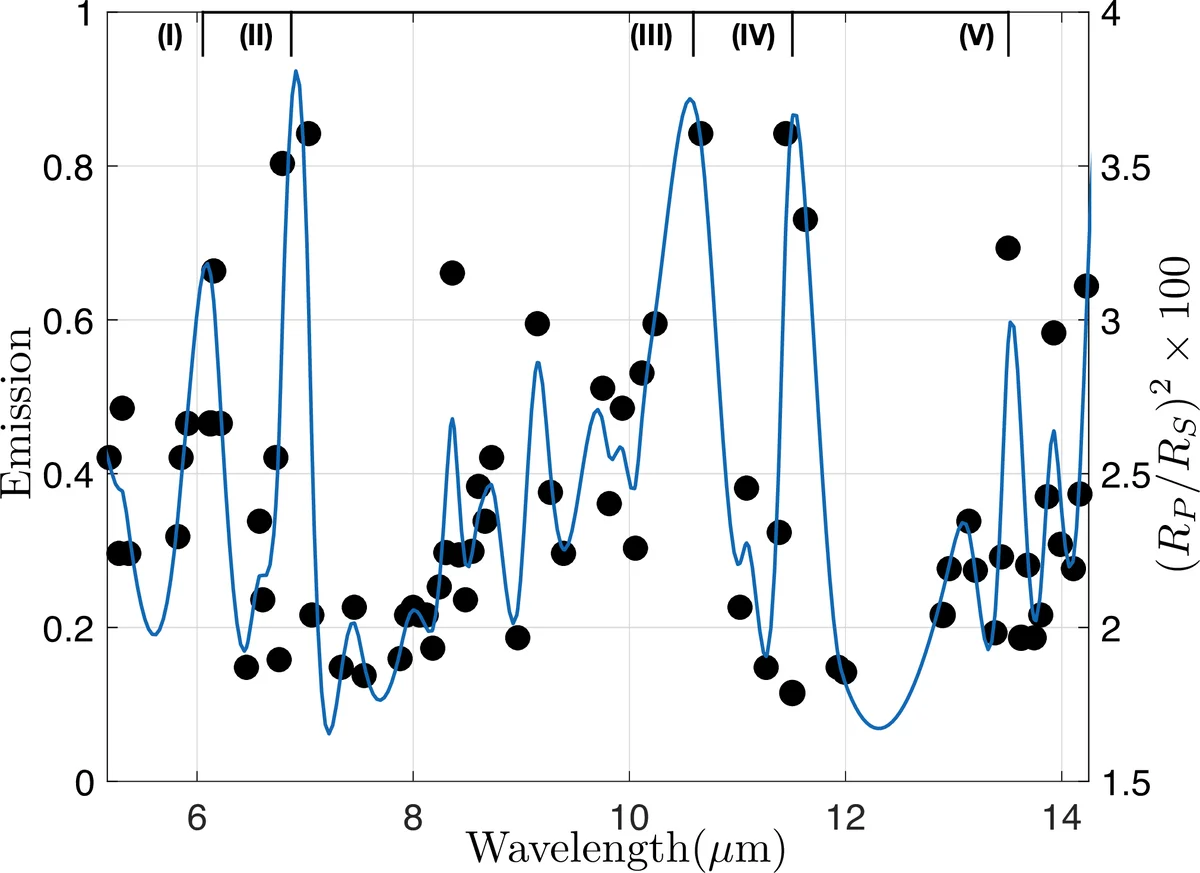
By inserting these timescales into simple geometric relations, the authors convert them into a wavelength‑dependent transit depth, i.e., the squared planet‑to‑star radius ratio (Rₚ/Rₛ)². This yields a “multifractal transmission spectrum” that directly reflects how the effective planetary radius changes with wavelength, without invoking atmospheric chemistry, cloud models, or radiative transfer calculations.
Applying the method to the Spitzer/IRAC data, the authors obtain a high‑resolution radius‑versus‑wavelength curve for HD 189733b. Five statistically significant peaks are identified: a water vapor feature near 6.2 µm, three ammonia features at ~6.9 µm, 10.5 µm, and 11.6 µm, and a carbon dioxide feature at ~13.5 µm. The water peak reaches ~1.7σ significance, while the ammonia peaks achieve ~2.5σ, indicating robust detections despite the modest signal‑to‑noise of the original data. These identifications are consistent with previous high‑resolution spectroscopic studies, but they are derived here solely from the multifractal timing analysis of the secondary‑eclipse light curve.
Beyond composition, the extracted timescales provide insight into planetary dynamics. The ratio τ₁₂/τ₂₃ and any asymmetry between ingress and egress can reveal whether the planet is tidally locked, the efficiency of day‑to‑night energy redistribution, and possible atmospheric jet streams. Because the secondary eclipse samples the planetary limb (terminator) rather than the sub‑stellar point, the method probes atmospheric regions that are difficult to access with traditional emission‑spectra analyses.
The authors acknowledge limitations: the technique requires long, continuous observations to resolve the multifractal scaling; strong instrumental or stellar noise can bias the extracted timescales; and the spectral resolution is bounded by the wavelength sampling of the instrument. Nevertheless, the approach eliminates the need for extensive forward modeling, reduces parameter degeneracy, and can be readily applied to upcoming JWST, ARIEL, and other infrared missions.
In summary, this work demonstrates that multifractal analysis of secondary‑eclipse photometry can directly retrieve wavelength‑dependent planetary radii, identify key atmospheric absorbers (H₂O, NH₃, CO₂), and provide dynamical diagnostics—all without relying on atmospheric models. It offers a powerful, data‑driven complement to existing spectroscopic retrieval techniques and opens new avenues for characterizing exoplanet atmospheres and climate dynamics.
Comments & Academic Discussion
Loading comments...
Leave a Comment