Spectral estimation for detecting low-dimensional structure in networks using arbitrary null models
Discovering low-dimensional structure in real-world networks requires a suitable null model that defines the absence of meaningful structure. Here we introduce a spectral approach for detecting a network’s low-dimensional structure, and the nodes that participate in it, using any null model. We use generative models to estimate the expected eigenvalue distribution under a specified null model, and then detect where the data network’s eigenspectra exceed the estimated bounds. On synthetic networks, this spectral estimation approach cleanly detects transitions between random and community structure, recovers the number and membership of communities, and removes noise nodes. On real networks spectral estimation finds either a significant fraction of noise nodes or no departure from a null model, in stark contrast to traditional community detection methods. Across all analyses, we find the choice of null model can strongly alter conclusions about the presence of network structure. Our spectral estimation approach is therefore a promising basis for detecting low-dimensional structure in real-world networks, or lack thereof.
💡 Research Summary
The paper introduces a general spectral‑estimation framework for detecting low‑dimensional structure in weighted, undirected networks while allowing the analyst to choose any generative null model. The authors formalize the comparison between a data network W and a null model by constructing a comparison matrix C = W − ⟨P⟩, where ⟨P⟩ is the expected weight matrix under the chosen null model. By sampling a large number (N) of networks from the null model, they compute the eigenvalue spectra of the corresponding comparison matrices Cᵢ = Pᵢ − ⟨P⟩. The distribution of these eigenvalues provides an empirical estimate of the null‑model‑induced variability; its upper bound (e.g., the 95th percentile) serves as a statistical threshold. Any eigenvalue of the data comparison matrix that exceeds this bound signals the presence of structure that departs from the null model, and the number of such eigenvalues (d) estimates the dimensionality of that structure.
The eigenvectors associated with the d exceeding eigenvalues define a d‑dimensional subspace. Projecting all nodes into this subspace yields a geometric representation where nodes that contribute to the low‑dimensional signal lie away from the origin, while nodes that do not (i.e., “noise” nodes) cluster near the origin. By comparing each node’s projection to the distribution obtained from the null‑model samples, the method can automatically reject nodes that are not part of the signal, producing a “signal network” that contains only the structurally relevant vertices.
Two null models are examined: the classic weighted configuration model (WCM) and a sparse variant (sparse WCM) that better matches the empirical weight distribution of many real networks. The authors demonstrate that the choice of null model critically influences results: sparse WCM correctly identifies the absence of community structure in random graphs, whereas the full WCM falsely detects modularity even when none exists.
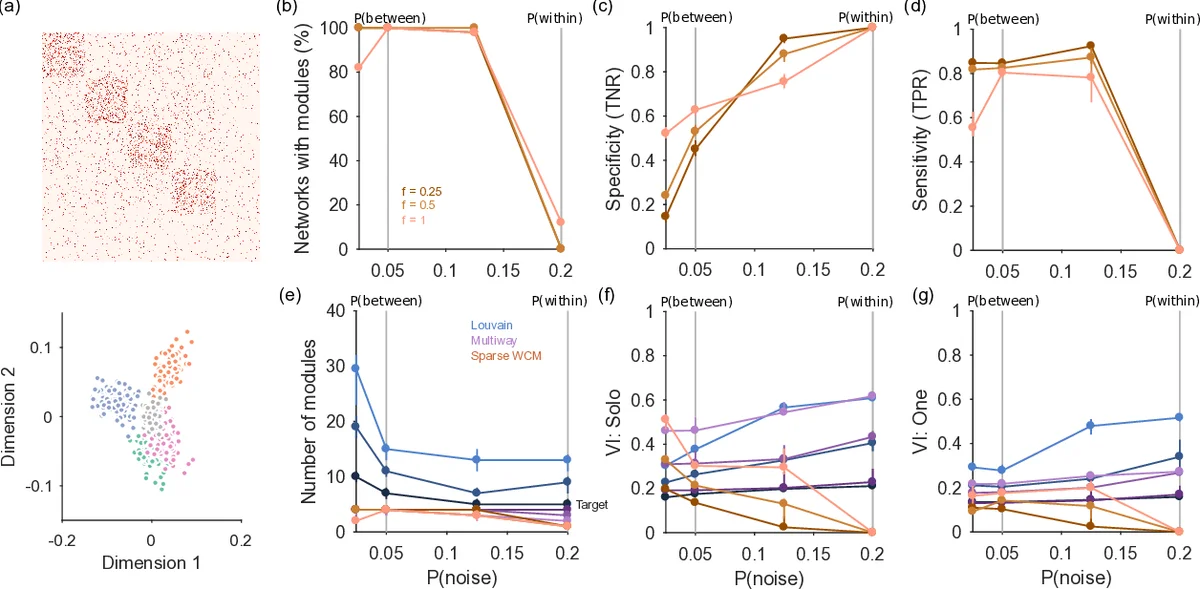
Synthetic experiments involve networks of 400 nodes divided into four planted communities. By varying the difference between within‑community and between‑community link probabilities (P(within) − P(between)), the authors show that spectral estimation sharply transitions from 0 % detection (no structure) to 100 % detection (clear modularity). Moreover, the number of eigenvalues above the null bound accurately predicts the true number of communities when the sparse WCM is used, while the full WCM overestimates it. Standard community‑detection algorithms (Louvain, multi‑way spectral clustering) are shown to detect communities even in purely random graphs and only achieve high accuracy when the planted structure is strong, highlighting their inability to signal the absence of structure.
A second set of synthetic tests adds “noise” nodes that are only weakly connected to the planted communities. By adjusting the noise‑node link probability P(noise) relative to P(within), the authors explore regimes from clear community signal to noise‑dominated graphs. Spectral estimation correctly identifies the presence of community structure when P(noise) < P(within) and declares its absence when P(noise) ≥ P(within). The node‑rejection step reliably isolates the noise nodes, especially at intermediate noise densities, while preserving almost all nodes belonging to the true communities.
Real‑world applications include a large co‑author network from the COSYNE conference and several social and biological networks. Traditional modularity‑based methods invariably report multiple communities, whereas spectral estimation often finds no statistically significant deviation from the null model, or it identifies a substantial fraction of nodes as noise. For the COSYNE network, the method concludes that the data are compatible with the null model, suggesting a lack of disciplinary boundaries among the authors—a conclusion opposite to that drawn from conventional community detection.
The paper emphasizes that the flexibility to select an appropriate null model is essential: different null models can lead to opposite conclusions about the existence and dimensionality of structure. By providing code (GitHub repository) and a clear algorithmic pipeline, the authors make the approach readily applicable to diverse domains.
In summary, this work offers a statistically principled, model‑agnostic spectral framework that simultaneously (i) tests whether a network contains low‑dimensional structure beyond a chosen null hypothesis, (ii) estimates the dimensionality of that structure, and (iii) isolates nodes that do not participate in it. The method outperforms standard community‑detection techniques in both detecting true structure and correctly recognizing its absence, and it opens new avenues for rigorous network analysis across scientific fields.
Comments & Academic Discussion
Loading comments...
Leave a Comment