27.5-29.5 GHz Switched Array Sounder for Dynamic Channel Characterization: Design, Implementation and Measurements
💡 Research Summary
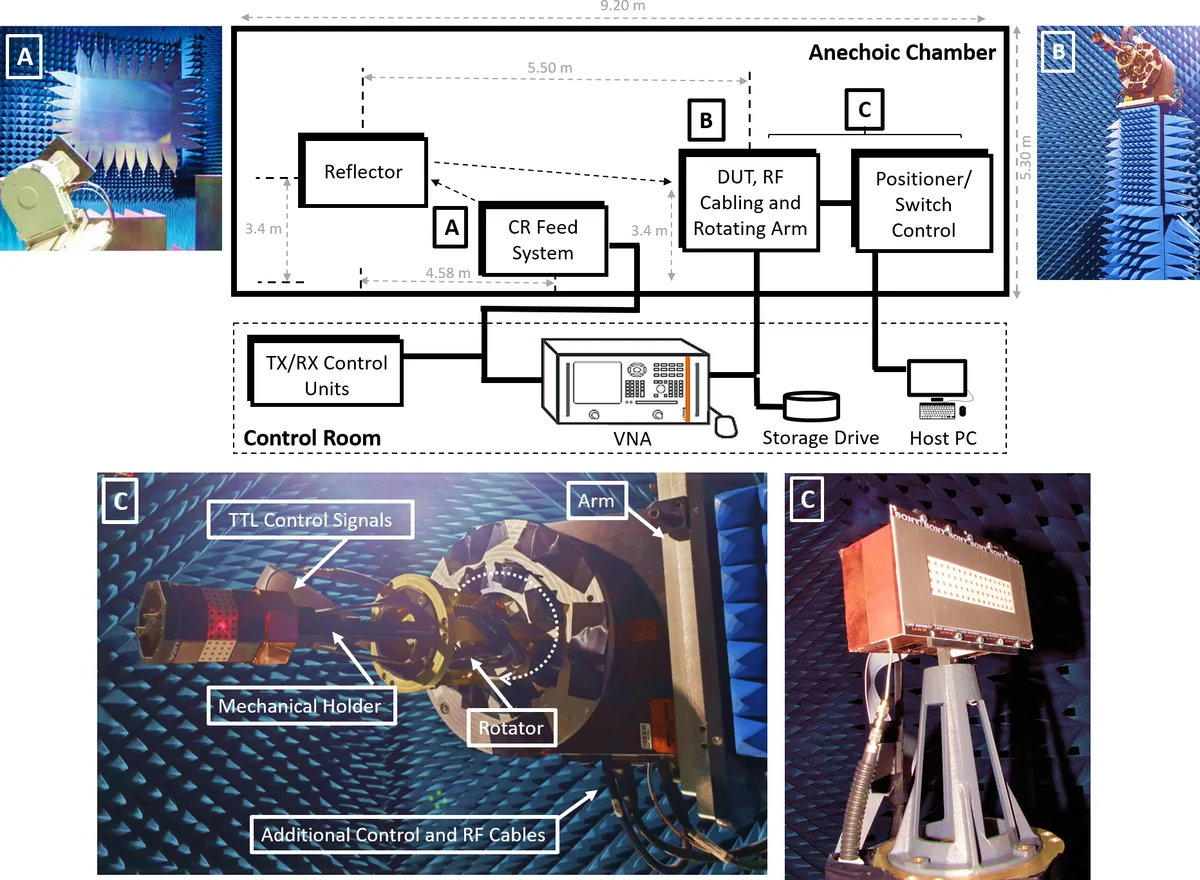
The paper presents a re‑configurable, switched‑array channel sounder operating in the 27.5–29.5 GHz band, capable of measuring 128 × 256 dual‑polarized MIMO channels within a single snapshot of roughly 600 ms. Traditional mmWave channel measurement setups rely on mechanically rotating horn antennas, which suffer from long acquisition times (tens of minutes) and limited angular resolution dictated by the horn beamwidth. To overcome these limitations, the authors design a high‑speed switching network based on cascaded SP4T switches, controlled by dedicated FPGAs at both the transmitter and receiver. The switching time, including processing latency, is about 18 µs, allowing a full 32,768‑channel MIMO snapshot to be captured in less than a second.
The antenna arrays are calibrated over a 4 GHz span (26–30 GHz) with dense angular sampling of 2° in azimuth and 5° in elevation, delivering an order‑of‑magnitude finer angular granularity than most existing mmWave sounders. The system supports up to 2 GHz instantaneous bandwidth (software‑tunable down to 1 GHz or less), providing nanosecond‑level delay resolution. Phase coherence between the transmitter and receiver local oscillators is maintained without a cabled connection, enabling coherent averaging of multiple complex waveforms (four are averaged per reception) to boost measurement SNR and dynamic range, which is especially valuable in high‑loss mmWave environments.
Measured data are processed with the high‑resolution RIMAX algorithm, exploiting the calibrated complex gains and phases of each antenna element to jointly estimate MPC amplitude, delay, azimuth/elevation angles, Doppler shift, and polarization. The authors demonstrate the sounder’s capabilities through static and dynamic measurements in an indoor office corridor at a 28 GHz center frequency and 1 GHz bandwidth. Dynamic scenarios reveal the appearance and disappearance of multipath components as scatterers move, while static measurements confirm the superior angular and delay resolution compared to rotating‑horn systems.
A key advantage of the proposed architecture is its flexibility: the number of measured channels, averaging count, polarization mode, bandwidth, and center frequency can be re‑configured in real time via software. The system can stream roughly 1 GB of raw measurement data per second, allowing efficient real‑time processing and storage. Overall, the work delivers a compact, high‑performance, and highly re‑configurable mmWave channel sounding platform that bridges the gap between the need for high‑resolution, dynamic channel characterization and the practical constraints of hardware complexity, cost, and measurement time—an essential tool for the development and validation of next‑generation 5G/6G mmWave communication systems.
Comments & Academic Discussion
Loading comments...
Leave a Comment