Modelling of thermal stratification at the top of a planetary core: Application to the cores of Earth and Mercury and the thermal coupling with their mantles
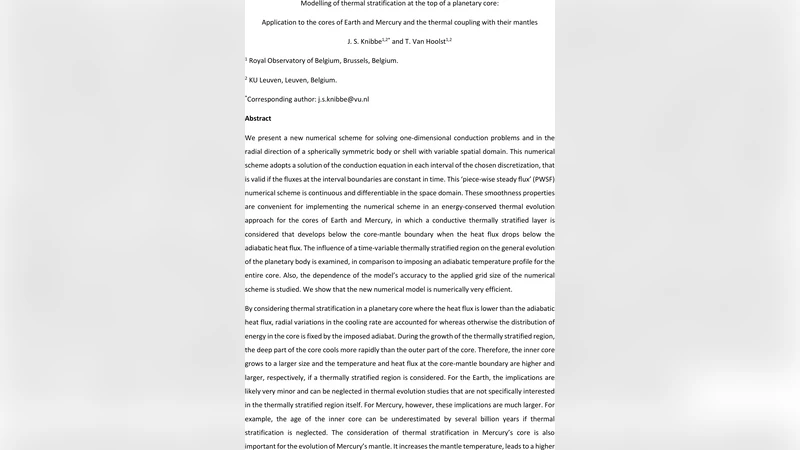
We present a new numerical scheme for one-dimensional conduction problems of a spherical shell. The scheme adopts a solution of the conduction equation in each interval of the chosen discretization that is valid if the fluxes at interval boundaries are constant in time. This piece-wise steady flux (PWSF) numerical scheme is continuous and differentiable in the space domain, which is convenient for implementing the numerical scheme in an energy-conserved thermal evolution model of a planetary core in which a conductive stratified layer develops below the core-mantle boundary when the heat flux is subadiabatic. The influence of a time-variable stratified region on the general evolution of the planetary body is examined, in comparison to imposing an adiabatic temperature profile for the core. By considering stratification in a planetary core where the heat flux is subadiabatic, radial variations in the cooling rate are accounted for whereas otherwise the distribution of energy in the core is fixed by the imposed adiabat. During the growth of the thermally stratified region, the deep part of the core cools more rapidly than the outer part of the core. Therefore, the inner core grows to a larger size and the temperature and heat flux at the core-mantle boundary are higher and larger, respectively, if a stratified region is considered. For the Earth, the implications are likely very minor and can be neglected in thermal evolution studies that are not specifically interested in the stratified region itself. For Mercury, these implications are much larger. For example, the age of the inner core can be underestimated by several billion years if thermal stratification is neglected. Consideration of thermal stratification in the core of Mercury also increases the mantle temperature, leads to a larger heat flux into the lithosphere, and prolongs mantle convection.
💡 Research Summary
The paper introduces a novel one‑dimensional conduction solver for spherical shells, called the Piece‑wise Steady Flux (PWSF) scheme. Unlike conventional finite‑difference approaches that treat the heat flux at each node as a time‑dependent variable, PWSF solves the steady‑state conduction equation analytically within each discretized interval, assuming that the fluxes at the interval boundaries remain constant over the time step. By stitching together these analytical solutions, the temperature field is continuous and differentiable throughout the shell, guaranteeing strict energy conservation when the scheme is embedded in planetary thermal evolution models.
Using this scheme, the authors examine the development of a thermally stratified layer at the top of a planetary core, which forms when the heat flux crossing the core‑mantle boundary (CMB) falls below the adiabatic heat flux that would be carried by a fully convecting core. In such a sub‑adiabatic regime, a conductive “stratified” region grows outward from the CMB, insulating the deeper core from the mantle. The model tracks the thickness of this layer over geological time and compares the results with a reference model that forces the entire core to follow an adiabatic temperature profile.
Key findings are as follows. First, the presence of a stratified layer creates a radial gradient in cooling rates: the deep core cools faster than the outer core because the conductive lid blocks heat loss from the region just beneath the CMB. Consequently, the inner core grows more rapidly, reaching a larger radius at any given age. Second, the temperature at the CMB rises and the heat flux emerging from the stratified region increases, feeding more energy into the mantle. Third, the enhanced mantle heat input raises mantle temperatures, boosts the surface heat flux, and prolongs the duration of mantle convection.
When the model is applied to Earth, the present‑day CMB heat flux is only marginally sub‑adiabatic, so the stratified layer remains thin and its impact on the overall thermal history is negligible. For most Earth‑focused thermal evolution studies, the simpler adiabatic‑core assumption is therefore justified.
In contrast, Mercury’s low CMB heat flux and high core‑to‑mantle mass ratio place it firmly in the sub‑adiabatic regime. The simulations show that neglecting thermal stratification can underestimate the age of Mercury’s inner core by several billion years. Moreover, the conductive lid raises the CMB temperature by tens of kelvin, which in turn lifts mantle temperatures, increases the heat flow into the lithosphere, and sustains mantle convection for a longer interval than would be predicted without stratification. These effects have direct implications for Mercury’s magnetic field history, surface volcanism, and tectonic evolution.
Overall, the PWSF scheme provides a robust, energy‑conserving tool for modeling planetary cores where non‑adiabatic heat transport is important. By capturing the feedback between a growing conductive layer, inner‑core growth, and mantle heat exchange, the method reveals dynamics that are invisible to models that impose a uniform adiabat. The authors suggest that future work could extend the scheme to multi‑dimensional convection‑conduction coupling, incorporate compositional buoyancy, and apply it to other bodies (e.g., Mars, exoplanets) where sub‑adiabatic CMB conditions may be common.