The Landscape of Academic Literature in Quantum Technologies
In this study, we investigated the academic literature on quantum technologies (QT) using bibliometric tools. We used a set of 49,823 articles obtained from the Web of Science (WoS) database using a search query constructed through expert opinion. Analysis of this revealed that QT is deeply rooted in physics, and the majority of the articles are published in physics journals. Keyword analysis revealed that the literature could be clustered into three distinct sets, which are (i) quantum communication/cryptography, (ii) quantum computation, and (iii) physical realizations of quantum systems. We performed a burst analysis that showed the emergence and fading away of certain key concepts in the literature. This is followed by co-citation analysis on the highly cited articles provided by the WoS, using these we devised a set of core corpus of 34 publications. Comparing the most highly cited articles in this set with respect to the initial set we found that there is a clear difference in most cited subjects. Finally, we performed co-citation analyses on country and organization levels to find the central nodes in the literature. Overall, the analyses of the datasets allowed us to cluster the literature into three distinct sets, construct the core corpus of the academic literature in QT, and to identify the key players on country and organization levels, thus offering insight into the current state of the field. Search queries and access to figures are provided in the appendix.
💡 Research Summary
**
This paper presents a comprehensive bibliometric analysis of the scholarly literature on quantum technologies (QT). Using the Web of Science (WoS) database, the authors assembled an initial corpus of 49,823 records based on a search query that combined expert‑derived terms (e.g., “quantum computing”, “quantum sensing”, “quantum communication”) with feedback from five domain specialists. After removing proceedings and articles with zero citations or references, a curated set of 42,530 papers remained for detailed analysis.
The study first characterises the disciplinary distribution of QT research. Approximately 85 % of the papers fall under the WoS categories “Physics” and “Optics”, and the majority of the top‑ranked journals are physics‑focused (e.g., Physical Review A). A Pareto‑type assessment shows that 87 % of the articles are published in the top 20 % of journals, indicating that the field, while mature in its physics core, has not yet reached the dispersion typical of fully established disciplines.
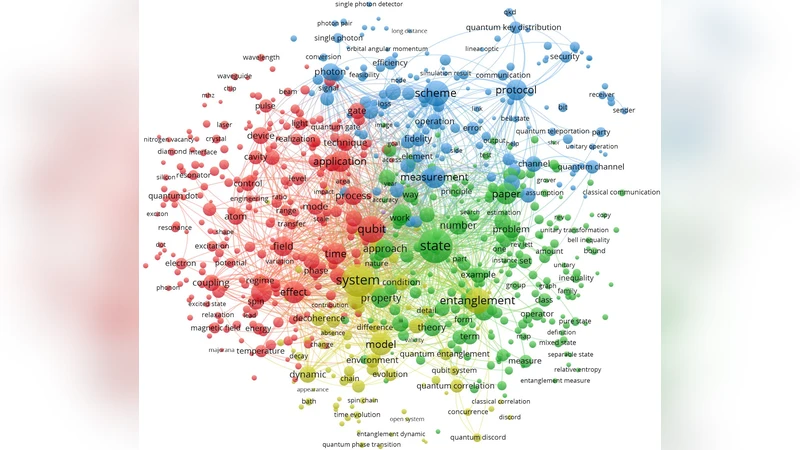
Keyword co‑occurrence mapping (VOSviewer) was performed on terms appearing at least 200 times in titles or abstracts (the top 60 % of keywords). Three robust clusters emerged:
- Physical Realizations (red) – experimental platforms such as superconducting circuits, trapped ions, and other hardware implementations.
- Quantum Communication & Cryptography (blue) – topics like quantum key distribution (QKD) and secure communication protocols.
- Quantum Computation & Information Theory (green) – algorithms, error correction, and theoretical measures (entanglement, discord).
When the full keyword set (100 %) is analysed, a fourth cluster appears, gathering more abstract theoretical concepts (entanglement, master equations, phase transitions). This demonstrates that higher‑resolution analyses can reveal sub‑fields within the broader clusters.
Temporal dynamics were explored through burst detection based on Kleinberg’s algorithm applied to author‑supplied keywords. Two density parameters were examined. With a lower gamma (1.2), strong, long‑lasting bursts were identified for “quantum computation” (peak around 2009) and “quantum teleportation” (a decade‑long burst ending around 2010). With a higher gamma (2.0), a broader set of 69 bursting terms surfaced, highlighting recent surges (2015‑2019) in “quantum coherence”, “quantum simulation”, “quantum annealing”, “quantum networks”, “quantum sensing”, and even interdisciplinary topics such as “ads‑cft correspondence”. Frequency checks confirmed that the algorithm correctly captures emerging versus stabilising concepts: for instance, “quantum teleportation” has plateaued at ~0.7 % of keyword occurrences since 2000, whereas “quantum annealing” only recently crossed that threshold.
Collaboration trends were quantified by counting the number of authors per paper over time. Across the entire dataset, the average number of authors rose from about two in the early 1990s to 4.5 in 2019. After 2013, the modal number of authors shifted from two to three, indicating a steady move toward larger, more interdisciplinary teams. Sub‑analyses limited to papers with fewer than 50 or 10 authors showed the same upward trajectory, confirming that the collaborative intensification is a field‑wide phenomenon rather than an artifact of large consortia.
To identify the “core corpus” of QT literature, the authors retrieved the WoS “Highly Cited Articles” (HCA) list for the same query, comprising 808 items with an average of 234.59 citations per paper. From this set, 34 papers were selected as the most influential (based on citation counts and network centrality). Comparing the thematic composition of the HCA core with the broader corpus revealed a shift: the core is heavily weighted toward experimental hardware and physical implementation studies, whereas the broader literature contains a larger proportion of algorithmic and cryptographic work. This suggests that funding and citation impact are currently more aligned with tangible quantum devices than with purely theoretical advances.
Finally, co‑citation networks at the country and institutional levels were constructed. The analysis shows strong inter‑connections among U.S. and European institutions, reflecting extensive trans‑Atlantic collaborations. In contrast, Chinese and Japanese institutions exhibit denser internal linkages and fewer cross‑regional ties, implying a more nationally focused research ecosystem.
In summary, the paper answers its five research questions:
- RQ1 – Field composition: QT research clusters into three major domains—physical implementations, quantum computation/information theory, and quantum communication/cryptography—each with distinct keyword signatures.
- RQ2 – Emerging/disappearing concepts: Burst analysis uncovers a transition from early focus on computation and teleportation toward newer interests such as quantum annealing, coherence, sensing, and networked quantum systems.
- RQ3 – Collaboration: The steady rise in average authors per paper demonstrates that QT has become increasingly collaborative over the past three decades, especially since the early 2010s.
- RQ4 – Core corpus: A concise set of 34 highly cited papers forms the field’s intellectual backbone, emphasizing experimental hardware and implementation over purely theoretical work.
- RQ5 – Key players: International co‑citation maps identify U.S. and European institutions as central hubs, while Chinese and Japanese entities are more internally clustered.
Overall, the study provides a data‑driven portrait of quantum technologies as a physics‑centric but rapidly diversifying discipline. It highlights the field’s evolution from foundational theory toward applied hardware and networked systems, underscores the growing importance of large, interdisciplinary collaborations, and offers a baseline for policymakers and funding agencies to monitor future developments.
Comments & Academic Discussion
Loading comments...
Leave a Comment