Automated Mechanism Design via Neural Networks
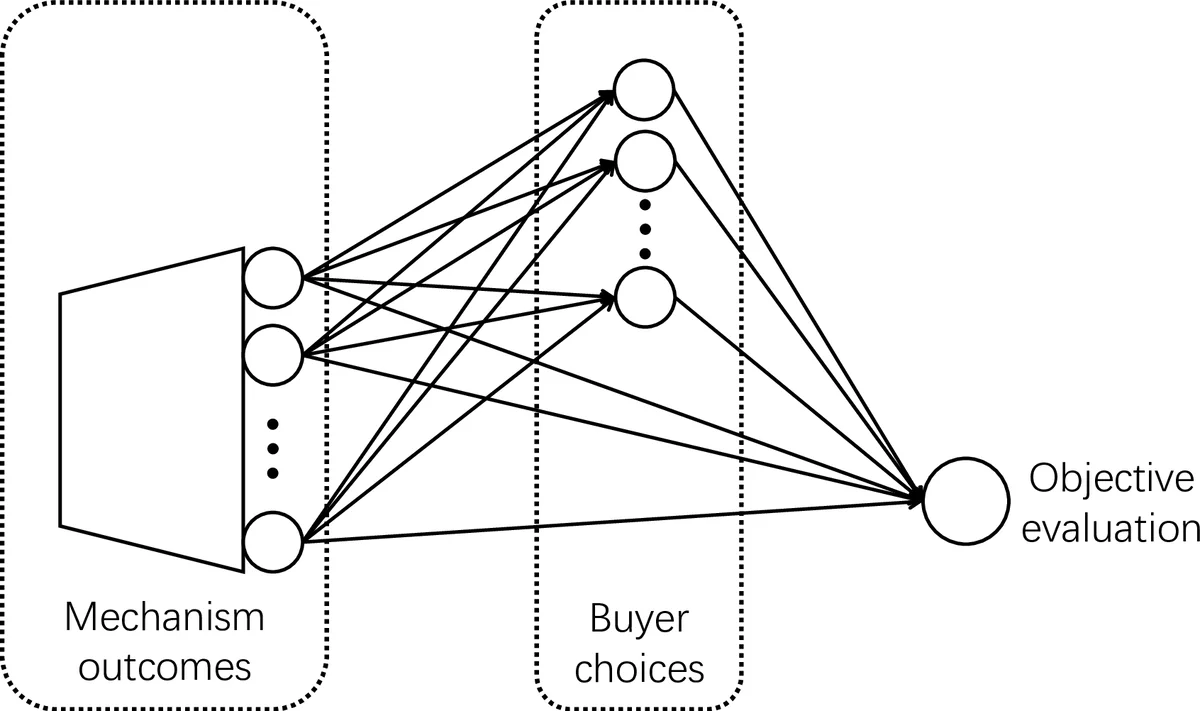
Using AI approaches to automatically design mechanisms has been a central research mission at the interface of AI and economics [Conitzer and Sandholm, 2002]. Previous approaches that attempt to design revenue optimal auctions for the multi-dimensional settings fall short in at least one of the three aspects: 1) representation – search in a space that probably does not even contain the optimal mechanism; 2) exactness – finding a mechanism that is either not truthful or far from optimal; 3) domain dependence – need a different design for different environment settings. To resolve the three difficulties, in this paper, we put forward – MenuNet – a unified neural network based framework that automatically learns to design revenue optimal mechanisms. Our framework consists of a mechanism network that takes an input distribution for training and outputs a mechanism, as well as a buyer network that takes a mechanism as input and output an action. Such a separation in design mitigates the difficulty to impose incentive compatibility constraints on the mechanism, by making it a rational choice of the buyer. As a result, our framework easily overcomes the previously mentioned difficulty in incorporating IC constraints and always returns exactly incentive compatible mechanisms. We then apply our framework to a number of multi-item revenue optimal design settings, for a few of which the theoretically optimal mechanisms are unknown. We then go on to theoretically prove that the mechanisms found by our framework are indeed optimal. To the best of our knowledge, we are the first to apply neural networks to discover optimal auction mechanisms with provable optimality.
💡 Research Summary
The paper tackles the long‑standing challenge of automated mechanism design (AMD) for multi‑dimensional auctions by introducing a novel neural‑network framework called MenuNet. Traditional AMD approaches have struggled with three core issues: (1) limited representation spaces that may not contain the true optimal mechanism, (2) lack of exact incentive compatibility (IC) or optimality, and (3) heavy dependence on the specific domain, requiring a new design for each environment. MenuNet simultaneously addresses all three.
MenuNet consists of two components. The Mechanism Network receives a description of the buyer’s value distribution (continuous or discrete) and outputs a menu, i.e., a list of (valuation, outcome) tuples. Each menu item specifies an allocation (probabilistic or deterministic) together with a price. The Buyer Network takes this menu as input and returns the buyer’s chosen action. Crucially, the buyer network is not trained; it simply implements a rational‑choice rule (an arg‑max over the buyer’s utility). By letting the buyer select the menu item that maximizes her utility, the framework automatically satisfies the taxation principle, guaranteeing that the resulting mechanism is exactly IC and individually rational (IR) without any additional constraints or penalty terms.
This design yields several advantages. First, representing mechanisms as menus provides a complete design space: any feasible mechanism can be expressed as a menu, avoiding the restrictive parametric forms used in prior work. Second, because IC is enforced by the buyer’s rational choice, the mechanism network does not need to encode IC constraints explicitly, eliminating the need for Lagrange multipliers, projection steps, or handcrafted regularizers. Third, the architecture is domain‑agnostic; swapping the input distribution is sufficient to adapt the system to a new environment, eliminating the need for problem‑specific network architectures.
The authors evaluate MenuNet on a suite of single‑buyer, multi‑item settings. They consider independent uniform distributions over squares and rectangles, correlated triangular domains defined by (v_1/c + v_2 \le 1), and scenarios where the menu size is explicitly limited (e.g., at most 2 or 3 items). For each case, the mechanism network is trained to maximize expected revenue, while the buyer network simply selects the utility‑maximizing menu item. Expected revenues are computed analytically from the learned menus and compared against known optimal revenues where available. Table 1 reports that MenuNet’s solutions achieve ≥ 99.99 % of the optimal revenue across all tested instances, confirming that the learned mechanisms are essentially optimal.
Beyond reproducing known results, the paper discovers new optimal mechanisms in two settings and provides rigorous proofs for them.
- Restricted menu size (≤ 3) for an additive buyer with values drawn from (U
Comments & Academic Discussion
Loading comments...
Leave a Comment