Reconstruction of rational ruled surfaces from their silhouettes
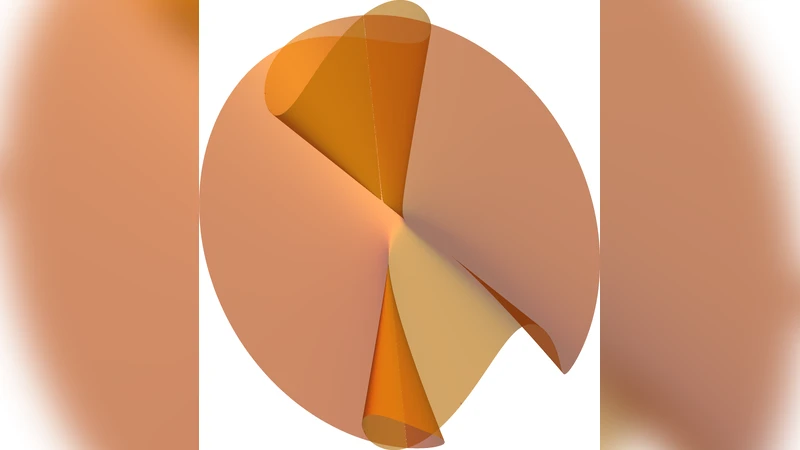
We provide algorithms to reconstruct rational ruled surfaces in three-dimensional projective space from the `apparent contour’ of a single projection to the projective plane. We deal with the case of tangent developables and of general projections to $\mathbb{p}^3$ of rational normal scrolls. In the first case, we use the fact that every such surface is the projection of the tangent developable of a rational normal curve, while in the second we start by reconstructing the rational normal scroll. In both instances we then reconstruct the correct projection to $\mathbb{p}^3$ of these surfaces by exploiting the information contained in the singularities of the apparent contour.
💡 Research Summary
The paper addresses the inverse problem of reconstructing a rational ruled surface in projective three‑space P³ from the apparent contour (silhouette) obtained by a single projection onto the projective plane P². Two distinct families of ruled surfaces are considered: (1) tangent developable surfaces, i.e., the union of all tangents to a space curve, and (2) general rational normal scrolls. The authors exploit the algebraic structure of the discriminant of the projection, which factorises into a triple component (the cuspidal image), a double component (the nodal image), and several simple linear factors (the proper silhouette).
For tangent developables, the key observation is that any such surface is a projection of the tangent developable Tₙ of a rational normal curve of degree d in Pᵈ. The discriminant of a generic projection of Tₙ to P² contains a factor of multiplicity three whose zero set is the projected cuspidal curve, a factor of multiplicity two whose zero set is the projected nodal curve, and linear factors corresponding to the images of the torsal rulings. The reconstruction algorithm (ReconstructTangentDevelopable) proceeds as follows: (i) compute a rational parametrisation (H₀:H₁:H₂) of the cuspidal image C; (ii) introduce an unknown fourth homogeneous polynomial H₃ of degree d; (iii) form the 4 × 4 matrix whose rows consist of the third derivatives of the Hᵢ with respect to the parameter t, and compute its determinant; (iv) select the set T of 4(d − 3) transverse intersection points of C and the nodal image D (these are the projected cuspidal pinch points); (v) impose that the determinant vanishes at each point of T, yielding a linear system for the coefficients of H₃; (vi) solve the system, obtaining H₃ up to linear combinations of H₀, H₁, H₂. Lemma 2.4 proves that the solution space is exactly four‑dimensional, guaranteeing uniqueness of the reconstructed space curve (H₀:H₁:H₂:H₃) and consequently of the original tangent developable surface in P³.
For rational normal scrolls, the approach starts by identifying the scroll from the silhouette. Using the µ‑basis of the parametrisation, the authors embed the scroll into a higher‑dimensional projective space Pⁿ⁺¹, where its dual curve coincides with the proper silhouette. The scroll’s parametrisation is recovered from the cuspidal and nodal images, after which the final step is to determine a linear projection π from Pⁿ⁺¹ to P³ that reproduces the observed singular image. This projection is obtained by solving a linear system derived from the constraints imposed by the nodal image (double component of the discriminant). The most computationally intensive part is the construction of the µ‑basis and the high‑dimensional embedding; the projection step itself involves only linear algebra.
The paper also supplies a specialised algorithm for parametrising planar rational curves that appear as silhouettes, noting that generic parametrisation methods are often a bottleneck. By exploiting the specific structure of the silhouettes (e.g., the known multiplicities of intersection points), the authors achieve a significant speed‑up.
All algorithms have been implemented in Maple (available at the authors’ website), and experimental results demonstrate that the new methods are faster than the more general reconstruction techniques previously described by the same authors. The work contributes both theoretical insight—linking discriminant factor multiplicities to geometric features of ruled surfaces—and practical tools for computer vision, computer graphics, and algebraic geometry applications where recovering three‑dimensional geometry from a single view is required.
Comments & Academic Discussion
Loading comments...
Leave a Comment