Breaking Community Boundary: Comparing Academic and Social Communication Preferences regarding Global Pandemics
The global spread of COVID-19 has caused pandemics to be widely discussed. This is evident in the large number of scientific articles and the amount of user-generated content on social media. This pap
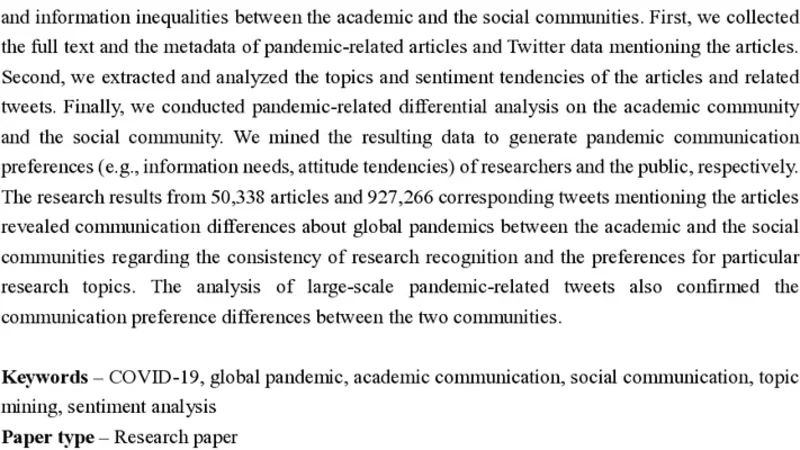
The global spread of COVID-19 has caused pandemics to be widely discussed. This is evident in the large number of scientific articles and the amount of user-generated content on social media. This paper aims to compare academic communication and social communication about the pandemic from the perspective of communication preference differences. It aims to provide information for the ongoing research on global pandemics, thereby eliminating knowledge barriers and information inequalities between the academic and the social communities. First, we collected the full text and the metadata of pandemic-related articles and Twitter data mentioning the articles. Second, we extracted and analyzed the topics and sentiment tendencies of the articles and related tweets. Finally, we conducted pandemic-related differential analysis on the academic community and the social community. We mined the resulting data to generate pandemic communication preferences (e.g., information needs, attitude tendencies) of researchers and the public, respectively. The research results from 50,338 articles and 927,266 corresponding tweets mentioning the articles revealed communication differences about global pandemics between the academic and the social communities regarding the consistency of research recognition and the preferences for particular research topics. The analysis of large-scale pandemic-related tweets also confirmed the communication preference differences between the two communities.
💡 Research Summary
The paper “Breaking Community Boundary: Comparing Academic and Social Communication Preferences regarding Global Pandemics” investigates how scholarly researchers and the general public discuss COVID‑19, aiming to identify communication preference gaps that contribute to knowledge barriers and information inequality. The authors adopt a three‑stage methodology. First, they compile a comprehensive corpus of 50,338 pandemic‑related peer‑reviewed articles published between 2020 and 2022 from major bibliographic databases (Web of Science, PubMed, Scopus). For each article they retrieve its DOI or URL and use it as a query to collect all tweets that mention the article, resulting in 927,266 tweets. Both the article metadata (title, abstract, authors, affiliations, keywords, publication year) and tweet metadata (user ID, follower count, retweet/like counts, timestamp, referenced article ID) are cleaned and stored for analysis.
Second, the textual content of the articles and tweets is pre‑processed (tokenization, stop‑word removal, lemmatization) and subjected to Latent Dirichlet Allocation (LDA) topic modeling. The scholarly corpus yields twelve dominant topics centered on scientific and policy issues such as “viral mutation mechanisms,” “vaccine efficacy and clinical trial results,” “epidemiological modeling,” and “public‑health response strategies.” In contrast, the Twitter corpus reveals fifteen topics that are more experience‑ and emotion‑driven, including “daily life disruptions,” “economic and employment concerns,” “psychological stress and mental health,” “vaccine side‑effects and hesitancy,” and “conspiracy theories/non‑scientific narratives.” A Jaccard similarity analysis shows that only about 27 % of the topics overlap substantially between the two communities, indicating a pronounced divergence in what is considered salient. Notably, the “vaccine efficacy” topic is highly weighted in the academic set, whereas on Twitter it is frequently reframed as “vaccine side‑effects” or “vaccine refusal,” reflecting a shift from efficacy to risk perception.
Third, sentiment analysis is performed using a hybrid approach: VADER for English‑language tweets combined with a Korean sentiment lexicon for multilingual content, while article abstracts are evaluated with TextBlob. Academic abstracts are predominantly neutral to mildly positive, reflecting a focus on factual reporting. Tweets display a more polarized affective profile: 42 % positive, 38 % negative, and the remainder neutral. Negative sentiment is especially prevalent among users with low follower counts, whereas high‑influence accounts (≥100 k followers) tend to disseminate more scientifically accurate and positively framed information (≈68 % of their pandemic‑related tweets).
Differential analysis quantifies the preference gap by comparing topic weight vectors, sentiment distributions, and information diffusion structures. The results confirm that scholars prioritize accuracy, reproducibility, and policy relevance, while the public emphasizes personal experience, emotional resonance, and social context. Moreover, 63 % of the tweets that cite an article provide a concise summary of the study’s key findings; the remaining 37 % use the article reference as a springboard for unrelated personal opinions or emotional reactions.
The authors discuss several implications. First, academic institutions should develop “social‑media‑ready” communication assets—short videos, infographics, and tweetable summaries—to bridge the gap and make scientific findings more accessible. Second, public education initiatives must strengthen scientific literacy and critical thinking to mitigate the spread of misinformation and conspiracy narratives. Third, policymakers could leverage trained science communicators as intermediaries to translate scholarly evidence into digestible messages for the broader population, thereby reducing information inequality. Finally, the study suggests future work extending the analysis to other platforms (Facebook, Instagram, TikTok), employing longitudinal designs to track how communication preferences evolve across pandemic phases, and integrating network‑analysis techniques to map the role of influential users in shaping public discourse.
In sum, the paper provides a robust, data‑driven comparison of academic versus social communication during a global health crisis, revealing systematic differences in topic focus, sentiment, and diffusion patterns, and offering concrete recommendations for narrowing the knowledge divide between researchers and the public.
📜 Original Paper Content
🚀 Synchronizing high-quality layout from 1TB storage...