The open access effect in social media exposure of scholarly articles: A matched-pair analysis
💡 Research Summary
The paper investigates how open‑access (OA) links perform on social‑media platforms compared with traditional paid‑content links, using a matched‑pair design that exploits a unique dataset from the journal Nature Materials. Between May 2017 and July 2019 the journal’s official accounts on Twitter and Facebook posted short‑links to newly published articles. For each article, two short‑links were provided: an OA “read‑only” link (anyone could view the article but could not download, print or save) and a paid‑content link (accessible only to subscribers with full functionality). The authors retrieved click‑through data for each link via the Bitly API, capturing total clicks, click‑origin countries, referrers and domains.
After removing duplicate postings (18 articles duplicated) and 11 anomalous posts with unusually high clicks from a single country, the final analytical sample comprised 417 posts (175 before 21 Sept 2018, 242 after). This natural matched‑case‑control set allowed a direct comparison of OA versus paid links for the same article within the same social‑media post.
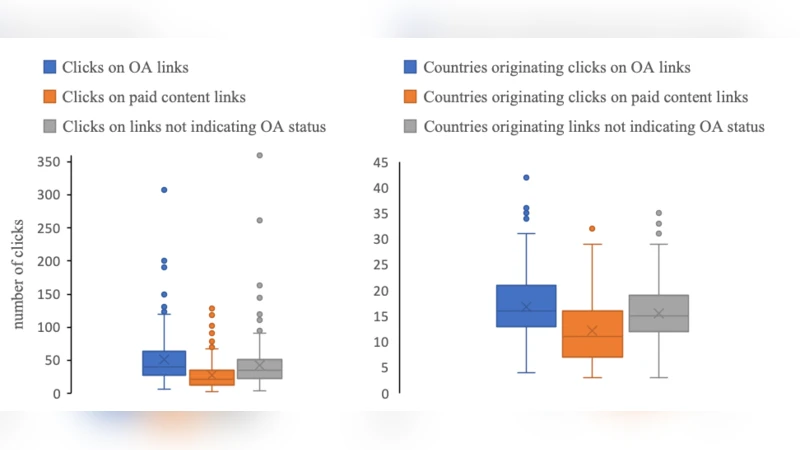
Descriptive statistics show that OA links received a median of 41 clicks, roughly double the median of 21 clicks for paid links. OA links also attracted visitors from a median of 16 countries, compared with 11 for paid links, indicating broader geographic reach. When the OA status was omitted (the “no‑status” links used after September 2018), median clicks (35) and median country count (15) fell between the OA and paid figures, suggesting that explicit OA labeling boosts user engagement.
Platform‑specific analysis revealed a pronounced difference: on Twitter, OA links garnered a median of 24 clicks versus only 5 for paid links, whereas on Facebook the median was 7.5 for OA and 9 for paid links. The authors hypothesize that Twitter’s audience is more likely to include the general public and non‑subscribers, who preferentially click OA links, while Facebook users tend to be researchers sharing within professional networks where subscription access is more common.
A paired‑difference test confirmed that the click advantage of OA links is statistically significant (p < 0.01). The effect persisted across regions, though it was slightly stronger in developed countries than in developing ones, aligning with prior literature that OA reduces access barriers especially where subscription budgets are limited.
The study acknowledges several limitations: it focuses on a single high‑impact journal, limiting generalizability; it measures only click‑throughs, not downstream behaviors such as full‑text downloads, reading time, or citation impact; and the observation window spans just over two years, precluding long‑term trend analysis. Future work should incorporate multiple journals across disciplines, extend the observation period, and link click data to bibliometric outcomes to more fully capture the OA advantage in the social‑media ecosystem.
In conclusion, the research provides robust empirical evidence that, within social‑media promotion, OA links attract significantly more clicks and a more diverse international audience than paid‑content links. Explicitly marking a link as OA further amplifies this effect, especially on open platforms like Twitter. These findings offer actionable insights for publishers and researchers seeking to maximize the visibility and societal impact of scholarly work through combined OA and social‑media strategies.
Comments & Academic Discussion
Loading comments...
Leave a Comment