Does the geographic proximity effect on knowledge spillovers vary across research fields?
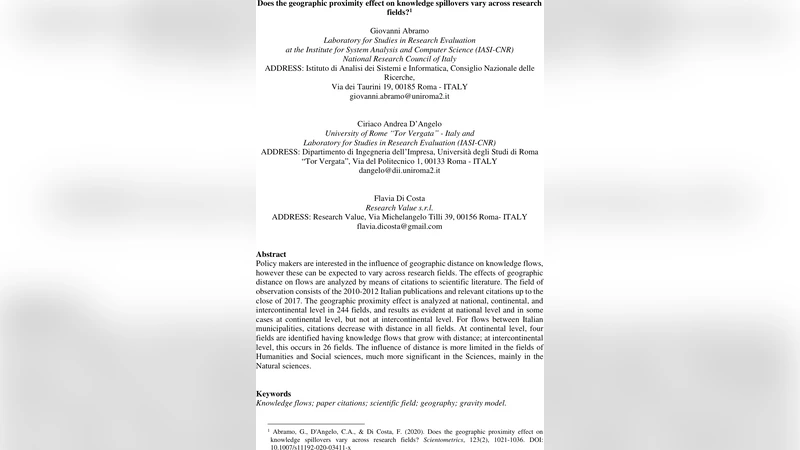
Policy makers are interested in the influence of geographic distance on knowledge flows, however these can be expected to vary across research fields. The effects of geographic distance on flows are analyzed by means of citations to scientific literature. The field of observation consists of the 2010-2012 Italian publications and relevant citations up to the close of 2017. The geographic proximity effect is analyzed at national, continental, and intercontinental level in 244 fields, and results as evident at national level and in some cases at continental level, but not at intercontinental level. For flows between Italian municipalities, citations decrease with distance in all fields. At continental level, four fields are identified having knowledge flows that grow with distance; at intercontinental level, this occurs in 26 fields. The influence of distance is more limited in the fields of Humanities and Social sciences, much more significant in the Sciences, mainly in the Natural sciences.
💡 Research Summary
The paper investigates whether the effect of geographic proximity on knowledge spillovers, measured through scientific citations, varies across research fields. Using a comprehensive dataset of Italian publications from 2010‑2012 and all citations they received up to the end of 2017, the authors construct a citation‑based network in which each citation is assigned a geographic distance based on the location of the citing author’s institution. Distances are categorized at three hierarchical levels: (i) national (within Italy, between municipalities), (ii) continental (between European countries), and (iii) inter‑continental (between Europe and the rest of the world). For each level, distances are further divided into five bands (0‑100 km, 100‑500 km, 500‑2000 km, 2000‑5000 km, >5000 km). The analysis covers 244 distinct research fields, which are later grouped into broad categories such as Humanities & Social Sciences, Natural Sciences & Engineering, and Health & Biomedical Sciences.
Methodologically, the study employs multivariate regression models where the dependent variable is the log‑transformed citation count for each paper‑citation pair. Independent variables include dummy variables for each distance band, field fixed effects, year fixed effects, and controls for journal impact factor and paper length. This specification isolates the pure effect of geographic distance while accounting for field‑specific citation cultures and temporal trends. The authors also estimate field‑specific distance coefficients (β) to assess whether the sign and magnitude of the distance effect differ across disciplines.
Key findings are as follows:
-
National level – In 239 out of 244 fields (≈98 %), citations decline with increasing distance between Italian municipalities. The negative distance coefficient is strongest in the Natural Sciences and Engineering, reflecting the importance of shared laboratories, equipment, and face‑to‑face collaboration for these disciplines.
-
Continental level – Only four fields (≈1.6 %) exhibit a positive distance‑citation relationship. These fields are characterized by large‑scale, internationally coordinated projects (e.g., high‑energy physics, space science, climate modeling) where broader geographic dispersion of partners appears to enhance visibility and citation impact.
-
Inter‑continental level – A more substantial set of 26 fields (≈10.7 %) show a positive distance effect. The majority belong to emerging, technology‑intensive domains such as artificial intelligence, data science, bio‑informatics, neuroscience, and advanced materials. In these areas, global data repositories, cloud‑based platforms, and multinational consortia mitigate the friction of physical distance, turning it into an advantage for citation performance.
-
Disciplinary variation – Humanities and Social Sciences display the weakest distance effects, suggesting that cultural and linguistic proximity outweigh physical proximity for knowledge diffusion in these fields. Conversely, the Natural Sciences and Engineering display the most pronounced negative distance effects at the national level, underscoring the role of localized research infrastructure.
-
Policy implications – The authors argue that national science policy should prioritize the development of regional research clusters, improve transportation and digital connectivity, and fund intra‑national mobility schemes to strengthen domestic knowledge spillovers. At the continental and inter‑continental scales, targeted support for fields that benefit from wide geographic dispersion—such as AI, bio‑informatics, and large‑scale physics—could amplify the positive spillover effects of distance.
Overall, the study demonstrates that geographic proximity is not a uniform determinant of knowledge flow. Its influence is highly contingent on the nature of the research field: it is a strong inhibitor in equipment‑intensive natural sciences, a modest factor in humanities, and even a catalyst in globally networked, data‑driven disciplines. These nuanced insights provide a valuable evidence base for designing differentiated research and innovation policies that align with the specific spatial dynamics of each scientific domain.