Against the Tyranny of Pure States in Quantum Theory
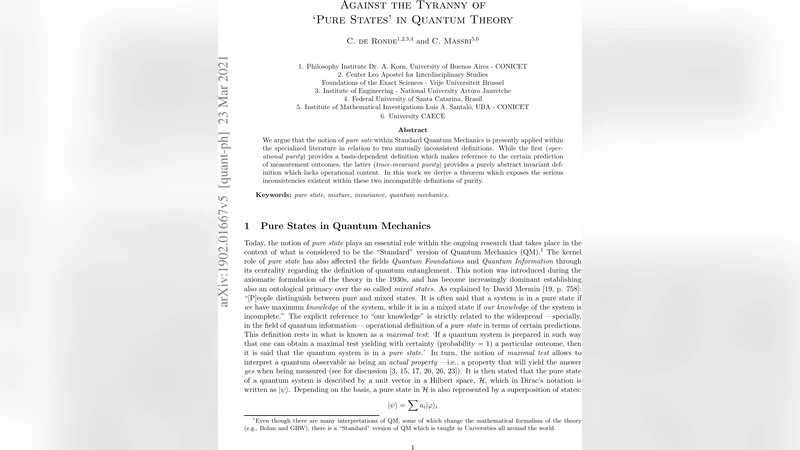
We argue that the notion of pure sate within Standard Quantum Mechanics is presently applied within the specialized literature in relation to two mutually inconsistent definitions. While the first (operational purity) provides a basis-dependent definition which makes reference to the certain prediction of measurement outcomes, the latter (trace-invariant purity) provides a purely abstract invariant definition which lacks operational content. In this work we derive a theorem which exposes the serious inconsistencies existent within these two incompatible definitions of purity.
💡 Research Summary
The paper “Against the Tyranny of Pure States in Quantum Theory” examines a deep conceptual inconsistency that has been largely overlooked in the standard formulation of quantum mechanics. It identifies two distinct ways in which the notion of a pure state is used in the literature. The first, which the authors call “operational purity,” is rooted in an experimental or operational perspective: a quantum system is said to be in a pure state if there exists a maximal measurement (a specific basis) that yields a particular outcome with certainty (probability = 1). This definition is basis‑dependent and ties the concept of purity to the existence of a deterministic prediction for a specific observable.
The second definition, “trace‑invariant purity,” is purely mathematical. A density operator ρ is called pure if Tr(ρ²)=1, which is equivalent to ρ being a rank‑one projector ρ=|ψ⟩⟨ψ|. This condition is invariant under any unitary change of basis; it does not refer to any particular measurement outcome and therefore lacks direct operational content.
The authors argue that the standard quantum‑mechanics textbooks and much of the quantum‑information literature implicitly treat these two definitions as equivalent, but this equivalence is false. They show that while every operationally pure state necessarily satisfies Tr(ρ²)=1, the converse does not hold: a density matrix with Tr(ρ²)=1 may fail to guarantee a deterministic outcome for a given measurement unless the measurement basis coincides with the eigenbasis of the state. Consequently, the two notions are mutually incompatible except in the special case where the measurement basis is aligned with the state’s eigenbasis.
To make the inconsistency explicit, the paper presents a theorem: “Operational purity implies trace‑invariant purity, but not vice‑versa.” The proof proceeds by taking a pure state |ψ⟩ and applying an arbitrary unitary transformation U that changes the measurement basis. While |ψ⟩ yields a certain outcome in its original basis, the transformed state U|ψ⟩ does not necessarily yield a certain outcome in the new basis, even though Tr
Comments & Academic Discussion
Loading comments...
Leave a Comment