Universal discriminative quantum neural networks
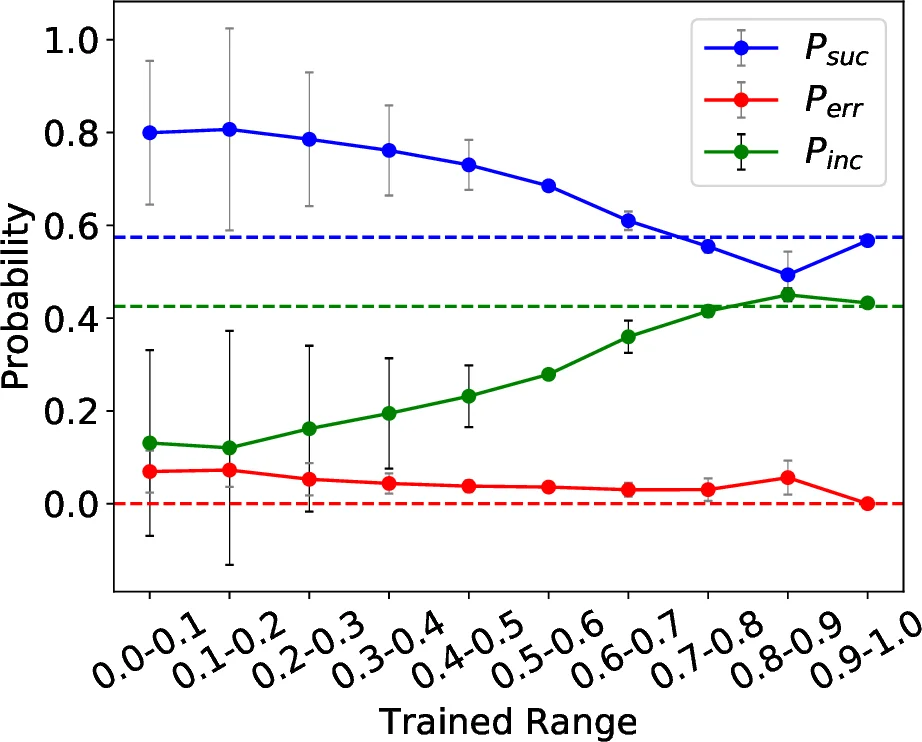
Quantum mechanics fundamentally forbids deterministic discrimination of quantum states and processes. However, the ability to optimally distinguish various classes of quantum data is an important primitive in quantum information science. In this work, we train near-term quantum circuits to classify data represented by non-orthogonal quantum probability distributions using the Adam stochastic optimization algorithm. This is achieved by iterative interactions of a classical device with a quantum processor to discover the parameters of an unknown non-unitary quantum circuit. This circuit learns to simulates the unknown structure of a generalized quantum measurement, or Positive-Operator-Value-Measure (POVM), that is required to optimally distinguish possible distributions of quantum inputs. Notably we use universal circuit topologies, with a theoretically motivated circuit design, which guarantees that our circuits can in principle learn to perform arbitrary input-output mappings. Our numerical simulations show that shallow quantum circuits could be trained to discriminate among various pure and mixed quantum states exhibiting a trade-off between minimizing erroneous and inconclusive outcomes with comparable performance to theoretically optimal POVMs. We train the circuit on different classes of quantum data and evaluate the generalization error on unseen mixed quantum states. This generalization power hence distinguishes our work from standard circuit optimization and provides an example of quantum machine learning for a task that has inherently no classical analogue.
💡 Research Summary
The paper tackles the fundamental quantum information problem of discriminating non‑orthogonal quantum states, a task for which deterministic, error‑free measurement is impossible. The authors propose a hybrid quantum‑classical learning framework that trains shallow, near‑term quantum circuits to implement generalized measurements (POVMs) capable of performing either minimum‑error discrimination, unambiguous discrimination, or any trade‑off between the two.
Problem formulation
Given an unknown quantum state ρ drawn from a known ensemble {ρ_i} with prior probabilities λ_i, the goal is to design a measurement that maximizes the probability of a correct decision (P_suc) while controlling the probabilities of error (P_err) and inconclusive outcomes (P_inc). Two classic strategies are considered: (a) minimum‑error discrimination (Helstrom bound) where P_inc = 0 and P_err is minimized, and (b) unambiguous discrimination (Holevo bound) where P_err = 0 and P_inc is minimized. Realistic applications often require a continuous interpolation between these extremes.
Universal circuit architecture
The authors construct a universal, near‑optimal circuit topology for implementing any POVM on m input qubits by exploiting the equivalence between POVMs and quantum channels from m to n qubits (n ≥ m). Using QR decomposition followed by a Cosine‑Sine decomposition, they obtain a layered structure composed solely of CNOT gates and single‑qubit rotations. A parameter‑counting argument shows that the number of single‑qubit gates introduced is the minimal required to span the full manifold of channels, guaranteeing universality. The design deliberately minimizes the number of CNOTs—critical for NISQ devices where two‑qubit gates dominate error budgets. For the discrimination task, two ancilla qubits are added, yielding four possible measurement outcomes; three of them are mapped to the two input state families and the “inconclusive” label.
Hybrid learning loop
A classical optimizer (Adam) drives the learning. For a given set of circuit parameters θ, the quantum processor prepares the training states, applies the parametrized circuit, and measures the ancillas to estimate P_suc(ψ_i(a)), P_err(ψ_i(a)), and P_inc(ψ_i(a)) for each training example ψ_i(a). The cost function is
J(θ) = Σ_i Σ_{a∈S_i}
Comments & Academic Discussion
Loading comments...
Leave a Comment