Structure Assisted NMF Methods for Separation of Degenerate Mixture Data with Application to NMR Spectroscopy
In this paper, we develop structure assisted nonnegative matrix factorization (NMF) methods for blind source separation of degenerate data. The motivation originates from nuclear magnetic resonance (NMR) spectroscopy, where a multiple mixture NMR spectra are recorded to identify chemical compounds with similar structures. Consider the linear mixing model (LMM), we aim to identify the chemical compounds involved when the mixing process is known to be nearly singular. We first consider a class of data with dominant interval(s) (DI) where each of source signals has dominant peaks over others. Besides, a nearly singular mixing process produces degenerate mixtures. The DI condition implies clustering structures in the data points. Hence, the estimation of the mixing matrix could be achieved by data clustering. Due to the presence of the noise and the degeneracy of the data, a small deviation in the estimation may introduce errors in the output. To resolve this problem and improve robustness of the separation, methods are developed in two aspects. One is to find better estimation of the mixing matrix by allowing a constrained perturbation to the clustering output, and it can be achieved by a quadratic programming. The other is to seek sparse source signals by exploiting the DI condition, and it solves an $\ell_1$ optimization. If no source information is available, we propose to adopt the nonnegative matrix factorization approach by incorporating the matrix structure (parallel columns of the mixing matrix) into the cost function and develop multiplicative iteration rules for the numerical solutions. We present experimental results of NMR data to show the performance and reliability of the method in the applications arising in NMR spectroscopy.
💡 Research Summary
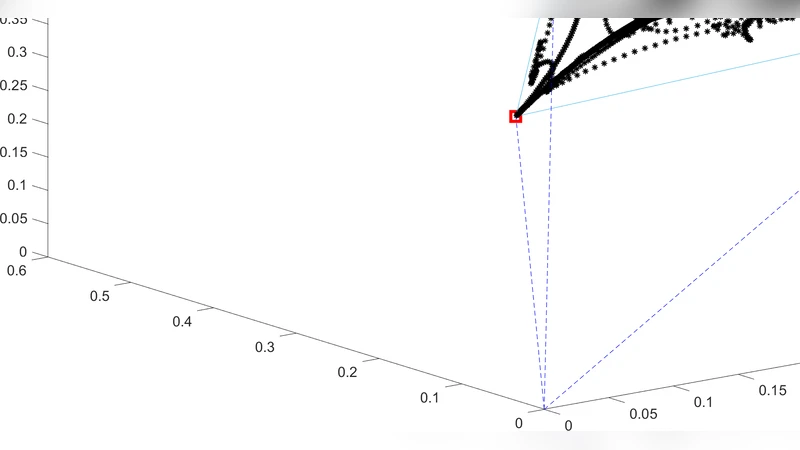
The paper addresses blind source separation (BSS) for non‑negative data in the challenging setting where the mixing matrix is nearly singular (degenerate) and the usual pure‑pixel or stand‑alone‑peak (SAP) assumptions do not hold. Motivated by diffusion‑ordered spectroscopy (DOSY) NMR experiments, the authors observe that each chemical component’s spectrum often exhibits a “dominant interval” (DI): a region of the acquisition variable where that component’s intensity is markedly larger than the others, while overlap may occur elsewhere. This DI condition induces a natural clustering structure in the columns of the observed mixture matrix X: points belonging to the same source cluster around the corresponding column of the mixing matrix A.
The authors first exploit this clustering by applying a fast K‑means algorithm to obtain an initial estimate of A. Because noise, initialization, and the near‑singularity of A can cause the centroids to deviate from the true columns, they introduce a refinement step formulated as a quadratic programming (QP) problem. The QP minimizes the squared deviation of the centroids while constraining the perturbations within a small admissible region, thereby pulling the estimate toward the true mixing matrix without over‑fitting to noise.
Next, they leverage the DI property to recover the source matrix S via an ℓ₁‑norm minimization. Since each source dominates on its DI, the ℓ₁ regularizer promotes sparsity precisely where the dominant peaks occur, yielding a solution that respects the physical sparsity of NMR spectra while relaxing the strict non‑overlap (NNA) requirement of the classic Naanaa‑Nuzillard (NN) method.
When no prior information about the sources is available, the authors propose a structure‑assisted non‑negative matrix factorization (NMF) model. They incorporate the knowledge that columns of A are nearly parallel (a consequence of the degenerate mixing) directly into the NMF cost function. This yields modified multiplicative update rules that enforce the parallelism constraint and preserve the geometric relationships among data points (similar to graph‑regularized NMF). The resulting algorithm can recover both A and S even in the absence of DI‑based sparsity cues.
The paper validates the approach on simulated data and on a real DOSY NMR dataset. Compared with the original NN method, its relaxed version (rNNA), and standard NMF, the proposed pipeline (clustering → QP refinement → ℓ₁ sparsity → structure‑assisted NMF) achieves substantially lower mean‑square error and higher signal‑to‑interference ratios. Importantly, it avoids the appearance of negative spurious peaks that plague NN under degenerate mixing, and it remains robust as noise levels increase.
Key contributions include: (1) introduction of the Dominant Interval (DI) assumption as a realistic relaxation of the pure‑pixel condition for NMR; (2) a QP‑based correction of clustering‑derived mixing matrix estimates, tailored for near‑singular A; (3) an ℓ₁‑based sparse recovery exploiting DI; (4) a novel NMF formulation that embeds parallel‑column constraints, preserving data geometry; and (5) comprehensive experimental evidence demonstrating superior performance on real NMR data. The methodology is applicable beyond NMR, to any domain where sources are non‑negative, partially overlapping, and the mixing process yields nearly collinear mixing vectors (e.g., hyperspectral imaging, fluorescence microscopy, and certain computer‑vision tasks).
Comments & Academic Discussion
Loading comments...
Leave a Comment