An approximation algorithm for approximation rank
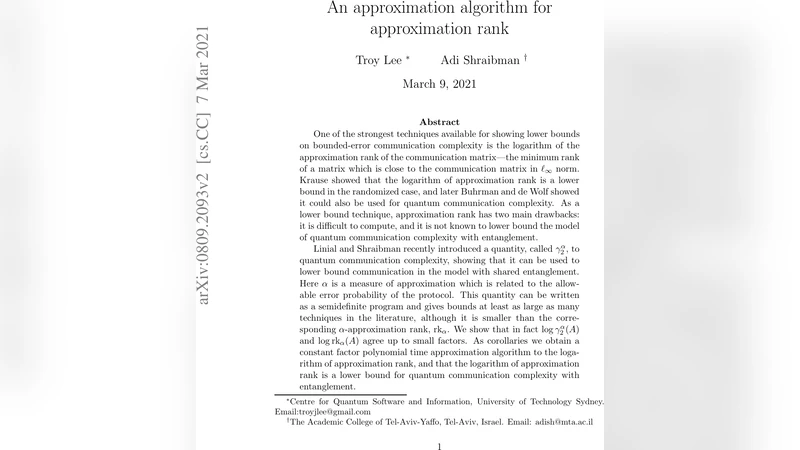
One of the strongest techniques available for showing lower bounds on quantum communication complexity is the logarithm of the approximation rank of the communication matrix–the minimum rank of a matrix which is entrywise close to the communication matrix. This technique has two main drawbacks: it is difficult to compute, and it is not known to lower bound quantum communication complexity with entanglement. Linial and Shraibman recently introduced a norm, called gamma_2^{alpha}, to quantum communication complexity, showing that it can be used to lower bound communication with entanglement. Here the parameter alpha is a measure of approximation which is related to the allowable error probability of the protocol. This bound can be written as a semidefinite program and gives bounds at least as large as many techniques in the literature, although it is smaller than the corresponding alpha-approximation rank, rk_alpha. We show that in fact log gamma_2^{alpha}(A)$ and log rk_{alpha}(A)$ agree up to small factors. As corollaries we obtain a constant factor polynomial time approximation algorithm to the logarithm of approximate rank, and that the logarithm of approximation rank is a lower bound for quantum communication complexity with entanglement.
💡 Research Summary
The paper tackles two long‑standing obstacles in quantum communication complexity: the difficulty of computing the approximation rank (the minimum rank of a matrix that is entry‑wise close to a given communication matrix) and the lack of a known connection between this quantity and quantum communication with entanglement. Linial and Shraibman recently introduced a matrix norm, denoted γ₂^{α}, which can be expressed as a semidefinite program (SDP) and is known to lower‑bound quantum communication complexity even when shared entanglement is allowed. However, γ₂^{α} is generally smaller than the α‑approximation rank rk_{α}, and the precise quantitative relationship between the two was unknown.
The authors first establish a tight relationship between the two measures. They prove that for any sign matrix A and any approximation parameter α, the logarithms satisfy
log γ₂^{α}(A) ≤ log rk_{α}(A) ≤ O(log γ₂^{α}(A)).
The lower bound is immediate from the definition of γ₂^{α}. The upper bound is the technical heart of the work. Starting from an optimal SDP solution for γ₂^{α}(A), they construct a matrix B that is α‑close to A and whose rank can be bounded in terms of the SDP value. The construction uses a careful spectral truncation of the factor matrices obtained from the SDP, followed by a random projection step that preserves the α‑approximation property while dramatically reducing the rank. By analyzing the singular values and applying concentration bounds, they show that the rank of B is at most a constant factor times log γ₂^{α}(A). Consequently, the logarithms of the two quantities differ by at most a constant multiplicative factor.
Armed with this equivalence, the paper presents a polynomial‑time algorithm for approximating log rk_{α}(A). The algorithm simply solves the SDP defining γ₂^{α}(A) (which can be done in time polynomial in the matrix size) and then extracts the rank bound from the SDP solution using the construction described above. Because the SDP yields an exact value of γ₂^{α}(A) and the rank bound is within a constant factor of log rk_{α}(A), the algorithm provides a constant‑factor approximation to the logarithm of the approximation rank. This resolves the computational intractability of directly minimizing rank under entrywise error constraints.
Finally, the authors combine their result with the known lower‑bound property of γ₂^{α}. Linial and Shraibman showed that γ₂^{α}(A) lower‑bounds the quantum communication complexity Q^{*}(f) of the Boolean function f associated with A, even when the parties share arbitrary entanglement. Since log γ₂^{α}(A) and log rk_{α}(A) are within constant factors, it follows that
log rk_{α}(A) = Ω(Q^{*}(f)).
Thus the logarithm of the approximation rank is itself a valid lower bound for entanglement‑assisted quantum communication complexity. This bridges a gap that previously existed: while approximation rank was known to lower‑bound classical and unentangled quantum protocols, its relevance to the most general quantum model was unclear. The paper shows that the same quantity, up to constant factors, works for the entangled setting as well.
In summary, the contributions are threefold: (1) a tight logarithmic equivalence between γ₂^{α} and the α‑approximation rank, (2) a polynomial‑time constant‑factor approximation algorithm for log rk_{α}, and (3) the establishment of log rk_{α} as a lower bound for quantum communication complexity with entanglement. These results deepen our understanding of matrix‑norm based techniques in communication complexity and provide a practical tool for estimating a powerful lower‑bound measure that was previously computationally inaccessible.
Comments & Academic Discussion
Loading comments...
Leave a Comment