Coupled models for total stress dissipation tests
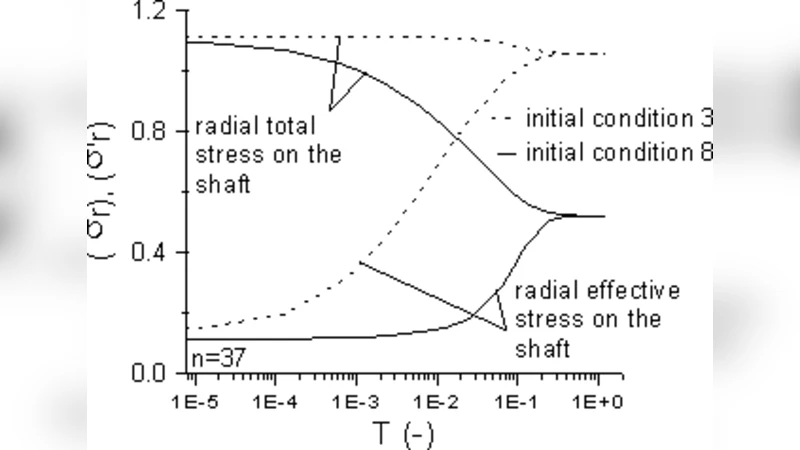
Two linear, point-symmetric, coupled consolidation model families with various embedding space dimension values (oedometer models - 1, spherical models - 3, cylindrical models - 2), differing in one boundary condition (coupled 1 - constant displacement, coupled 2 - constant stress) are analysed analytically and numerically. The method of the research is partly analytical, the models are unified into a single model with unique analytical solution, every model can be derived from this by inserting the proper boundary condition and embedding space dimension m. The constants of the solutions are determined and an approximate time factor and model law are derived for the m >1case which is identical to the one valid in the oedometer case. The convergence of the infinite series are examined in the function of the initial condition. Concerning the total stress at the pile shaft, significant decrease (with the value of the initial mean pore water pressure) is encountered for the coupled 1 consolidation models, zero stress drop is resulted by the coupled 2 models. The total stress dissipation test is suggested to be evaluated by the coupled 1 models with a time dependent constitutive law, eg., by adding a relaxation part-model. The rate of convergence is the smaller if the initial condition is the closer to the one of a zero solution (beyond the trivial one, a non-trivial zero solution exists for the coupled 1 model, at the Terzaghi initial condition).
💡 Research Summary
The paper presents a unified analytical framework for two families of linear, point‑symmetric coupled consolidation models that differ only in the upper boundary condition: “coupled 1” (constant displacement) and “coupled 2” (constant stress). The framework accommodates three embedding space dimensions—m = 1 (oedometer), m = 2 (cylindrical), and m = 3 (spherical)—by expressing the governing diffusion equation in a generalized m‑dimensional spherical coordinate system. The solution is derived as an infinite series of Bessel or spherical‑Bessel functions, with coefficients determined by the initial condition (particularly the initial mean pore‑water pressure, u₀) and the chosen boundary condition.
A key analytical achievement is the demonstration that, for m > 1, the time factor and model law governing the series are identical to those of the classic one‑dimensional oedometer case. This reveals that the fundamental consolidation dynamics are dimension‑independent once the appropriate eigenvalue problem is solved. The paper also identifies a non‑trivial “zero solution” that exists when the initial condition coincides with the Terzaghi initial condition; in this special case the series converges rapidly, often requiring only the first eigenmode for accurate results. Conversely, when the initial pore‑water pressure deviates significantly from this zero‑solution condition, higher‑order terms become necessary and convergence slows.
The authors examine the evolution of total stress (σ_total) at the pile shaft for both model families. In coupled 1 models, σ_total exhibits a pronounced decrease over time, and the magnitude of this drop is directly proportional to the initial mean pore‑water pressure. This behavior reflects the unrestricted fluid flow allowed by the constant‑displacement boundary, which facilitates dissipation of excess pore pressure and consequent stress relaxation. In contrast, coupled 2 models maintain nearly constant σ_total because the constant‑stress boundary suppresses fluid migration, limiting the dissipation process.
Based on these findings, the paper recommends that total‑stress dissipation tests be interpreted using coupled 1 models augmented with a time‑dependent constitutive law, such as a Maxwell‑type or Kelvin‑Voigt‑type relaxation component. Incorporating such a visco‑elastic element captures both the rapid early‑time stress drop and the slower long‑term stabilization observed in laboratory tests.
To validate the analytical results, the authors perform numerical simulations (finite‑element analyses) and compare them with the series solutions. They quantify convergence by evaluating the radius of convergence, relative error versus the number of retained terms, and the sensitivity of the solution to the initial condition. The numerical experiments confirm that the analytical series provides high fidelity across all three dimensions, especially when the initial condition is close to the zero‑solution state.
In summary, the study unifies multiple consolidation scenarios into a single, analytically tractable model, clarifies the impact of boundary conditions on stress dissipation, and offers practical guidance for interpreting total‑stress dissipation tests. The proposed approach enhances theoretical understanding while delivering a versatile tool for engineers dealing with pile‑shaft loading and consolidation phenomena in soils.