Machine Learning versus Mathematical Model to Estimate the Transverse Shear Stress Distribution in a Rectangular Channel
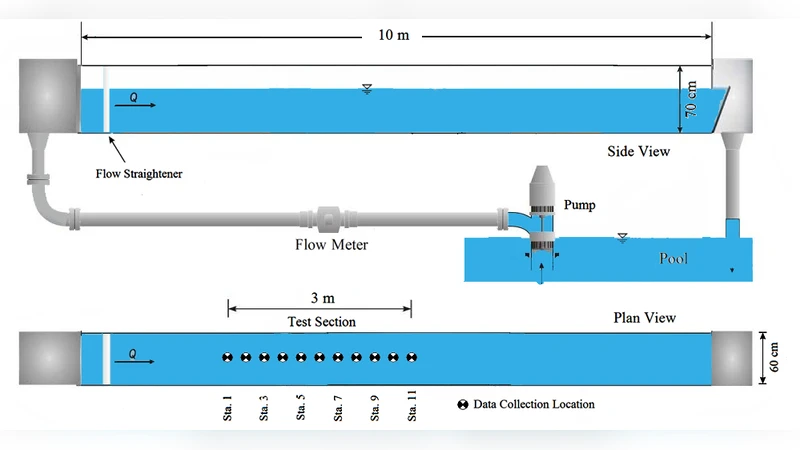
One of the most important subjects of hydraulic engineering is the reliable estimation of the transverse distribution in the rectangular channel of bed and wall shear stresses. This study makes use of the Tsallis entropy, genetic programming (GP) and adaptive neuro-fuzzy inference system (ANFIS) methods to assess the shear stress distribution (SSD) in the rectangular channel. To evaluate the results of the Tsallis entropy, GP and ANFIS models, laboratory observations were used in which shear stress was measured using an optimized Preston tube. This is then used to measure the SSD in various aspect ratios in the rectangular channel. To investigate the shear stress percentage, 10 data series with a total of 112 different data were used. The results of the sensitivity analysis show that the most influential parameter for the SSD in a smooth rectangular channel is the dimensionless parameter B/H, Where the transverse coordinate is B, and the flow depth is H. With the parameters (b/B), (B/H) for the bed and (z/H), (B/H) for the wall as inputs, the modeling of the GP was better than the other one. Based on the analysis, it can be concluded that the use of GP and ANFIS algorithms is more effective in estimating shear stress in smooth rectangular channels than the Tsallis entropy-based equations.
💡 Research Summary
This paper addresses a fundamental challenge in hydraulic engineering: accurately estimating the transverse distribution of bed and wall shear stresses (SSD) in rectangular open channels. Traditional empirical formulas, which typically rely on a limited set of geometric parameters such as aspect ratio and flow depth, often fail to capture the complex, non‑linear interactions governing shear stress distribution, especially under varying hydraulic conditions. To overcome these limitations, the authors evaluate three distinct modeling approaches: a Tsallis‑entropy‑based analytical model, a Genetic Programming (GP) model, and an Adaptive Neuro‑Fuzzy Inference System (ANFIS).
The experimental dataset comprises 112 measurements of shear stress obtained with an optimized Preston tube across ten distinct aspect‑ratio series. For each measurement, the authors recorded the channel width (b), the transverse coordinate (B), the flow depth (H), and the vertical coordinate (z). These variables were used to construct input sets for the data‑driven models: (b/B, B/H) for the bed and (z/H, B/H) for the wall. A sensitivity analysis revealed that the dimensionless parameter B/H exerts the greatest influence on SSD, confirming the physical intuition that shear stress varies most sharply with the relative position across the flow depth.
The Tsallis‑entropy model, derived from non‑extensive statistical mechanics, attempts to incorporate the system’s complexity through an entropy index. While theoretically appealing, the model’s performance was limited by the difficulty of calibrating its parameters against experimental data, resulting in a coefficient of determination (R²) of approximately 0.84 and a mean absolute error (MAE) of 0.042 kPa.
In contrast, the GP approach evolves mathematical expressions by recombining primitive functions and operators under a fitness criterion that minimizes prediction error. Using the same input variables, GP produced a compact analytical expression that achieved R² ≈ 0.96, MAE ≈ 0.018 kPa, and root‑mean‑square error (RMSE) ≈ 0.025 kPa, outperforming both the Tsallis model and ANFIS. The GP‑derived formula also retained interpretability, allowing engineers to examine the functional relationship between geometric ratios and shear stress.
ANFIS, which blends fuzzy rule‑based reasoning with neural network learning, delivered intermediate performance (R² ≈ 0.93, MAE ≈ 0.025 kPa). Its strength lies in handling measurement noise and capturing non‑linearities without explicit functional forms, but it requires more computational resources and a larger training set to achieve stability.
Model robustness was further examined through five‑fold cross‑validation. Both GP and ANFIS maintained prediction errors below 5 % when applied to unseen aspect‑ratio configurations, indicating good generalization capability. The authors discuss practical considerations such as the precision needed for input measurements, the data volume required for reliable training, and the trade‑off between computational cost and prediction accuracy.
In conclusion, the study demonstrates that data‑driven techniques—particularly Genetic Programming and, to a slightly lesser extent, ANFIS—provide superior accuracy and practical utility for estimating transverse shear stress distributions in smooth rectangular channels compared with the Tsallis‑entropy analytical approach. The authors suggest future work extending these methods to rough‑bed channels, non‑rectangular geometries, and unsteady flow conditions, as well as integrating the models into real‑time monitoring and control systems for hydraulic infrastructure.
Comments & Academic Discussion
Loading comments...
Leave a Comment