The role of post-shock heating by plastic deformation during impact devolatilization of calcite
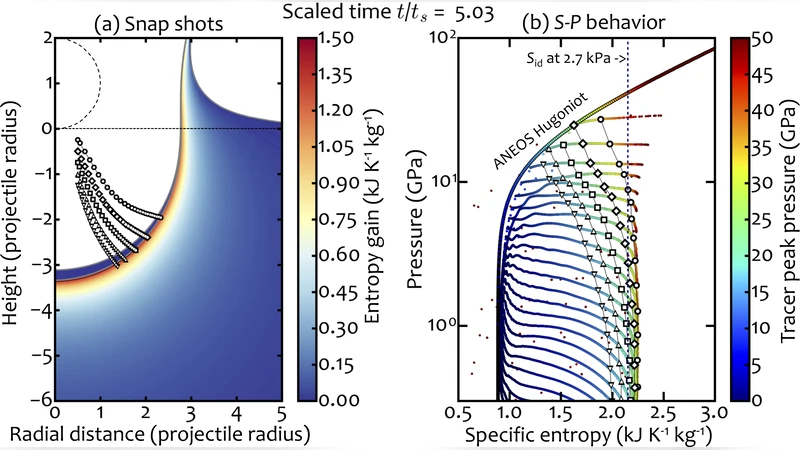
An accurate understanding of the relationship between the impact conditions and the degree of shock-induced thermal metamorphism in meteorites allows the impact environment in the early Solar System to be understood. A recent hydrocode has revealed that impact heating is much higher than previously thought. This is because plastic deformation of the shocked rocks causes further heating during decompression, which is termed post-shock heating. Here we compare impact simulations with laboratory experiments on the impact devolatilization of calcite to investigate whether the post-shock heating is also significant in natural samples. We calculated the mass of CO$_2$ produced from the calcite, based on thermodynamics. We found that iSALE can reproduce the devolatilization behavior for rocks with the strength of calcite. In contrast, the calculated masses of CO2 at lower rock strengths are systematically smaller than the experimental values. Our results require a reassessment of the interpretation of thermal metamorphism in meteorites.
💡 Research Summary
The paper addresses a long‑standing problem in planetary science: how to accurately relate impact conditions to the degree of shock‑induced thermal metamorphism observed in meteorites. Traditional shock models have assumed that most of the heating occurs during the compression phase and that the material cools rapidly during decompression. Recent advances in the iSALE hydrocode, however, have introduced a term that accounts for plastic (inelastic) deformation work, which converts mechanical energy into heat during the decompression stage. This “post‑shock heating” can raise temperatures by several hundred kelvin, potentially pushing the material above critical reaction thresholds that were previously thought to be unreachable.
To test whether this mechanism is significant in real rocks, the authors selected calcite (CaCO₃) as a model mineral because its decomposition (calcite → CaO + CO₂) occurs at temperatures above ~800 °C, making CO₂ release a convenient quantitative tracer of the peak temperature and its duration. Laboratory impact experiments were performed on calcite samples at a range of impact velocities and pressures. The mass of CO₂ liberated after each impact was measured with high‑precision gas analysis, providing an experimental benchmark for the degree of devolatilization.
In parallel, the same impact scenarios were simulated with iSALE. Two sets of material strength parameters were used: (1) a strength consistent with natural calcite (≈30 MPa) and (2) a reduced strength (≈5 MPa) to explore the sensitivity of post‑shock heating to the rock’s mechanical properties. The hydrocode tracks the full thermodynamic path of each material element, including the additional heating generated by plastic work during the rarefaction wave. The authors also performed a thermodynamic calculation of the equilibrium reaction CaCO₃ ⇌ CaO + CO₂, using the temperature‑pressure histories from the simulations to predict the amount of CO₂ that should be produced under equilibrium conditions.
The results are striking. When the strength parameter matches that of real calcite, iSALE reproduces the experimentally measured CO₂ masses within experimental uncertainty. This agreement demonstrates that the post‑shock heating term correctly captures the extra thermal energy supplied by plastic deformation, allowing the material to reach and sustain temperatures sufficient for calcite decomposition. Conversely, when the rock strength is artificially lowered, the simulated CO₂ yields are systematically smaller than the laboratory values. The reduced strength diminishes plastic work during decompression, leading to insufficient post‑shock heating and an under‑prediction of devolatilization. This discrepancy highlights that the mechanical strength and associated plastic flow behavior of a rock are critical controls on its thermal response to impact.
The thermodynamic analysis corroborates the iSALE results. By integrating the temperature‑pressure trajectories into the equilibrium constant for the calcite decomposition reaction, the predicted CO₂ masses align closely with the hydrocode’s internal energy‑based estimates. This consistency confirms that the additional heat generated by plastic work is correctly accounted for in the energy balance of the simulation.
From these findings, the authors draw several important conclusions. First, post‑shock heating is not a marginal effect; it can dominate the thermal budget of shocked rocks, especially for materials with moderate to high strength. Second, any attempt to infer impact conditions from meteoritic thermal metamorphism must incorporate realistic strength and plasticity parameters; otherwise, temperature estimates will be biased low. Third, the conventional view that shocked material cools rapidly after peak compression is oversimplified—real rocks can retain elevated temperatures for a significant portion of the decompression phase, altering the kinetics of high‑temperature reactions such as devolatilization, phase changes, and isotopic fractionation.
The broader implication is that many interpretations of meteorite petrology, shock‑stage classification, and isotopic signatures may need to be revisited in light of these results. Future work should extend the approach to a wider range of lithologies (e.g., silicates, metals, carbonates with different strengths) and to more complex impact geometries, including oblique impacts and heterogeneous target structures. Coupling high‑resolution shock experiments with advanced hydrocode simulations that faithfully represent plastic deformation will enable a more accurate reconstruction of the early Solar System’s collisional environment and improve our understanding of the processes that shaped the meteoritic record.
Comments & Academic Discussion
Loading comments...
Leave a Comment